

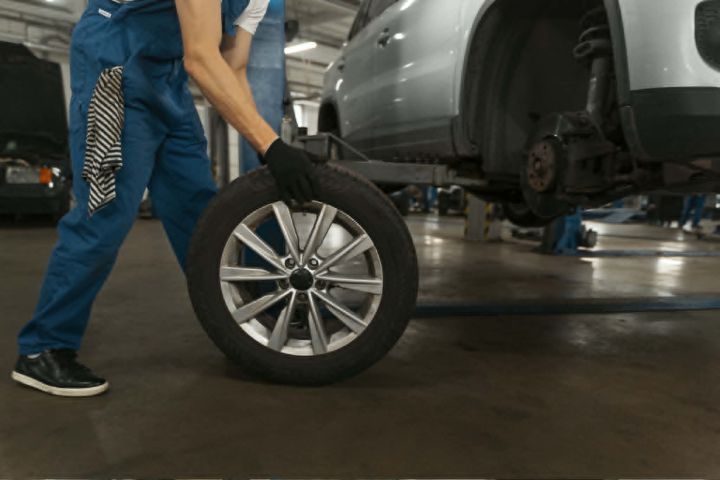
Over the past two decades, automotive engineering, aesthetics, and performance standards have shifted dramatically. Wheels have grown substantially larger, while the tires wrapped around them have grown increasingly thinner. Where a 15-inch rim with a generous 70-series sidewall was once standard on family sedans, 19-inch, 20-inch, and even 22-inch rims equipped with ultra-low-profile tires are now common straight from the factory.
Larger wheels and lower-profile tires can sharpen steering response and cornering feel by reducing sidewall flex. However, the results depend on wheel weight, tire construction, suspension design, and road conditions. Excessively large or heavy wheels can also reduce ride comfort and negatively affect some aspects of vehicle performance.
As the metallic mass of the wheel moves farther from the center hub and the rubber sidewalls lose some of their shock-absorbing volume, drivers may notice minor imbalances and geometric irregularities more easily. Addressing these vibrations requires equipment suited to the size, weight, width, and design of contemporary wheel assemblies. Wheel balancers for modern wheels must be capable of handling these characteristics accurately to help provide a smooth, stable ride.
The core challenge with modern wheel assemblies is the redistribution of unsprung and rotating mass. In many traditional automotive setups, more of the wheel’s metallic mass was concentrated closer to the axle. A taller rubber sidewall provided additional compliance, helping absorb road imperfections and making some minor wheel irregularities less noticeable.
With modern alloy wheels, more mass may be positioned farther from the axis of rotation, increasing rotational inertia when compared with a wheel of similar construction and weight but a smaller diameter.
The physics of wheel imbalance become more noticeable as speed increases. At typical highway speeds, even a quarter-ounce imbalance near the outer radius of a tire can create several pounds of repeating centrifugal force. The exact force depends on the wheel radius and rotational speed. Because low-profile tires generally have stiffer sidewalls and less air volume, they may transfer more of this vibration into the suspension and chassis instead of absorbing it.
This structural rigidity means that a standard dynamic balance may not resolve every vibration complaint. Dynamic balancing corrects weight discrepancies across the inner and outer planes of the wheel, but it cannot correct every geometric or structural irregularity.
Conditions such as radial runout—the amount by which a tire or wheel deviates from a perfectly circular rotation—and tire radial force variation can remain perceptible even after the assembly is properly balanced. What might have been less noticeable on a vehicle with taller, more compliant sidewalls can produce steering-wheel shake or chassis vibration on a vehicle equipped with wide wheels and low-profile tires.
To address the increased sensitivity of modern wheel setups, automotive technicians may rely on advanced diagnostic capabilities. A standard wheel balancer measures static and dynamic imbalance by spinning the wheel and using sensitive force-measurement sensors to identify where corrective weight is needed.
Some premium wheel balancers go considerably further. Depending on the model, they may use laser scanning, optical measurement, sonar sensors, or automated measuring arms to capture wheel dimensions and create a detailed profile of the tire-and-wheel assembly.
These systems can automatically determine rim dimensions and identify the appropriate planes for corrective weights. This automation is especially useful for large, expensive alloy rims where placing traditional clip-on weights on the outer lip may be aesthetically unacceptable.
Advanced software can calculate locations behind the wheel spokes where adhesive weights can be concealed. By splitting the required corrective mass and positioning it behind the spokes, the technician can balance the assembly without compromising the appearance of a premium wheel. Automated profiling also reduces manual measurement and data-entry errors when working with sensitive wheel profiles.
One of the most useful advancements in diagnosing difficult wheel vibrations is road-force measurement. Even if a heavy rim and low-profile tire are properly balanced by weight, the assembly can still vibrate if the tire has variations in its internal construction or the wheel has excessive runout.
Manufacturer service guidance for wheel-vibration diagnosis identifies imbalance, radial runout, and tire road force variation as three primary contributors to tire-and-wheel assembly vibration.
A diagnostic road-force balancer applies a loaded roller against the tire tread while the assembly rotates. This simulates part of the load placed on the tire under driving conditions and allows the machine to measure radial force variation. Some systems can also evaluate lateral forces or tire-pull conditions. These are measurements that a traditional free-spinning balance does not provide.
If the machine detects excessive road-force variation, it may guide the technician through a process known as match mounting. This procedure generally involves aligning the tire’s measured high point of radial force variation with the wheel’s measured low point of radial runout.
Repositioning the tire on the wheel can reduce the combined variation of the assembly and improve ride quality. However, match mounting may not eliminate every vibration, especially when a tire or wheel is damaged or outside the manufacturer’s allowable specifications.
Advanced diagnostic balancing systems can be valuable for modern tire shops, dealerships, and performance garages. The integration of diagnostic software, automated measurements, and sensitive mechanical sensors helps technicians handle heavier and wider wheels accurately. Several available technologies stand out:
The transition toward large alloy wheels and low-profile tires has changed automotive maintenance and ride diagnostics. The softer, more forgiving sidewalls found on many older wheel-and-tire combinations provided a greater degree of vibration isolation. Today, variations in tire stiffness, wheel runout, mounting accuracy, and weight distribution can become more noticeable to the driver.
In this environment, wheel balancers for modern wheels have evolved from basic rotational equipment into sophisticated diagnostic systems. Depending on the machine, technicians can map rim profiles with lasers, calculate hidden weight placements behind spokes, measure runout, and simulate road-force conditions.
Not every wheel assembly requires every advanced diagnostic feature. A properly operated standard balancer can still correct ordinary static and dynamic imbalance when the machine has the appropriate capacity and mounting hardware. However, advanced diagnostic systems can help identify persistent vibration problems that corrective weights alone cannot resolve.
By combining accurate mounting, precise weight placement, runout measurements, and road-force diagnostics when necessary, modern balancing technology helps preserve the visual and performance benefits of large wheels and low-profile tires without compromising ride quality.
The post Wheel Balancers for Modern Wheels: Handling Larger Rims and Low-Profile Tires appeared first on Gauge Magazine.