
Short version: Oil appearing near the rear of a Pentastar engine may have started at the oil cooler and filter housing higher in the valley. Confirming the source before authorizing rear-main-seal work can prevent an unnecessary and expensive repair.
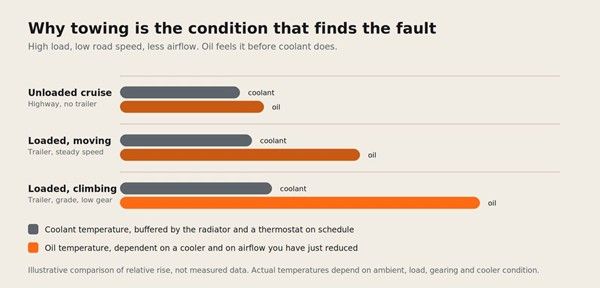
Boost. Transmission temperature. Sometimes a wideband. The gauge pod on a built truck gets filled with everything except the number that can change significantly when you hitch up a trailer: oil temperature. Coolant is regulated by a radiator, thermostat and cooling fans. Oil circulates through the sump, bearings and other highly loaded engine components, and its temperature depends partly on an oil cooler that many owners could not point to under the hood.
Towing changes the load picture in a way that is easy to underestimate. The engine may spend longer at higher load, and climbing grades at lower road speeds can increase heat production while reducing natural airflow through the front of the vehicle.
Oil temperature can rise even while the coolant gauge appears normal. As oil becomes hotter, its viscosity decreases, and prolonged exposure to excessive heat can accelerate oxidation and reduce useful service life. However, 100°C is not a universal operating-temperature limit. It is one of the standardized temperatures used to measure and classify engine-oil viscosity.
Coolant has a radiator and thermostat working to control its temperature. Oil depends on the engine’s lubrication and cooling systems—and on the airflow and operating conditions available.
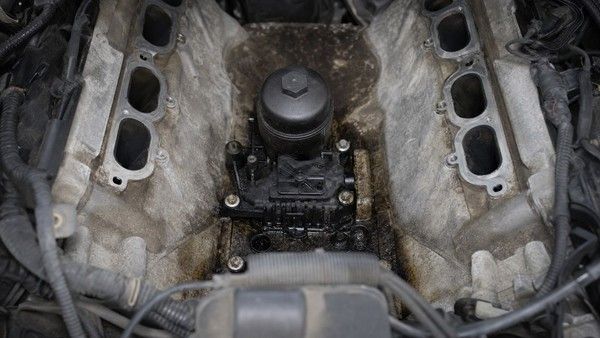
An oil cooler helps manage this heat, although its operation varies by engine design. On many Pentastar applications, the cooler is integrated with the oil-filter housing in a module located in the valley beneath the intake manifold. Original and replacement housing materials vary, so fitment and construction should be confirmed before ordering.
The location is part of the problem. Oil escaping from the housing or its seals can run backward and downward. By the time it becomes visible, it may appear to have originated from a more expensive component.
| What It Looks Like | What May Be Suspected | Another Source to Inspect |
|---|---|---|
| Oil pooling near the bellhousing | Rear main seal | Oil traveling down from the cooler housing or its seals |
| Oil down the back of the block | Valve-cover gaskets | Filter housing, cooler or associated seals |
| Coolant loss accompanied by an oil leak | Head gasket | Housing, cooler or seal leak that requires pressure testing |
| Oil contamination in the coolant reservoir | Head gasket | Possible internal cooler breach; other causes must also be ruled out |
| Leak becomes visible after towing | A minor leak that can be ignored | Heat and pressure exposing an existing housing or seal problem |
That last row matters for anyone who tows. A housing that appears dry during a cold inspection may begin leaking after extended operation because heat and pressure can expose an existing crack, damaged seal or sealing-surface problem. That does not prove the housing is warped, but it is a reason to inspect the engine again at full operating temperature.
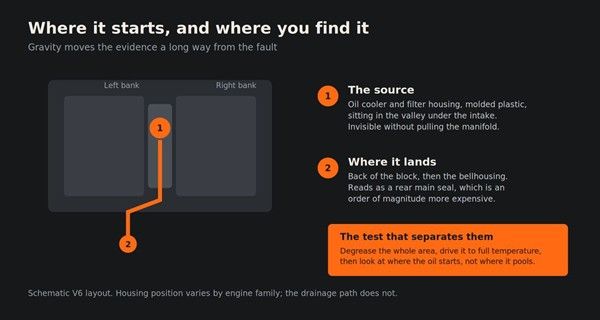
Start by cleaning the affected area and identifying where the oil first appears rather than where it eventually collects. Inspection mirrors, a borescope or an appropriate ultraviolet dye may help locate the source. If coolant loss or fluid contamination is present, a cooling-system pressure test and further diagnosis may be necessary.
Never remove the coolant cap while the engine is hot. Oil film or residue in the reservoir can support a diagnosis, but it does not conclusively prove that the oil cooler has failed. A head-gasket problem, previous contamination or another internal leak may create similar evidence.
The parts market has responded to the number of vehicles needing these repairs. At the time of writing, the linked supplier listed separate assemblies for Grand Cherokee 3.6L, Wrangler 3.6L, Cherokee 3.2L and Grand Cherokee 3.0L CRD applications.
If you are pricing an aluminum oil cooler Jeep owners may consider, listed petrol-engine assemblies were approximately AUD 269.99, while the separate 3.0L CRD assembly was approximately AUD 499.99. Prices, construction and warranty terms can change. More importantly, the 3.0L CRD assembly is for a different engine and should not be confused with a Pentastar housing.
Do not rely only on a listing’s model-year range. Confirm the vehicle’s VIN, engine displacement and original part number before ordering. Use the supplied new seals where required, and follow the correct surface-preparation, tightening-sequence and torque procedures. A metal replacement housing will not stay dry if it is incorrectly installed or paired with the wrong seals.
Labor is where much of the repair cost comes from. The intake manifold must be removed to expose the engine valley, and several components above the housing have to be disconnected or moved. Completing the repair once with compatible parts and new seals is considerably cheaper than repeating the job.
If you are lifting the truck to complete related work, support it with appropriately rated equipment on solid, level ground. Gauge’s article covering seven flatbed loading mistakes that can wreck your tow rig makes the same broader point about staying within the ratings and intended use of towing and support equipment.
Do not assume the oil cooler or filter housing is covered by a safety recall—or that a zero-result VIN search provides the vehicle’s complete service history. Recall eligibility can depend on the exact VIN, model year and market.
NHTSA’s recall lookup can identify certain unrepaired safety recalls for a specific vehicle. NHTSA explains that the VIN results do not display completed recalls, some recently announced recalls, most recalls more than 15 years old, non-safety service campaigns or international recalls. A dealer can also check for manufacturer communications, warranty extensions and service campaigns that may not appear as open safety recalls.
If any of this sounds familiar, the inexpensive intervention may be monitoring rather than replacing a part immediately. An oil-temperature display can reveal how the engine responds to towing, long grades, hot weather and sustained load. It cannot diagnose or predict every housing leak, but it can help the driver recognize a thermal trend before excessive heat contributes to oil degradation or other problems.
Before adding hardware, check whether the vehicle already provides an oil-temperature data parameter through a compatible scan tool or OBD display. If a separate sender is required, install it only in a suitable, approved location. Readings vary according to whether the sender measures oil in the sump, gallery or filter adapter, so the installation location should remain consistent when comparing temperatures.
The API Engine Oil Licensing and Certification System supports the quality marks found on licensed engine oils and references SAE J300 for viscosity classification. API tests include viscosity at 100°C as well as high-temperature/high-shear testing. That 100°C test point describes how viscosity is measured; it does not establish one ideal operating temperature for every engine.
Use the viscosity grade and performance specification required by the vehicle manufacturer, including any towing or severe-service guidance in the owner’s manual. Moving to a heavier oil without manufacturer approval is not automatically safer. Gauge’s guide to regular engine-oil maintenance also explains why checking the oil and following an appropriate service schedule remain essential.
Most people fit an oil-temperature gauge after encountering a heat-related concern. Installing or activating a reliable display before the next heavy tow gives you a baseline and turns an unexpected problem into a trend you can monitor.
The post Oil temperature is the number your build never watches appeared first on Gauge Magazine.