

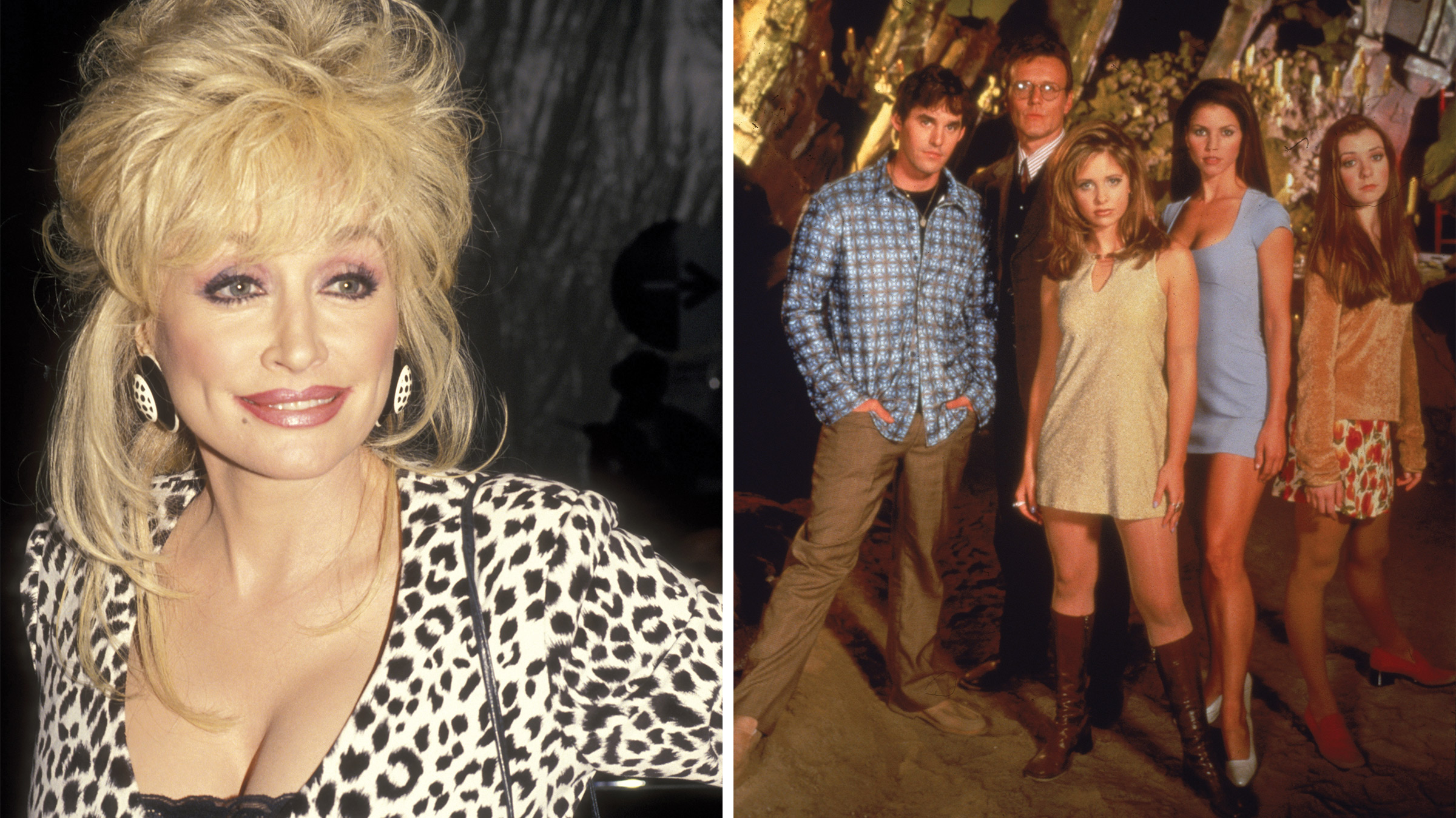
By the time she passed away on Tuesday, Dolly Parton had become an American saint, celebrated not just for giving us immortal songs like “Jolene” and “9 to 5,” but for philanthropic work that provided hundreds of millions of free books to children and proved instrumental in the development of a COVID vaccine. That wasn’t always her reputation, though. While her songwriting prowess was always respected within the country-music community, for much of her career, the public knew Parton most for the cartoonishly feminine figure she cut—platinum wigs, costumes sagging under the weight of rhinestones, nails for days, the bustline that launched a thousand punchlines. As she once put it: “A lot of men thought I was as silly as I looked.”
So it makes perfect sense that, among her various and sundry contributions to American culture, Parton was an uncredited producer of Buffy the Vampire Slayer. Under the auspices of Sandollar Productions, which she founded with her then-manager Sandy Gallin, the music icon and entrepreneur supported not just the cult-classic, Y2K-era teen drama series, but also the 1992 feature film on which it was based. She was still on board decades later, when Hulu was developing a Buffy reboot with director Chloé Zhao. (It has since been scrapped.) Parton’s involvement with the franchise has only been widely known in recent years. “I thought Buffy the Vampire Slayer was a wonderful little show,” she told Andy Cohen in a 2021 Watch What Happens Live appearance. “I was very, very proud to be part of that.” Star Sarah Michelle Gellar has said that, while Parton wasn’t present on set, she honored the cast with gifts and praise.
Well, of course Buffy resonated with Dolly. In many ways, she was the real-life equivalent of Buffy Summers. Creator Joss Whedon (a man whose relationship to feminism is notoriously complicated at best) conceived the character as an empowered antidote to the hot, scantily clad victim types of 1980s slasher flicks. He has said that he intended the original Buffy to be “one of these crappy, low-budget movies,” but one that “had a feminist agenda, had females in it who were people.” Instead of being saved by some heroic boyfriend, the busty, blonde cheerleader lead (played by Kristy Swanson in the film) “would have to get her own back.” Maybe Buffy looked like the stereotypical high school bimbo. But, especially in a TV series that paired the character’s battles against supernatural baddies with mundane teenage rites of passage, she also had intelligence, resourcefulness, depth, and, of course, a once-in-a-generation gift for slaying vampires. Being underestimated based on her beauty often put her at an advantage.
As far as I know, Dolly Parton never staked any bloodsucker stalking a suburban California cul-de-sac—though I wouldn’t be terribly surprised to learn, amid the outpouring of fond reminiscences her death inspired, that she had. But she was certainly smart and independent and compassionate, all traits that people rarely acknowledge in women they would rather treat as empty-headed sex objects. Her superpower had nothing to do with vampires and everything to do with her staggering talent. She also understood that she could make sexist assumptions about her appearance work in her favor. “By the time they think that I don’t know what’s going on,” Parton joked, “I done got the money and gone.” I have no doubt that she possessed the perspicacity to make a connection between her place in the public consciousness and Buffy’s. Maybe the character’s popularity even helped prime pop culture to fully appreciate a certain silent producer, a woman for whom breasts and brains were never mutually exclusive.