

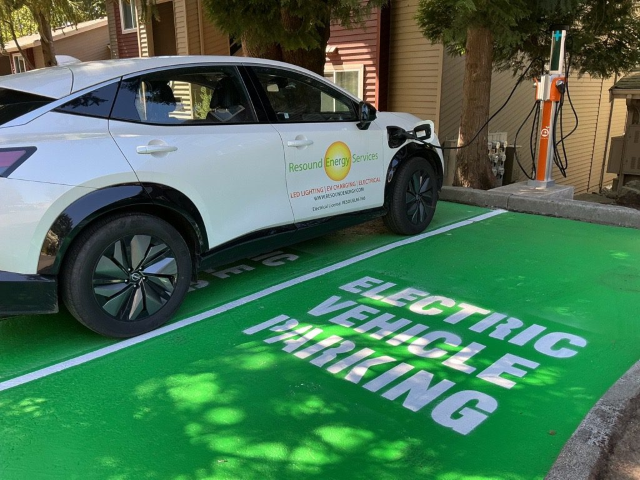
Thirty seconds after you pull your new EV out of the dealership lot, one thought hits you: Where am I actually going to charge this thing tonight? If you own a house with a garage, the answer is usually simple. If you live in a condo, congratulations—you have just discovered one of the most frustrating gaps in the electric vehicle rollout.
The condo EV charging problem is real, and it is bigger than many buyers realize. The U.S. EV market expanded sharply through 2024, but many HOA parking garages were not designed around residential vehicle charging. Here is why that gap exists, what makes condos uniquely complicated, and how newer charging-management technology may help close it.
The EV market reached 1.56 million sales and a 10% share of all new light-duty vehicle sales in 2024, up from approximately 2% in 2020, according to the International Council on Clean Transportation’s April 2025 analysis of U.S. passenger EV sales. That is not a niche hobby anymore. It represented approximately one out of every ten new light-duty vehicles sold that year.
The enthusiast crowd is right in the middle of this wave. Truck guys, import tuners, lowrider builders, and weekend warriors who have spent decades obsessing over their builds are increasingly curious about EV powertrains. The torque figures alone are enough to make anyone look twice. But some of the same people who thrive on weekend car shows and garage wrenching sessions live in condominiums, especially in urban and suburban markets where condo ownership makes financial sense.
That leaves a growing EV market, a car-passionate buyer base, and a large segment of the population that may not have practical access to overnight home charging. That is the gap nobody at the dealership talks about. Gauge Magazine’s guide to car ownership costs explains why charging access and electricity prices should be considered before purchasing an EV.
Roughly 30% of Americans live in an apartment or condo, yet a Plug In America survey cited by the Smart Electric Power Alliance in July 2022 found that 85% of EV owners were single-family home residents. Access to low-cost, convenient home charging was identified as the most significant economic factor in EV adoption.
That tells you a lot. Some people are not avoiding EVs because they dislike them. They are hesitating because they cannot determine where or how they will charge one overnight.
Apartments have it hard, but condos have a different and arguably trickier problem. In a rental building, one property owner or management company may make the final decision. In a condominium, you have an HOA board, multiple individual owners, governing documents, parking-right questions, electrical infrastructure, and the challenge of determining who pays for installation and electricity.
The U.S. Department of Energy’s Alternative Fuels Data Center notes that charging at multifamily housing requires additional considerations and may resemble public charging more than charging at a single-family home.
In some condo buildings, most of the available electrical capacity is allocated through individual-unit meters, while the common-area panel serving the parking garage has limited spare capacity. Resound Energy states that individual units may receive as much as 95% of a condo building’s electrical capacity in some properties. That percentage should not be assumed for every building, however. A qualified electrical load study is needed to determine how the specific property is configured.
When an HOA tries to add chargers to the garage, it may discover that the common-area service cannot support the planned number of stations at full output. Depending on the building and utility, the project could require load management, new panels, longer wiring runs, utility coordination, or a transformer upgrade. Those changes can be expensive, slow, and politically complicated for a volunteer board to approve.
Then there is billing. If chargers use common-area power, the HOA or charging-network operator needs a way to measure individual usage and recover the cost. That may involve networked chargers, submeters, user fees, or another approved billing arrangement. Without a clear plan, the administrative burden can stall an HOA charging proposal before installation begins.
Before any condo EV charging rollout moves forward, there are four questions that need honest answers. Getting them wrong can waste money and create exactly the kind of HOA drama nobody wants.
These four questions help buildings avoid spending years discussing a proposal without developing an installable plan.
Consider a hypothetical owner like Mark, a truck enthusiast in the Seattle area who has moved into a high-rise condo and purchased an electric pickup. His HOA has 120 parking stalls. A professional load study shows that the common-area panel can support only a limited number of chargers at the requested output.
Mark does not want a reserved spot near a bank of shared chargers. He wants to charge in his assigned stall, have his electricity usage measured accurately, and avoid sending charging expenses through the HOA’s general operating account. In the past, that scenario often required expensive infrastructure or an inconvenient compromise.
Modern condo EV charging systems may use dynamic load management or Dynamic Demand Control to address that problem. In a compatible building, a management device monitors the electrical demand associated with an individual unit or meter and allows the charger to operate only when sufficient capacity is available.
Some configurations can connect the charging consumption to the owner’s existing utility meter, allowing the electricity to appear on that owner’s utility bill. Availability depends on the utility, metering arrangement, building design, local electrical requirements, charger location, and selected equipment.
Because the system manages charging against available capacity instead of assuming every charger will operate at full output simultaneously, it may allow more stalls to be served. In some buildings, this can reduce, defer, or avoid a service or transformer upgrade. It does not guarantee that every stall can be electrified without additional infrastructure.
For anyone evaluating condo EV charging solutions, Dynamic Demand Control is one approach that may reduce power and billing obstacles. A site assessment is still necessary to confirm which results are achievable at a particular property.
Approximately 30% of U.S. households are multifamily dwellings such as apartments and condos, and almost 75% of those households own at least one vehicle, according to Atlas Public Policy’s January 2021 analysis of multifamily EV charging. That is a large segment of car owners who may approach the EV market through the lens of “I want one, but I cannot charge it conveniently at home.”
The good news is that awareness inside HOA boards is increasing. Building amenities are competitive, and convenient garage charging may make a condominium more attractive to some current and future EV owners. The effect on resale value will vary by property and market, so it should not be presented as a guaranteed return.
Car people have always known that what you can do with your vehicle matters as much as the vehicle itself. Charging at home, on your own schedule, and through a clearly defined billing arrangement is the EV equivalent of having a properly equipped garage. You feel the difference immediately.
| Barrier | Traditional Condo EV Setup | Potential Dynamic Demand Control Setup |
|---|---|---|
| Common-area power limit | May restrict how many chargers can operate at the requested output | Uses available unit-level capacity and load management where the building supports it |
| Billing complexity | HOA or network operator may need to track usage and recover costs | Direct utility billing may be possible when supported by the meter and utility |
| Utility or transformer upgrade | May be required after an electrical and utility review | Load management may reduce, defer, or avoid an upgrade, but it is not guaranteed |
| Equitable access | A limited pilot may serve only a few stalls | Planned raceways and phased installations may make broader access possible |
| HOA involvement | Can involve continuing billing and administrative work | May reduce billing work, although the HOA still approves infrastructure and operating rules |
“People who live in multiunit dwellings are the most challenged when it comes to owning an EV and being able to charge at home.”
Garrett Wong, then-senior sustainability analyst at the City of Santa Monica, in research published by the UCLA Luskin Center for Innovation in 2017.
The quote is several years old, but the underlying challenge has not disappeared. What has changed is that condo EV charging technology and billing options have become more capable. Dynamic load management, unit-connected charging, networked billing, utility programs, and phased infrastructure give condo boards more approaches to evaluate.
The correct solution still depends on a professional load study, the parking arrangement, utility rules, local codes, installation costs, and the number of residents expected to charge. If your condo’s next board meeting includes an agenda item on EV charging, push for a complete feasibility review instead of assuming that a small shared-charger pilot or one particular technology will solve every problem. The cars are already on the road. The available solutions are improving. The next step is making an informed decision for the building.
The post Why Condo Owners Are the Last to Benefit From the EV Revolution appeared first on Gauge Magazine.