
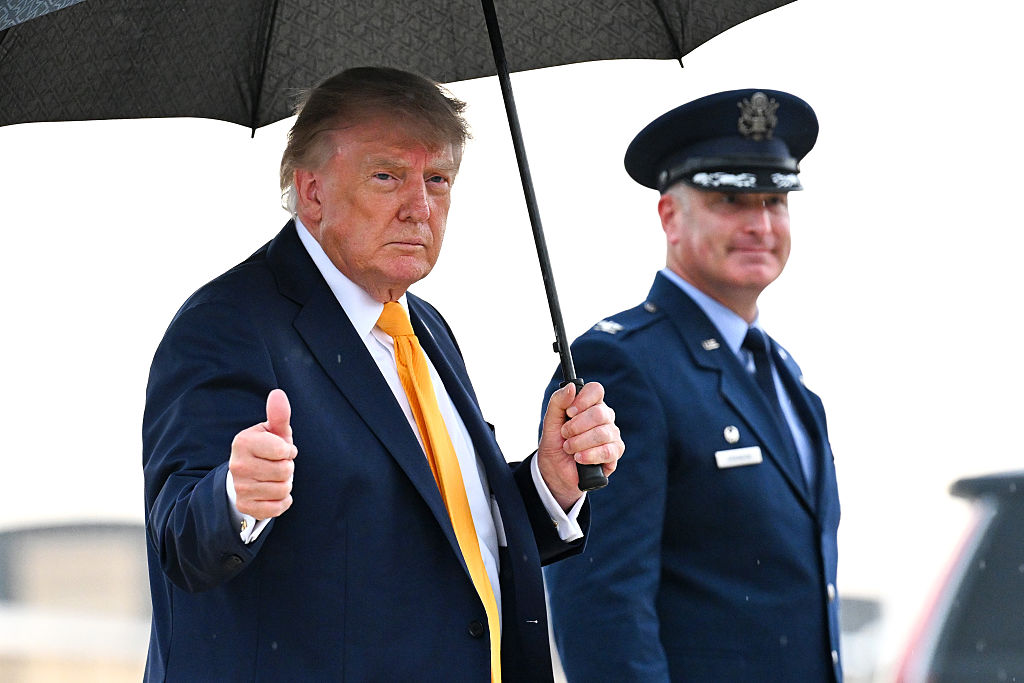
President Donald Trump appeared to float the idea of renaming New Mexico as “New America,” sharing several maps of the state that listed the new moniker. The images posted Monday, without context or comment, came a day after Trump uploaded an initial "New America" map via social media—an item that was later reshared by the official White House account.
Trump also posted an AI-generated video of himself slapping “America” over a road sign that had previously read “Welcome to New Mexico” and claimed that “many people” had suggested the name change. The White House has not announced any effort to rename New Mexico. TIME has reached out for comment.
The rhetoric has prompted backlash from Democratic lawmakers representing the state. “New Mexico’s name isn’t up for debate—it’s been ours since before the United States existed,” said the state’s Gov. Michelle Lujan Grisham. “While the White House wastes time coloring on maps, Nuevo México is busy doing the work.”
Lujan Grisham suggested that Trump’s renaming jibes were an attempt to “distract Americans from his disastrous war in Iran,” as well as the rising price of gas and other consumer goods.
“You can’t be serious. New Mexico is not for renaming. Not up for sale,” said former Secretary of the Interior and candidate for state Governor Deb Haaland. “My promise: I’ll always stand up for what makes New Mexico, New Mexico.”
Sen. Ben Ray Luján offered a similar rebuttal, insisting “it’s New Mexico, always has been and always will be” as he referred to Trump as “corrupt.”
Elsewhere, some Trump allies came out in support of the floated name change. “New America? Kind of catchy,” argued Republican Sen. Mike Lee of Utah.
The President’s social media rhetoric regarding New Mexico comes days after he floated renaming the vital trade passage the Strait of Hormuz as “Trump Strait.”
It also follows Trump signing an Executive Order renaming Lake Ontario as “Lake America” on Aug. 27, amid a widening trade war with Canada. The change was met with widespread disapproval from both U.S. lawmakers and Canadian politicians, who vowed Lake Ontario will continue to be called by that name.
The order applies to U.S. federal references of the lake and does not determine how Canada—or others—refer to the body of water. U.S. users of Google Maps and Apple Maps, however, will notice the change reflected.
Trump has often turned to name changes as a show of power and a way to undermine his perceived adversaries.
After returning to the White House last year, Trump signed an Executive Order renaming the Gulf of Mexico as the “Gulf of America.” The name has since been used by federal agencies and departments to refer to the sea south of the U.S., and was updated for U.S. users on Google Maps and Apple Maps.
The President has also put his stamp on Washington, D.C., renaming the Kennedy Center by adding his own surname to the title. After much back-and-forth and legal complications, the Center’s board voted in August to reinstate Trump’s name on the building’s facade, testing a judge’s order from May that mandated its removal.
Trump added his name to the U.S. Institute of Peace late last year, pointing towards his claim of ending a number of global conflicts since his return to the White House.
Outside of renaming landmarks and buildings after himself, Trump has also faced backlash over a string of what Democratic lawmakers have referred to as “vanity projects” across D.C.