

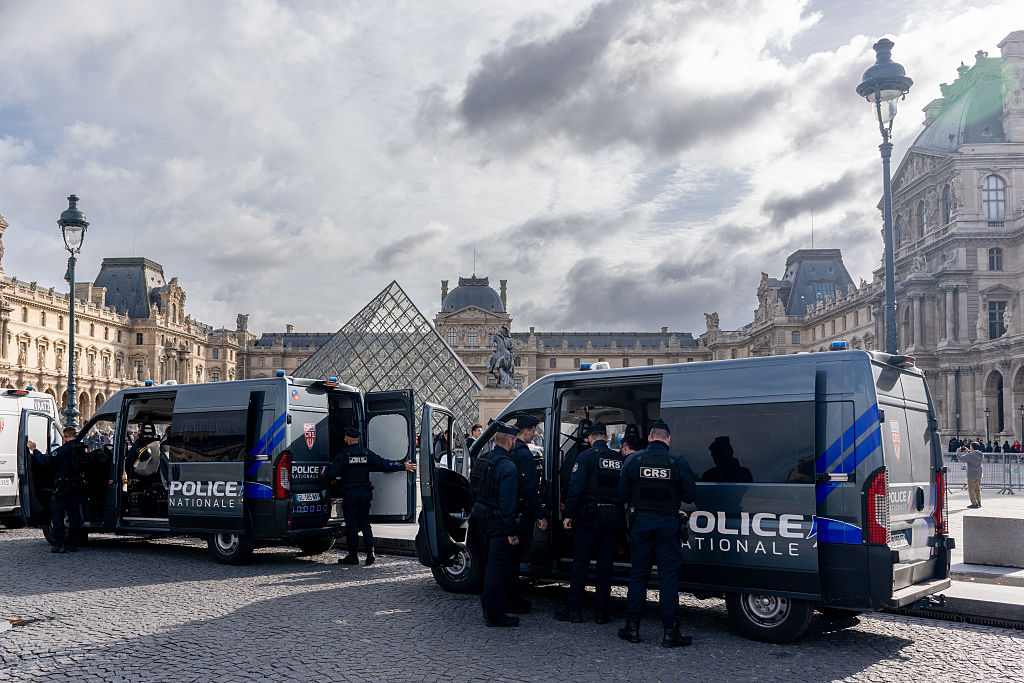
Nearly a year after precious jewels were stolen from the Louvre in broad daylight, France’s museums suffered another loss of major art when thieves stole four valuable paintings from the Renoir Museum on the French Riviera on Tuesday. These events, while seemingly isolated, point toward a broader trend in art heists across Europe.
According to art theft investigator Anthony Amore, the crime has persisted throughout history.
“It has always happened. It always will happen,” he tells TIME. At the same time, it’s “hard to deny” that there has been an uptick in major thefts of art from museums across Europe, he says.
“In terms of big name artists who are targeted, the number of heists—successful heists—that have happened, is without question spiking over the last 11 months,” Amore says.
That recent concentration was particularly striking in France. The country’s specialist art-crime office has recorded roughly 20 museum thefts annually over the past 15 years. But seven museums were targeted in September and October 2025 alone, the office’s chief told French lawmakers, describing an accumulation of unusually serious crimes.
Read More: 25 Works of Art That Define America Now
The latest heist targeted the former home and studio of Pierre-Auguste Renoir, an Impressionist artist born in the mid-19th century. The residence in Cagnes-sur-Mer was converted into a museum in 1960.
French investigators have launched a national search for the perpetrators, who broke in before 6 a.m. and executed the heist in less than three minutes. Cagnes-sur-Mer Mayor Bryan Masson told press that the thieves were “well-equipped” and “well-informed,” slicing through the garden fence with what is believed to be either an electric knife or saw, entering the museum on the ground floor, and cutting the cords holding the artworks.
Circumstances of their escape caused them to abandon two of the four pilfered artworks, but they fled with “Portrait of Madame Colonna Romano” and “Young Woman at the Well.”
The incident bears similarities to the high-profile theft of the roughly $100 million worth of historic French crown jewels from the Louvre on Oct. 19, 2025. The haul has yet to be recovered or returned to the museum, even though authorities believe they have captured the entire four-man team responsible.
Many of the heists in the year since have duplicated that team’s successful approach: Do it quickly and with force.
Amore says that these “quick heists” often utilize brute force entry, like breaking a window.
“Or it’s more of a smash and grab: Pull something off the wall and run. That's what we saw here,” he continues. “That's what we saw at the Louvre.”
The approach often facilitates one of the most essential elements of a successful escape: time.
“We're now getting into what I call the four-minute heist, where you can smash and grab your way into almost any museum in that amount of time,” says Christopher Marinello, the founder of Art Recovery International.
After the Louvre, thieves now see museums as accessible targets, he says—as long as they act fast.
“Criminals have discovered that with high-security museum systems, where the police are alerted and they arrive within four to five minutes, if they can get out before that, then they’re good—especially in a museum in a big city where you can use a moped or a scooter, and you could wind in and out of traffic,” Marinello continues.
Brute force allows criminals to enter and exit the scene as fast as possible. For example, a gang used a tractor to batter down a gate at the Magnani Rocca Foundation, a private museum about 12 miles from Parma, Italy, on March 22. In just three minutes, thieves managed to steal paintings by Renoir, Paul Cézanne, and Henri Matisse.
Thieves successfully undertook another heist lasting just a few minutes at a small museum in Sicily on Aug. 16, making off with several works by Renaissance painter Antonello da Messina.
Not all thefts get the same level of publicity, and examples from the past year abound.
Ancient Romanian artifacts were taken from the Drents Museum in the Netherlands in January 2025, $11 million of porcelain works were lifted from the Adrien Dubouché National Museum in France in September 2025, and a 200-carat diamond-and-platinum necklace from Vienna's Museum of Applied Arts (MAK), worth $4 million, was taken last month.
And the problem has spread beyond Europe, as well. In the United States, more than 1,000 historic artifacts were stolen from an offsite storage facility belonging to the Oakland Museum of California in October 2025.
The Sept. 8 Renoir heist is consistent with the methods used at the Louvre, says Amore. It is also consistent with the methods of most of the major art heists since early 2025.
The similar methodologies point to potential cases of copycats, according to Amore.
“My educated opinion is that I think the Louvre heist might have captured the imagination of thieves,” he says.
Nick O’Donnell, a lawyer specializing in art and cultural property law, says that the Louvre heist potentially showed prospective thieves that if four thieves could successfully steal from one of the most famous museums in Europe, then they could easily transfer those tactics to less prominent museums.
“It has given fuel to the perception that there are many museums where security may not be as tight as people think it is,” he says. “It seems to me that once that perception gets going for the would-be thieves, it's very hard to contain.”
Marinello believes that a lack of security can be traced back to financial constraints.
“They don't have money to protect their own treasures,” Marinello says. “And security systems are not keeping up with technology.”
He also believes broader economic and political factors play into potential budget shortfalls.
“The arts are always the first to go when governments are trying to save money,” he says. France, for example, cut its national culture budget by €150 million (about $170 million) in 2025, including a €200 million (about $226 million) reduction in heritage funding, which supports museums as well as monuments, archaeology, and archives.
It is not directly evident how this might have impacted security at any of the museums robbed in the ensuing year; however, France launched a €30 million ($34 million) museum-security fund in July 2026, according to the French Culture Ministry.
But it’s not all down to budget, Amore says. Part of the issue with upping security at cultural institutions is that it risks undermining the entire point of museums: bringing the public closer to incredibly valuable and precious artifacts.
“The whole point of the museum is accessibility to rare valuables, important pieces, cultural patrimony,” Amore says. “Museums work really hard to get people to come and look at them and stand in front of them and take all the time in the world they need.”
He adds: “The best a museum can do is try to make it difficult to get in, difficult to get back out, using layers of security to slow people down.”
But the uptick in heists is not entirely explained by copycats and opportunists. The break-ins are also occurring amid high demand for precious metals and gemstones, which can make objects containing those materials attractive targets.
They also come amid global economic instability, when some investors turn to art to hedge against inflation and diversify from stocks and bonds. A survey by Art Basel and UBS found that high-net-worth collectors allocated an average of 20% of their wealth to art in 2025, up from 15% in 2024.
Europol, the law enforcement agency of the European Union, released a report in August highlighting how art thieves “are increasingly focusing on precious metals, gemstones, and culturally significant artefacts, driven by high market demand and ease of illicit resale.”
Amore says those items may be less traceable and easier to fence than other valuables. Thieves can theoretically melt down the precious metals, remove gemstones from their settings, and sell the components separately.
“People might be moving toward objects like jewels or highly valuable jewelry pieces because they think that they can sell them—or break them up and sell them more easily,” he says.
But while that might explain the incidents at the Louvre and Vienna’s MAK, it doesn’t quite fit with paintings—which are easily identified and therefore significantly harder to offload.
Famous paintings can be complicated to sell, in part because of how recognizable they are—which is intrinsic to their value.
Marinello says that the thieves involved in the Renoir heist will soon find that the paintings they hold are “radioactive.”
“And when they can't sell them, sometimes they will try to ransom them back to the museum,” he says. “And after they fail at all those other attempts, then the artwork will travel on the dark web at a fraction of its true value.”
The risk may not be worth the consequences. Many of the culprits of recent high-profile heists have been caught by law enforcement, although recovering the lost art is another matter that has proven more difficult. In addition to the four people arrested in connection to the Louvre robbery, five people were detained last month in connection to the heist at the Magnani Rocca Foundation.
At the same time, law enforcement and museum organizations have only grown more aggressive in their attempts to deter thefts and counteract the art heist trend.
The International Council of Museums (ICOM) announced a new initiative with Interpol last year in hopes of supporting museums “in strengthening their security systems and reinforcing collective efforts to prevent the theft and illicit movement of cultural goods.”
“The growing number and sophistication of security challenges facing museums and cultural institutions require urgent, coordinated, and informed action,” Medea Ekner, the director general of ICOM, said in a statement sent to TIME. “ICOM and INTERPOL are working closely to assess the scale and evolving nature of this threat, including through a sector-wide survey, and to identify where the museum community most needs support.”