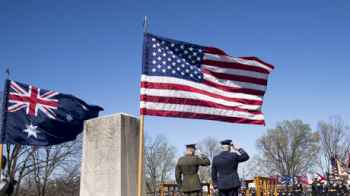

During the terror attacks of Sept. 11, 2001, first responders faced a number of problems. One of the most significant was a communications system that did not allow emergency workers from different agencies to easily coordinate with one another.
They all had unique radio systems with their own frequencies. That slowed responses in many instances at the World Trade Center in New York City, at the Pentagon and at the crash site in Shanksville, Pennsylvania.
The federal 911 Commission, established to examine the attacks and the response, recommended the creation of an agency that would work on delivering a nationwide broadband network that would be dedicated to public safety. The network needed to be robust enough to provide interoperable communications between all responding agencies to a major disaster.
In 2012, Congress created the First Responder Network Authority, known as FirstNet, to oversee the buildout of the network. Through a public/private agreement, AT&T was selected to build, operate and maintain the network. Congress appropriated a $7 billion to start the buildout and purchase dedicated prime broadband spectrum capable of supporting public safety communications.
The initial buildout was completed in 2023.
“It’s shocking that we went so long without it,” said Anne Arundel County Fire Chief and FirstNet Board member Trisha Wolford. “There’s two things that keep us safe: One is our SCBA (self-contained breathing apparatus) with our air, but the other thing is our communication,” she said.
Through a series of consultations with all 56 U.S. states and territories, FirstNet collected data on existing communications assets in each jurisdiction the agency could use to build the network. In many rural areas where assets are sparse, FirstNet was able to use existing radio towers and deployable antennas as well as satellite communications technology.
“And that’s what’s really important is that level of communication is about keeping your community safe, but it’s also about keeping our first responders safe,” Wolford said, adding that some 30,000 police, fire/EMS and other public safety agencies use the system currently nationwide.
“We see the successes, and we just hope it continues to build and grow to save more lives and to keep more responders safe,” she said.
Source