

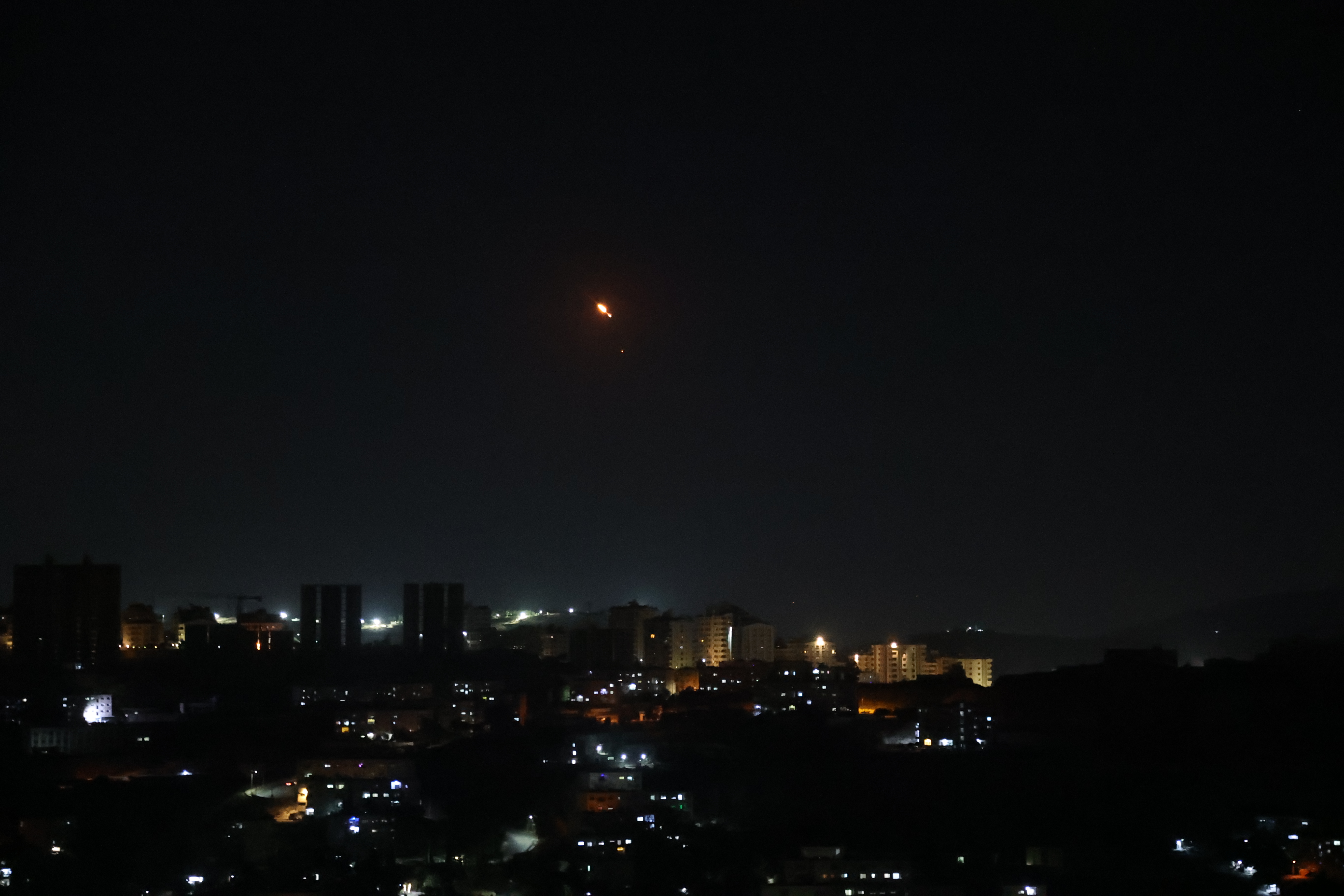
Oil prices soared above $100 a barrel again Wednesday for the first time since July as the U.S. and Iran exchanged tit-for-tat strikes amid renewed hostilities.
Iran targeted a U.S. base in Jordan with a series of missiles overnight, in retaliation for the U.S. military destroying five Iranian oil tankers. “The defeated and aggressor U.S. terrorist military, out of desperation, attacked several Iranian commercial and oil vessels,” said the Islamic Revolutionary Guard Corps (IRGC), according to Iranian state media. ”This powerful battle will continue.”
A spokesperson for the Jordanian Armed Forces said a barrage of “20 ballistic missiles” had been launched towards its territory in the early hours. The country’s air defense system successfully intercepted and destroyed 18 of the missiles, while the remaining two "fell in areas devoid of population centers."
The IRGC on Wednesday said it had also attacked two U.S. vessels, eight oil tankers, and 10 “noncompliant vessels” near the Strait of Hormuz, as tensions simmer over the maritime chokepoint.
U.S. Central Command (CENTCOM) denied the IRGC’s claims regarding the U.S. vessels, insisting that “no U.S. Navy warship has been struck” as “all IRGC attempted attacks failed.”
U.K. Maritime Trade Operations had earlier flagged reports of several merchant vessels in the region that were subject to "disabling fire,” but it was unable to confirm the nature or impact of the disturbances.
CENTCOM said its operation against the five Iranian crude oil tankers on Tuesday was in response to Iran targeting U.S. Navy ships with ballistic missiles over the previous two days. “The U.S. warship successfully evaded the attempted Iranian attacks and continued to patrol regional waters. No American personnel were harmed,” said the U.S. defense force.
The attacks on shipping mark a serious intensification of the reignited war, which experienced a brief respite before flaring up again last week. The strikes are unfolding as President Donald Trump pursues a campaign of military and economic pressure on Tehran, with Iranian officials threatening it could escalate the conflict further by targeting U.S. oil and gas interests in the Gulf.
Iran has specifically denounced the U.S. attacks on its oil shipments, with the Iranian Foreign Ministry on Wednesday insisting the strikes are “not only a dangerous escalation of tensions in the region, but also a clear threat to regional and international peace and security.”
Brent crude oil prices crossed the $100 benchmark on Wednesday for the first time in six weeks, deepening concerns over global supply.
The impact is already being felt across energy markets, with the average retail price of U.S. diesel hitting an all-time high of $5.94 on Wednesday, according to the American Automobile Association.
The continued conflict has also taken a toll on U.S. strategic petroleum reserves, which currently stand at their lowest levels since 1982.
The flare-up of the Iran war, now in its seventh month, risks pushing oil prices even higher, with Daan Struyven, co-head of global commodities research at Goldman Sachs, telling CNBC that the price of oil could rise to above $120 a barrel, if the active hostilities continue.
Meanwhile, the Iran-backed Houthi militia in Yemen contributed to the regional instability by launching attacks on four cities in Saudi Arabia on Tuesday, with the aim of targeting oil infrastructure.
Saudi Arabia’s Ministry of Foreign Affairs said 73 people had been injured in the strikes.
The attacks came after weeks of escalation between the Houthis and the Saudi-backed government of Yemen, shattering a four-year informal cease-fire in the country's civil war.
“The U.S. has a very strong defensive military relationship with Saudi Arabia, and we’re watching those events very closely. It’s been going on for some time,” Secretary of State Marco Rubio said Tuesday.
The renewed fighting threatens to further disrupt shipping through the Bab al-Mandeb strait, a critical trade route off the Arabian Peninsula for oil and global commerce.
Mohammed Bagher Ghalibaf, an Iranian negotiator and Parliament Speaker, told lawmakers on Sunday that the era of “proportionate responses” to American attacks had come to an end, according to state media.
Trump has said he's "not trying to force Iran to the bargaining table" and "couldn’t care less if they sign a worthless, to them, agreement." In a Sept. 1 message shared via Truth Social, he claimed the U.S. has "almost total control" of the Strait and pointed to Iran's suffering economy as evidence his approach was working.
Rosemary Kelanic, director of the Middle East program at Defense Priorities, tells TIME the current stalemate is a way for both countries to demonstrate their power and test each other’s limits.
“One way to think about war is that it's a disagreement over the balance of power and who would win a conflict,” she says. “The United States and Iran haven't figured out yet where each other's limits are, and they both think that they have to convince the other side that their position is stronger than the other.”
The two countries signed the Memorandum of Understanding (MoU) on June 17, but the pact fell apart, with Washington and Tehran seemingly adopting different interpretations of the language used in the interim agreement.
Kelanic says that, as the conflict currently stands, each exchange of tit-for-tat strikes is “disproportionately bad for the U.S. because Iran can show us that they can continue to strike ships" in and around the Persian Gulf.
“They can continue to strike U.S. bases in Jordan and elsewhere. The U.S. can continue to defend, but the cost of defending is much higher because we're using these interceptors,” she adds.
The Iran war has cost the U.S. at least $37.5 billion, Defense Secretary Pete Hegseth said in July, prompting criticism from Democratic lawmakers who have pointed to the rising costs of gas, groceries, and more for American consumers.