

Walk onto any dealership lot in 2026, and the EV conversation follows a familiar script. First comes the torque. Then the range figures. Then the charging map on the salesperson’s phone, with its reassuring spread of green dots.
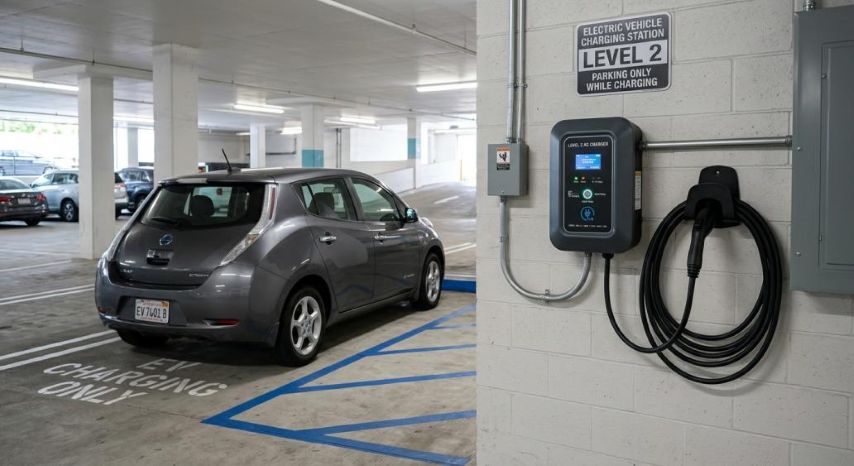
What rarely comes up is the part you will actually live with: how that car gets its energy back when it is sitting in your garage or outside your shop. Installing a charger is closer to a wiring project than adding a plug-and-play accessory. Like any good automotive project, the visible piece—the charger on the wall—is only one part of what you are really paying for.
That explains why the price estimates online vary so widely. Some people report spending a few hundred dollars, while others describe electrical work costing several thousand. Both stories can be true because EV charger installation cost depends heavily on the building, its available electrical capacity, the distance between the panel and parking space, permitting requirements, and any necessary site work.
Here is the straight version of what charging installation can cost in 2026, what quietly drives the price higher, and how to avoid discovering the expensive details after signing a quote.
Many plug-in vehicles can charge from a standard 120-volt household outlet using compatible Level 1 equipment. When a suitable outlet on a dedicated branch circuit already exists near the parking space, little or no installation work may be needed.
The catch is speed. Level 1 charging generally restores only a few miles of driving range per hour. An overnight session may replace the energy used during a modest daily commute, making it workable for some plug-in hybrids, low-mileage vehicles, and cars that remain parked for long periods.
For a modern battery-electric vehicle—especially an electric truck, large SUV, or performance car that is driven regularly—Level 1 may be better treated as a backup than a primary charging strategy. Recharging a large battery from a low state of charge can take considerably longer than one night.
Gauge Magazine’s introduction to home EV chargers and installation provides a broader look at the equipment choices available.
The usual home upgrade is Level 2 charging equipment connected to a dedicated 240-volt circuit. Depending on the vehicle, circuit, and charger output, this arrangement can restore substantially more range per hour and allow many EVs to recharge overnight.
A straightforward home installation is often quoted in the low four figures, and some published 2026 estimates use approximately $1,200 to $3,000 as a planning range. That is not a universal price. A short cable run beside a modern panel is fundamentally different from an installation requiring a service upgrade, extensive conduit, trenching, or repairs to finished surfaces.
The charging equipment can be one of the less expensive lines on the invoice. A qualified electrician may need to complete a load calculation, install a correctly sized dedicated circuit and breaker, route conductors or cable, follow the manufacturer’s installation instructions, and obtain any required permits and inspections.
Charging equipment is considered a continuous electrical load. The circuit therefore has to be designed for sustained use rather than only the charger’s headline amperage. The U.S. Department of Energy’s Alternative Fuels Data Center recommends consulting a qualified electrician to determine whether the property has adequate capacity and to ensure compliance with applicable codes.
Some owners consider using an existing dryer outlet or another 240-volt receptacle. Whether that is appropriate depends on the circuit, outlet condition, conductor size, breaker, grounding arrangement, charger specifications, and locally adopted electrical code. It should not be assumed that an existing receptacle is suitable for hours of continuous EV charging simply because the plug fits.
Low advertised prices generally assume a favorable site: a modern electrical panel with available capacity, a charger mounted nearby, uncomplicated access, and little or no restoration work. Real garages and commercial properties are not always that cooperative.
The presence of an empty breaker position does not prove that the building has enough electrical capacity. Air conditioning, electric heat, water heaters, cooking equipment, workshop tools, and other substantial loads all affect the calculation.
If the existing service cannot support the proposed charging load, possible solutions may include a panel or service upgrade, a lower charging output, or approved energy-management equipment. The appropriate solution depends on the property, local code, utility requirements, and the owner’s charging needs.
Longer routes require more conductor, conduit, labor, and sometimes additional voltage-drop planning. A charger installed directly beside the panel is usually the simplest scenario. One mounted at the opposite end of a large garage—or on the other side of a finished building—can be a much larger project.
A detached garage or workshop may require underground conduit, excavation, upgraded feeders, or even utility involvement. Soil, drainage, existing utilities, pavement, concrete, and required burial depth can all affect the price.
Trenching can add thousands of dollars to a complicated project, but no national per-foot estimate applies reliably to every property. The route should be measured and inspected before quotes are compared.
Permitting rules and fees vary by jurisdiction. Many communities require a permit for a new 240-volt circuit or permanently installed charging equipment, while commercial projects may require additional electrical, planning, accessibility, or site approvals.
Electrical labor rates vary by region, and experience with EV equipment is not equally distributed. A contractor who regularly installs charging systems may be better prepared to identify service-capacity, permitting, equipment, and utility issues before work begins.
The correct budget cannot be determined from the charger’s retail listing. It comes from a site assessment, an electrical load calculation, and an itemized quote.
Car enthusiasts do not always stop at home charging. The same person installing a charger in a residential garage may also own a repair shop, operate a small dealership, manage a fleet, or want to accommodate customers arriving in EVs.
Commercial installation belongs to a different cost category. These projects may involve heavier electrical infrastructure, utility coordination, longer cable runs, trenching, concrete pads, protective bollards, network commissioning, payment systems, signage, and applicable accessibility requirements.
The right charging level depends on how long vehicles will remain parked. Level 2 may suit a shop, workplace, hotel, or dealership where vehicles stay for several hours. DC fast charging may be more appropriate when rapid turnover is central to the business model, but its electrical and utility requirements can make it dramatically more expensive.
Gauge Magazine’s guide to electrical infrastructure for modern automotive workshops explains why chargers and other high-draw equipment must be considered as part of the building’s overall power system.
Anyone budgeting a commercial project can also review this detailed EV charging station installation cost guide. Its figures should be treated as vendor planning estimates rather than guaranteed prices, but it identifies the hardware, electrical infrastructure, labor, site work, incentives, and operating expenses that commonly influence a project.
Installation day is not the end of the spending. For a home charger, the main recurring expense is electricity. Actual cost depends on the vehicle’s efficiency, local rates, charging losses, and the time of day charging occurs.
If the utility offers time-of-use pricing, scheduled off-peak charging may reduce costs. Whether a smart charger pays for itself depends on the rate difference, annual energy use, equipment price, and whether the vehicle can schedule charging without additional hardware.
Commercial and public installations can introduce additional recurring expenses:
Hardware quality therefore becomes a lifetime-cost issue. Buyers should look for equipment listed or certified by a recognized testing laboratory for the applicable market, suitable environmental ratings, clearly written warranty terms, and access to replacement parts and technical support.
The federal Section 30C Alternative Fuel Vehicle Refueling Property Credit is no longer available for equipment first placed in service after June 30, 2026.
According to the Internal Revenue Service, qualifying home or business property bought and placed in service between January 1, 2023, and June 30, 2026, may still be claimed using Form 8911. The equipment must satisfy the applicable requirements, including installation in an eligible low-income or non-urban census tract. Buying a charger or signing a contract before the deadline was not sufficient if the equipment was not placed in service in time.
New projects should therefore be budgeted without assuming that Section 30C will reduce the cost. Other possible funding sources include:
The DOE overview of the NEVI Formula Program explains that eligible public projects may receive funding for up to 80% of qualifying costs. Awards, application rounds, locations, and host requirements are administered through individual states. NEVI should not be treated as a general rebate for private residential chargers.
Incentive rules and utility programs change frequently. Check current state, local, and utility requirements before choosing hardware or signing an installation agreement.
Drivers without a private garage face another set of infrastructure and billing questions. Gauge Magazine’s examination of condo EV-charging barriers explains why shared parking can make installation more complicated.
Before paying a deposit or ordering a charger, run through this list. It will not guarantee a cheap installation, but it can make the final invoice more closely resemble the original estimate.
Anyone who has ever built a car knows the pattern: the exciting part gets all the attention, while the unglamorous part determines whether the project becomes a pleasure or a money pit. EV charging is the same. The charger is the visible component, but the electrical service, wiring route, permits, site work, and installation quality determine the real price and long-term reliability.
Get the load calculation done. Collect itemized quotes. Choose equipment with recognized certification, appropriate ratings, and a meaningful warranty. If the project is commercial, include network, maintenance, electricity, demand, and downtime costs from the beginning.
Do that, and the charger on the garage wall becomes exactly what it should be: the least interesting and most reliable part of owning an EV. That is the kind of boring car people can appreciate.
The post What Installing an EV Charger Really Costs appeared first on Gauge Magazine.