
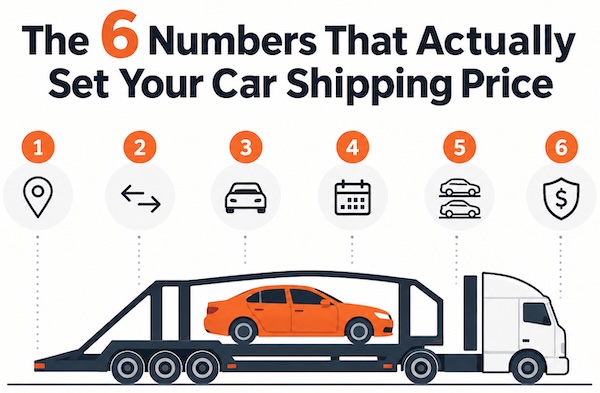
Your car’s sticker price tells a transporter surprisingly little about the job. The miles ahead, space the vehicle occupies, and days available for collection are more useful. Those details help explain why two owners shipping similar cars can receive different estimates.
There is no universal formula that turns six figures into a guaranteed bill. But understanding the numbers behind a shipment makes quotes easier to compare—and gives you specific questions to ask when a price seems high.
The pricing guidance from Navi Auto Transport connects route, vehicle, equipment, and timing with the estimated charge. Here are six numbers worth examining before you book.
Start with driving distance between the actual pickup and delivery locations. A longer journey generally costs more in total, although the price per mile can fall as distance increases.
For context, Navi publishes sedan estimates of $450–$650 for open transport up to 500 miles and $1,100–$1,500 beyond 2,000 miles. These are planning ranges, not a mileage formula you can apply to every route.
Mileage does not reveal how conveniently a shipment fits a carrier’s route. Exact ZIP codes help distinguish a pickup near a major corridor from one requiring an additional detour.
Give the provider your real locations first. If access is difficult, ask whether an agreed meeting point changes the quote. Include the expense and effort of reaching that location before deciding it saves money.
Length, width, and height help determine how a vehicle fits on the trailer. Factory make-and-model details provide a starting point, but modifications can change the loading requirements.
Report a lift kit, oversized tires, roof equipment, or lowered suspension before accepting an estimate. Supply measurements or photographs when requested. Do not assume a quote for a standard pickup covers an extended or heavily modified version.
The same trip can attract a different price at another time of year. Navi identifies summer demand and seasonal snowbird traffic as influences on its estimates.
Request pricing for your intended shipment date rather than using today’s availability to budget a move months away. If two departure weeks would work equally well, ask for both. A seasonal pattern does not guarantee that shifting your date will produce a discount.
A five-day collection window offers more scheduling options than a single afternoon. Keep that window separate from the number of days between booking and departure.
Ask what flexibility is worth on your route, then calculate its practical cost. In a hypothetical comparison, saving $100 on shipping while spending $150 on extra rides leaves you $50 worse off. Use the widest window you can comfortably manage.
Navi lists enclosed service at approximately 40–60% above open transport on the same route. Applied to an illustrative $1,000 open quote, that suggests $1,400–$1,600 for enclosed shipping.
Request paired quotes for your specific vehicle. The upgrade may suit valuable paintwork or a collector car, but confirm loading equipment and coverage separately. A higher price does not automatically include every specialized service.
These numbers give your comparison structure, but operating condition and special handling still matter. Send each provider identical details, confirm the complete charge, and ask what could change before dispatch. A useful quote should explain the shipment clearly enough that you can see what your money buys.