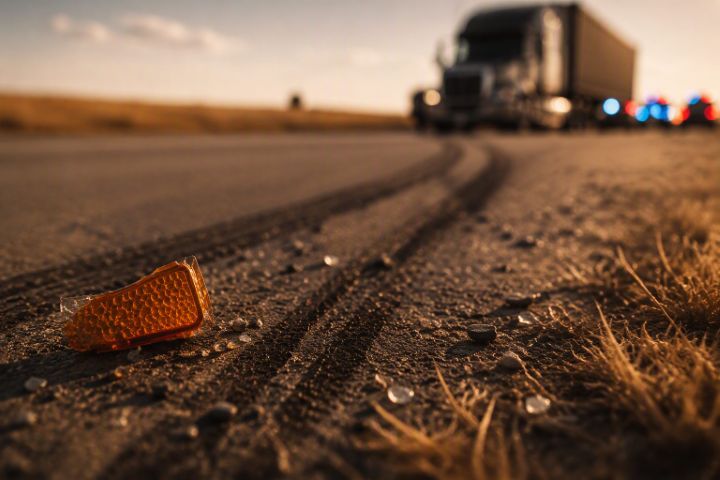
An 18-wheeler crash in Texas can leave drivers facing injuries, damaged vehicles, moving traffic, and an unfamiliar commercial trucking operation. Your first priority is getting yourself and everyone else clear of immediate danger. Call 911 and accept medical care if emergency responders recommend it before reaching for a camera.
No photograph is worth stepping into a live lane or making an injury worse. Once the scene is stable, documentation can include safe photographs, truck identifiers, witness information, official reports, medical records, and the paperwork that follows.
Call 911 first, follow emergency personnel’s directions, and get medical attention before attempting to document the scene. Take photographs or exchange information only when you can do so without entering traffic or approaching leaking fuel, unstable cargo, fire, smoke, or damaged electrical equipment.
Never make a dangerous movement simply to improve a camera angle. For a property-damage-only collision on a metropolitan-area freeway, Texas law requires normally and safely drivable vehicles to be moved as soon as possible to a designated investigation site, frontage road, cross street, or another suitable location.
The applicable provisions appear in Chapter 550 of the Texas Transportation Code. The law defines a normally and safely drivable vehicle as one that does not require towing and can operate under its own power without creating additional damage or danger.
Do not attempt to move a severely damaged or unsafe vehicle. Follow emergency personnel’s instructions when someone may be injured, the vehicle cannot operate normally, cargo has fallen, or fire, smoke, leaking liquid, or another hazard is present.
Stop documenting if traffic is moving around you or if you feel dizzy, confused, weak, or unsteady. Get to a protected location first. Photographs can wait.
There is no single injury pattern after a collision with a commercial truck. The outcome can depend on impact speed, intrusion into the passenger compartment, restraint use, vehicle design, and the part of the vehicle that absorbed the impact.
Possible injuries include head trauma, spinal damage, fractures, internal injuries, and soft-tissue damage. Symptoms may develop or become more noticeable after the initial shock begins to fade. Gauge Magazine’s guide to delayed injury symptoms after an accident explains why feeling reasonably well at the scene does not rule out an injury.

Large trucks involved in injury crashes increased 18% between 2016 and 2024, according to the National Safety Council.
The National Safety Council counted 120,724 large trucks involved in injury crashes nationwide during 2024, an 18% increase from 2016. Its 2024 reporting also found that 70% of people killed in large-truck crashes were occupants of other vehicles.
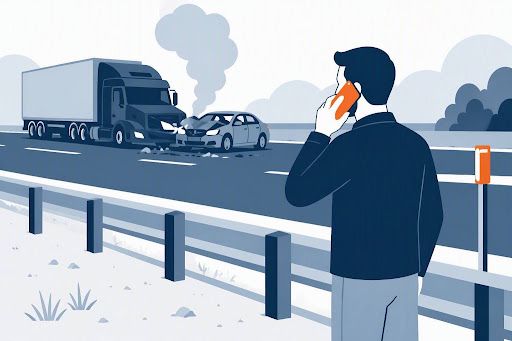
Call emergency services from a protected position away from active traffic.
Report your exact location and direction of travel. Tell the dispatcher how many vehicles are involved and whether anyone appears injured. Mention fire, smoke, leaking material, displaced cargo, blocked lanes, or a driver who left the scene.
Do not speculate about fault, speed, fatigue, distraction, or another driver’s medical condition. Give responders information they can act on rather than conclusions that have not been established.
When officers arrive, provide an accurate account and ask for the responding agency’s name, the officer’s information, and the incident or crash-report number. Save that information with your photographs and insurance records.
TxDOT is the custodian of Texas crash records. An eligible person can later request the Texas Peace Officer’s Crash Report through the TxDOT Crash Report Online Purchase System.
A crash report records information gathered by law enforcement, but it does not necessarily resolve every question of civil responsibility. Evidence in a truck case may also include driver logs, maintenance records, dispatch information, onboard video, electronic truck data, and other carrier-controlled material.
If you were hit by an 18-wheeler, legal counsel may be able to identify potentially relevant records and request that they be preserved. Not every truck or carrier will possess every type of evidence.
Report a property-damage hit-and-run even when nobody appears seriously injured. Texas Transportation Code Chapter 550 establishes duties following collisions involving injuries, deaths, and vehicle damage.
Write down or safely photograph:
Do not pursue the truck. Give the available description to police and let law enforcement handle the search.
Texas does not classify every failure to stop in the same way. The possible offense depends on whether the collision caused property damage, bodily injury, serious bodily injury, or death. Sections 550.021 and 550.022 contain different requirements and offense levels for those circumstances.
General summaries about leaving a Texas crash scene should not be used to predict a charge or sentence in an individual case. Prosecutors and courts evaluate the applicable facts and law.
Photograph only what can be seen from a protected location. Never walk between active lanes, stand behind an unstable vehicle, climb onto truck equipment, or touch displaced cargo and debris.
Begin with wide views that establish the roadway and vehicle positions. Move to closer photographs only when it is safe. Useful images may include:
Do not move debris or other evidence to create a clearer photograph. A speed-limit sign or traffic signal may provide context, but a photograph of it does not independently prove what caused the collision.
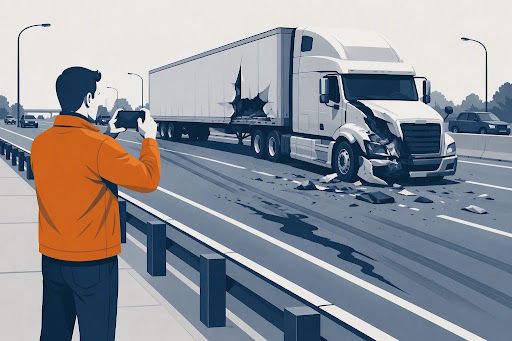
Photograph vehicle damage from a sidewalk, shoulder, or another protected location—not from an active traffic lane.
Short video may capture traffic flow, changing weather, flashing signals, visibility, and surrounding noise more effectively than still images. Record only from a safe location, such as a sidewalk, protected shoulder, or area behind a barrier.
Keep the original files and their metadata intact. Do not crop, filter, annotate, or compress your only copy. Make separate copies for sharing with police, an insurer, or an attorney.
Avoid adding captions that guess about speed, fault, fatigue, or distraction. Preserve what the camera recorded without turning the file into an argument.
The name painted on the cab may differ from the company operating the truck, owning the trailer, or employing the driver. When it is safe, photograph or record:
Collect only information that can be viewed or exchanged safely. Let police address any refusal to cooperate. Do not climb onto the truck, open compartments, touch cargo, or demand access to the driver’s phone or company paperwork.
Do not argue about fault, accuse the driver of fatigue or distraction, threaten litigation, or post allegations online. A calm, factual exchange makes it easier to obtain the information needed by police and insurers without escalating the situation.
If the truck leaves, write down what you remember and give the information to police. Do not follow it.
Ask each willing witness for a name and phone number. Record an email address if offered and note where that person was positioned when the collision occurred.
Request a short account of what the witness personally saw or heard. A useful neutral question is, “Where were you when you saw the collision?” Avoid coaching witnesses toward a theory or combining several accounts into one version.
Nearby homes, businesses, dashcams, traffic cameras, and fleet vehicles may hold relevant footage. Note the location and approximate time without trespassing or demanding immediate access. Video may be overwritten, so identifying possible sources early can matter.
Scene photographs are only one category of documentation. Create a physical or digital file that keeps the remaining truck-crash records together.
| Record category | What to preserve |
|---|---|
| Medical care | Visit summaries, diagnoses, prescriptions, bills, test results, referrals, and follow-up instructions |
| Vehicle damage | Tow records, repair estimates, invoices, photographs, storage notices, and total-loss correspondence |
| Official records | Incident number, responding agency, officer information, citations, and the completed crash report |
| Income effects | Missed-work dates, employer correspondence, wage records, and work restrictions |
| Digital evidence | Original photographs, videos, dashcam footage, phone backups, and relevant messages |
| Insurance records | Claim numbers, adjuster information, letters, emails, estimates, offers, and release documents |
Gauge Magazine’s broader guide explaining what to do immediately after a car accident provides additional steps for organizing information and protecting your health after leaving the scene.
Documentation preserves facts, identifies possible evidence, and creates a timeline. It does not independently prove who caused the collision or guarantee a particular insurance or legal result.
Carrier-controlled records may become relevant as the investigation develops, but no single item is guaranteed to exist or provide a complete explanation. Keep copies of everything and leave original files unchanged.
A Texas claim involving back pain, post-traumatic stress symptoms, or another lasting condition has no automatic value. An evaluation may consider documented diagnoses, treatment expenses, recovery time, future care, income effects, disputed responsibility, and available insurance coverage.
Online averages cannot responsibly value an individual claim, and no photograph, medical bill, or receipt guarantees an outcome.
Seek care promptly for new pain, numbness, weakness, breathing difficulty, confusion, severe headaches, or emotional symptoms. Never delay medical care to finish taking photographs or organizing paperwork.
Preserve photographs and repair records before authorizing the disposal, dismantling, or repair of badly damaged property. Ask the insurer, repair facility, or storage yard before removing anything from the vehicle, and keep records of every authorization.
Save dashcam footage promptly so the device does not overwrite it. Back up phone photographs and video without deleting the original files.
Avoid posting crash footage, medical details, accusations, or edited clips on social media. Anything published may later be reviewed without the context you intended.
After an 18-wheeler crash in Texas, emergency care and a protected location away from traffic outrank every documentation step. Once you are safe, gather the incident number, original media files, driver and carrier identifiers, witness information, and medical and repair records in one place.
Preserve what you can without entering traffic, confronting another driver, touching cargo, or delaying treatment. Careful documentation can give police, insurers, medical providers, and legal counsel a clearer factual record, but preventing another injury remains the first priority.
This article provides general information and is not legal advice. Legal rights, reporting duties, and claim requirements depend on the facts of each collision.
The post Hit by a Semi Truck in Texas? How to Safely Document an 18-Wheeler Crash appeared first on Gauge Magazine.