

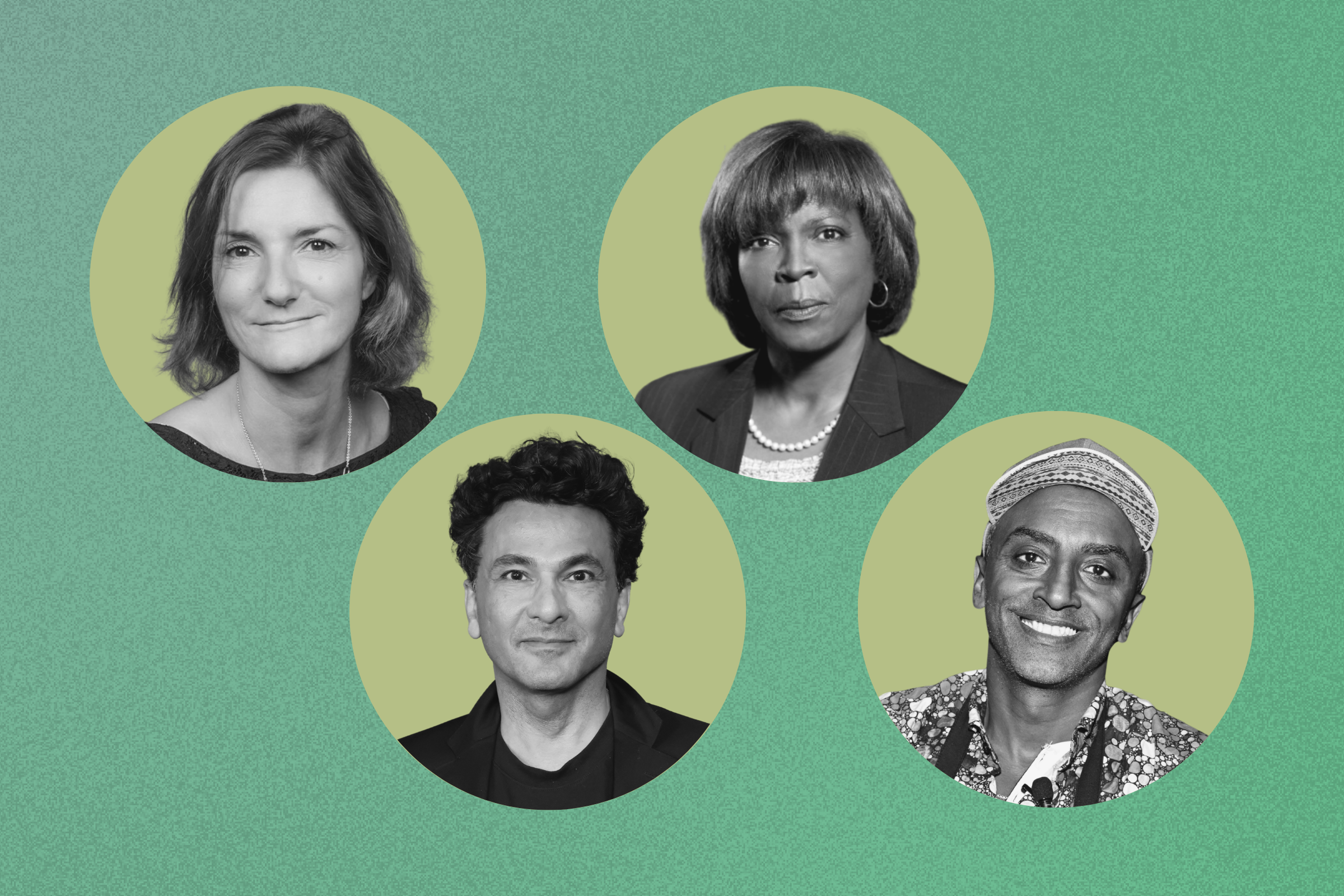
At a TIME100 Talks event in New York City on Sept. 21, chefs and food industry experts discussed the challenges our communities face in making food healthier, more accessible, and more joyful for everyone.
Cecile Beliot-Zind, the CEO of Bel Group, which sponsored the event, said that her company believes “there is a model to make healthier and sustainable food for all possible,” but one of the issues facing the industry today is that people “keep on opposing instead of combining” ideas.
“We believe that the right way to define healthier food is to combine what usually people tend to see as trade-offs,” she said. “The big issue of our industry: If you want to scale healthier and sustainable food, you are first to make sure and to believe very strongly that health can be combined with taste, that nutrition can be combined with accessibility, that fair revenues for the farmers—who, by the way, feed all of us—could be combined with fair values for the communities we feed.”
She gave an example: Bel Group makes Babybel, the popular small cheese snack wrapped in a red wax coating, which Beliot-Zind called “the perfect snacks.”
“The reason why kids and I love Babybel is because it’s convenient, because it’s a great natural source of protein, because I play with the wax. It gives me joy,” she said. Bel Group, she continued, focuses on balancing these two ideas: making food both healthy and desirable.
“Healthy food will have an impact on the world if we are capable to make it nutritious enough to matter, accessible enough to be everywhere for everyone, and desirable enough to be chosen,” she said. “The issue with the food industry is that the big food manufacturers have created desire for product[s] that provide empty calories. They scale it, they spread it all over the world. We feed the world with fat and sugar at a low cost. … It hurts the planet, and it hurts the health of the people.”
TIME executive editor and panel moderator Nikhil Kumar then asked Vikas Khanna, a chef, author, and filmmaker, how he navigates making healthy food as a restaurateur. Khanna, who was on the 2026 TIME100 list, talked about how, at his New York City restaurant Bungalow, he and his team have worked to make their food delicious, healthy, and sustainable.
“There’s also an extreme stigma around ethnic cuisines not being healthy,” Khanna said, but it isn’t necessarily accurate. Much of Indian cuisine, he said, “is based on the principles of Ayurveda and sustainability.” And eating healthy doesn’t have to come at the cost of authenticity. For instance, Bungalow has reduced the ratio of creams used in its foods. “I do understand you adding 40% cream makes everything taste more delicious,” he admitted, “but I want people to feel as if they’re eating at home. I have never met an Indian who says that we use cream in our home cooking.”
Marcus Samuelsson, a chef and author, spoke about how there’s been a long-held belief that healthy food can’t be tasty—and how it’s the role of a chef to disprove that idea.
“Healthy and delicious can coexist. Healthy and delicious definitely can be celebrated together,” Samuelsson said. “We think about healthy and delicious constantly. And it’s not either or.”
He went on to urge everyone to learn how to cook: “Learn how to cook, and with that, you will follow your own curiosity and you will feel better. Guaranteed.”
Ertharin Cousin, the CEO and managing director of Food Systems for the Future, said that, while she thinks it’s a great idea for everyone to learn how to cook their own food, it can be a challenging task for people from low-income communities who may not have access to regular refrigeration or electricity or gas to support cooking.
“When we think about making that nutritious plate more available, we also need to think about how to support the households without access to the cooking and storage that we take for granted,” Cousin said. “Everyone wants to put a plate in front of their child that is going to ensure that that child thrives. Not everyone has the capacity to do it from a financial standpoint or from the tools that are required to make it available.”
Cousin also spoke about how “we grow enough calories,” but not enough food “to support the nutritious, diverse diet that’s necessary for the body to thrive.” That has led to nutritious and diverse diets becoming unaffordable for many Americans, and for many people around the world, which results in malnutrition, according to Cousin. At the same time, she said, “we have made food that is less nutrient-dense more affordable and available,” which has led to an overconsumption of unhealthy foods.
She went on to say that it should be the responsibility of everyone—ad companies, food processors, retailers, policymakers, and even consumers—to make changes across the entire system to make our food healthier.
The panelists ended the discussion by emphasizing the idea that food should be both joyful and healthy—that the two are not mutually exclusive. Cousin even said that “there’s a place for indulgent food,” though it shouldn’t be “at the center of your plate.”
“Food is joy. It’s health. It’s family. It’s culture. It’s love. You think about what moms go through to put food on the table for their families every night and how they think about what they’re providing for their children, for their futures. And we’ve lost some of that,” Cousin said. “We need to ensure that they have access to that diverse diet that is required for them to thrive—for the child to thrive.”
TIME100 Talks: Architecting Healthier Food Systems for All was presented by Bel Group.