

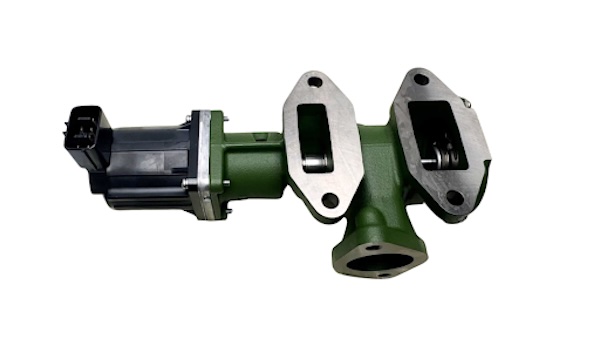
 Cummins EGR Valve. (Photo by Wisent Parts Center)
The main purpose of the EGR (Exhaust Gas Recirculation) system on a 6.7L Cummins is to help reduce emissions without changing how the truck feels on the road. Usually you don’t even notice it since it just runs in the background. Problems start when carbon builds up, the valve begins to stick, or a replacement part does not respond the way the ECM (Engine Control Module) expects. Then a system designed to help the engine can become the reason it runs poorly.
The EGR valve controls how much exhaust gas is sent back into the intake. Recirculating a measured amount of exhaust lowers combustion temperature and helps reduce NOx emissions. It’s the ECM’s job to figure out when the valve should open and how much EGR flow the engine needs.
Mechanically, the valve itself is simple. Inside the housing are spring-loaded valve elements. An electronic actuator pushes them open when it receives a command from the ECM, allowing exhaust to pass through the EGR system. When the valve needs to close, spring pressure helps return the mechanism.
On select 6.7L Cummins ISB applications, the valve may appear under several related part numbers. Stores such as Wisent Parts Center list buy 5473296RX part alongside other commonly referenced numbers for the same EGR valve family. Cummins identifies this valve kit primarily with EPA13 6.7-liter ISB/QSB engines, so confirm the fitment for the specific engine.
Even though the EGR valve has a simple design, it works under very harsh conditions. The exhaust gases passing through carry soot and carbon, which over time collect around moving parts.
As buildup gets heavier, the valves may stop moving as freely as they should. Over time, carbon buildup can make the valve stick, prevent it from opening or closing fully, or leave it stuck open. The actuator may still receive the correct electrical command, but the mechanical valve is no longer following it correctly.
That is where the engine can start fighting its own EGR system. Too much or too little exhaust flow at the wrong time can affect how the engine runs and can cause the ECM to recognize that EGR flow is not where it should be.
An EGR problem does not always show up the same way. Some trucks first set a warning light, while others begin to feel different before the driver sees a code.
– Check-engine light or EGR-related fault codes
– Rough or uneven running
– Loss of power or sluggish response
– Slow acceleration
– Excessive smoke in some conditions
– Poor response under load
A fault code is a starting point, not proof that the EGR valve itself is bad. Wiring, connectors, sensors, airflow problems, or other EGR components can create similar symptoms. Replacing the valve based only on a code can turn into an expensive guess.
Some aftermarket replacement valves may look the same, even fit and mount the same, and still fail to work correctly. Low-cost units can have internal electrical and actuator problems.
Some repair examples showed that aftermarket replacements produced circuit and internal fault codes after installation. That does not mean every aftermarket EGR valve is bad. Quality varies, so replacement unit quality matters.
The actuator must respond correctly to ECM commands, the valve mechanism must move freely, and the electrical side of the unit must operate the way the engine expects.
Once diagnosis confirms that the valve needs to be replaced, the rest is fairly straightforward. Following the correct installation steps is still important.
Use the correct gaskets and make sure the sealing surfaces are clean. Position the valve correctly before tightening the mounting bolts, and keep the housing aligned as the bolts are started. The electrical connector and wiring should also be checked, along with the position of the actuator and valve mechanism.
A scan tool should be used to clear the stored diagnostic codes and check the system again. The important part is confirming that the circuit or EGR faults do not return.
If the same code comes back, the original problem has not been fully corrected. The replacement valve may not be operating correctly, an electrical problem may still be present, or another part of the EGR system may need attention.
The 6.7L Cummins EGR valve is a good example of how a simple mechanical part can create complicated symptoms. Carbon can stop the valve from moving freely, electrical problems can imitate a bad valve, and a poor replacement can introduce new faults. Understanding how the valve works, diagnosing the original problem, and verifying the repair afterward can keep a small EGR issue from becoming a much bigger headache.