
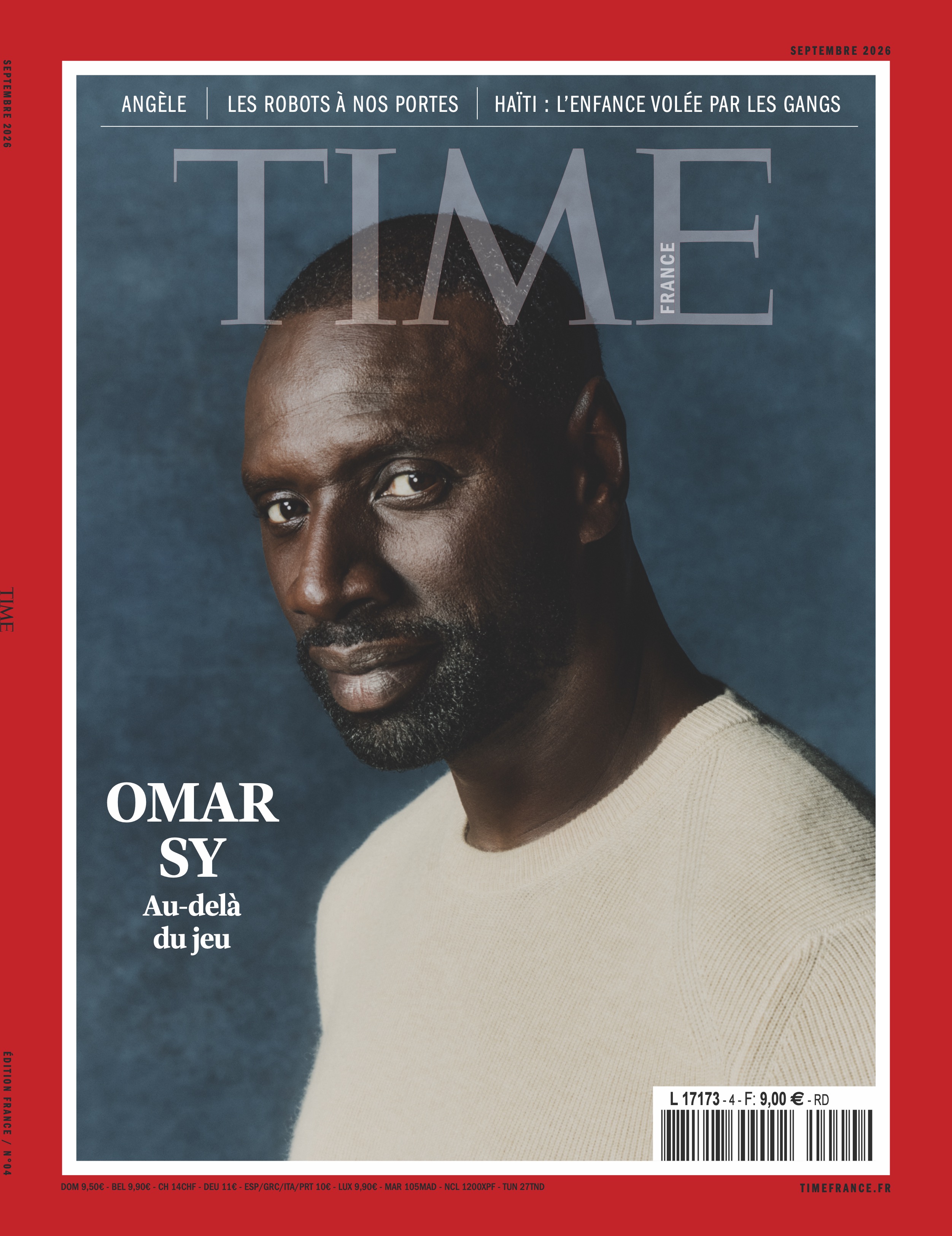
This article originally appeared in TIME France; click here to read it in French.
A door opens. The 6-foot-3 actor is sitting on a large leather sofa.
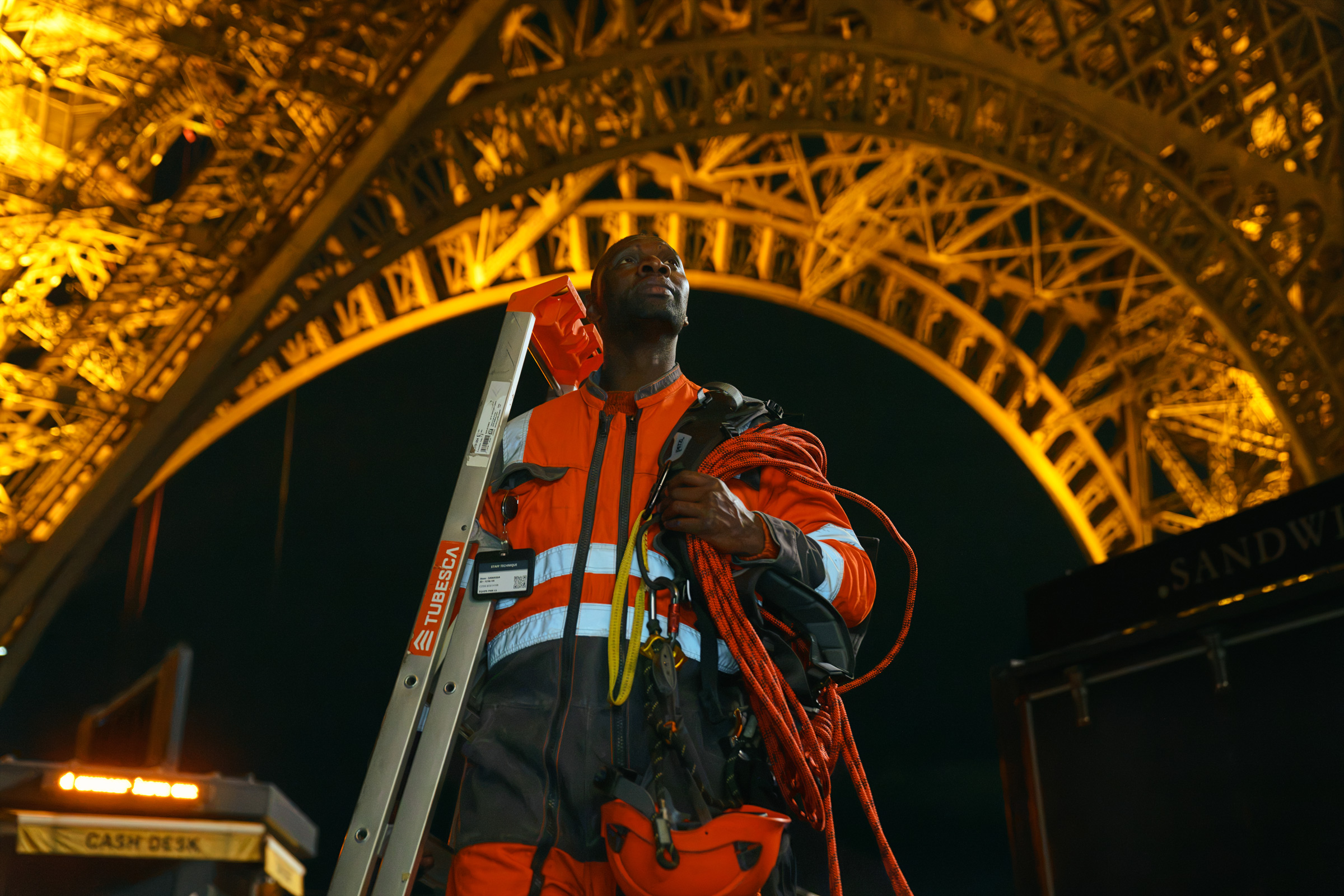
His eyes are bright, his smile infectious despite the French team's World Cup defeat, from which he's still recovering. "I feel like m’être fait ‘mêler,' as we say in the neighborhood when 10 guys jump you,” he says. “But if I'm complaining about the World Cup like it's a major misfortune, it means things aren't too bad." It's summer when we meet; he's just arrived at the studios in La Plaine Saint-Denis to promote the fourth season of Lupin, the series that saw him explode into global view, in the guise of a gentleman thief who, this time, faces off against a copycat.
The actor has reached a milestone by elevating the program—which he co-produces with his company Carrousel Studios—to the rank of the most-watched non-English language series in the world on Netflix.
It all started with a hunch. A few years ago, alongside director Louis Leterrier, the French duo sensed a great opportunity. “At the time, in France, Netflix was still a somewhat unclear thing,” he says. “But based on the United States, we knew perfectly well that the series would be watched all over the world. We simply said to ourselves: let's make a show that does France proud.” The bet paid off, close to hundreds of millions of views later, all without ever having taken a single drama class. “It also comes down to the people you meet; that's what I love most about this job.”
Having already appeared in the blockbusters X-Men and Jurassic World, he will soon be seen on posters for the next Ocean's Eleven, directed by Bradley Cooper, whom he met nearly 10 years ago on a film set and who has since become a close friend—the story of his life.
TIME France: What aspects of yourself do you see in Assane Diop, the elusive thief you play on Lupin?
OMAR SY: I don't know if there are similarities between us. But there are many things I envy, admire, and like about him. That elusiveness—the fact that he's always where you least expect him. He uses every means at his disposal. He has a bit of an aikido quality: he takes what others consider a weakness and turns it into a strength. I also like his way of dispensing justice. Even though he's a thief, he has this desire to right wrongs, a Robin Hood-like quality. And then there's his panache, his lightheartedness, his playfulness…
We see you a lot at times, then you disappear. Is that necessary for your well-being?
Yes, I work in a creative field, and creativity feeds on life. You can't create if you are constantly on. Otherwise, it becomes industrial. I need to go back to living, to feeling the strong emotions that shape you, define you, and then inspire you to express things. And that's, that’s happens off-set… You have to take a break, to recapture a bit of and ask yourself: “Where am I in my life? What moves me? What do I want to express?”
How did you react to the Louvre heist a few months ago, which echoed the series so strongly?
I was a bit overwhelmed by it. People were calling me and inevitably making the connection; there were all the jokes: “Give it back!” “Was it you?” It’s crazy to see the extent to which much we draw inspiration from real life… and the extent to which reality can also be inspired by us in turn, like communicating vessels. I was torn between a lot of feelings.
First, immense surprise. I was truly stunned to see that the robbers were capable of trying to reproduce something reminiscent of what we did on Lupin. You tell yourself there was some inspiration, then laugh at the absurdity of the thought. But then comes a moment when you feel guilty and ask yourself, “How much of all this is my responsibility?”
Perhaps one day they'll say they were inspired by Lupin, just as Rédoine Faïd was by Michael Mann's Heat …
That’s also one of the reasons why, in writing Lupin, we pay close attention to the moral of the story, to the values we convey. Because Assane Diop and Arsène Lupin are extraordinary characters, but they remain thieves.
Every second foreign tourist in Paris has watched the series. Do you consider yourself an ambassador for France abroad?
I felt like an ambassador for France long before Lupin. I've never been more of a representative of France than since I left. By living abroad, I've become even more French. Because the truth is you carry your country within you. And others see you that way. In my daily life in the United States, I'm "the Frenchman in the neighborhood." In my work, I'm "the Frenchman" in the story. I'm chosen for that reason too. Obviously, when we launched Lupin, we didn't expect to reach such a level of success. Today, I'm extremely proud of it. And what also touches me is that Lupin has rekindled the desire to read the writer Maurice Leblanc. Booksellers and publishers thank us for giving his character a new lease on life. Well… The inhabitants of Étretat [where the series was partly filmed] hate us a little bit. [laughs] It has become unbearable for them; I want to take this opportunity to apologize again.
You seem—through your choice of roles—to want to spotlight something deeper in society. Is that a fair impression?
My work is precisely that. When I say I take time to live before expressing my feelings, that's exactly why. I always have an image in my mind, which I've never articulated before: I think of the shelves at Fnac. I tell myself that in the end, when you look at all of an actor's films, there has to be a coherence. And that coherence is who I am. Yes, I always need to say something.
Sometimes it comes through a particular genre, sometimes through a character, a different story. But, deep down, there's always something I want to express. Regarding Assane Diop and Lupin, what interests me are injustices, the invisible people. All those who exist, but that we don't see, that we don't consider. Through this character, there's also a way to bring them to light. There's always a little Trojan horse in what I do. It's not some grand declaration. I'm not going on a crusade. But it's a driving force. No character interests me if he doesn’t carry a message, if he has nothing to say to the world. It has to be bigger than me for me to take it on. Otherwise, I'm too timid.
This series is also a consequence of The Intouchables, the film that transformed your life and brought you to the United States. What do you enjoy most about this life you've been living there for the past 14 years?
It's given me a much more global perspective on the world…and on my profession. It's allowed me to take a step back with the right amount of distance. One of the most important things I've learned there is that filmmaking is also an industry. In France, it's something we sometimes find hard to admit. Yet, here too, we strive to make films that are successful and profitable. We simply talk about it less openly. Over there, that aspect is much less taboo. We can discuss it, study it, understand it. Today, this knowledge helps me as a producer. When you better understand the economic mechanisms of our profession, you can ultimately better express yourself, with even greater impact. For example, if I was able to develop certain productions, if I was able to make Father & Soldier, if we were able to make Lupin, it's also thanks to this understanding of the business. It also allowed me to develop real estate projects in Senegal.
Do you perceive France differently from a distance?
When you live in France, you feel so many things. The French are passionate; they experience their country very emotionally. Being far away sometimes allows me to observe things with more perspective. I see my American neighbors’ view of France and, ultimately, I have both perspectives now: that of someone who experiences France from the inside, and that of someone who can also observe it from the corner of the room.
You have expressed concern in the past about the state of French society. Do you feel it even more today?
It’s not that I’m more worried—I’m just as worried as ever. I have the feeling that we are going toward what I fear most: a France that is deeply fractured at every level. A France where bridges are becoming more and more difficult to build. Not impossible, mind you, but much more complicated.
Has the idea of "vivre-ensemble" eroded?
It's an overused term. "Le vivre-ensemble" has been used so much, so politically co-opted by both sides… It no longer really means what it should. We've ended up making it lose its meaning.
Your filmmakers and friends Olivier Nakache and Éric Toledano recently made a film in which the banlieue of the 1980s were less fractured. Did you feel that was the case for you as well?
When I was a child in Trappes, I didn't have that feeling of division. That doesn't mean everything was great, but we were together. I didn't feel that there were divides between people, like today, where you sometimes feel like you have to cross a river to meet someone. I didn't feel that. There were shared spaces. Of course, there was already racism; I've never had any trouble saying it. And I continue to say it, it's real. But to truly understand it, you have to be Black or Arab in France. We've always experienced it. It's just that today, there's a different intensity. And above all, there is another way to express it… and to experience it.
We're a few months away from the presidential election, and the National Rally is leading in the polls. What does that tell you?
It goes along with everything I've been saying and it confirms the concerns I've been expressing for a long time. We're heading towards a France that's asking itself a lot of questions. And giving itself the wrong answers.
Do you know who you'll vote for in April 2027?
It's still quite unclear. Like many French people, I'm lost; it's been a while since we've had any innovative proposals… On the other hand, I know who I won't vote for.
Is it a delicate matter for you to express your views on the presidential election while living in the United States, or do you feel you have the right to do so?
I feel totally entitled to do so because I am French. France allows French citizens living abroad to vote. So, if my vote exists, it means my voice counts. The day they decide that French citizens abroad should no longer vote, then we'll talk about it again. But today, I have that right. I remain concerned about what is happening in my country. The fact of living elsewhere does not make me a foreigner.
What do you say to those who use that argument against you?
The simple fact that some people question my feelings about France, that I can express my opinion about the country, is clearly racism. It's not that I'm abroad that’s the problem; it's that I'm Black. When people tell me, “You should thank France”— why should I thank France more than anyone else? If everyone is supposed to thank France, then everyone should thank it in the same way. Why is this injunction directed more at me? That's also a form of racism.
I'm often told I'm ungrateful. That because I live abroad, I shouldn't criticize France or have a negative opinion. But what are they all doing all the time?
You arrived in the United States during Barack Obama's presidency. Now, Donald Trump is in his second term, and there too you live in a troubled society…
The world is troubled, the world is asking itself questions… We are part of that world. I've seen the difference, I still see it, but I don't have the right to vote because I'm not American, and therefore, I can’t legitimately speak on the subject.
You've said that you experience more racism in France than in the United States…
Of course, and in a very real way. There are acts that are punishable by law in the United States that aren't here. In France, we still see things occur without provoking the same reactions. Therefore, in my opinion, there is a different level of legal protection. And there is also a difference in behavior. Some attitudes that are still accepted here would be much harder to find there.
In recent months, there's been the Epstein affair, and, in France, scandals surrounding after-school programs are piling up. As a father of five, are you worried?
What worries me is how late we're discovering things about our children. What strikes me most is the density of the silence. How is the silence so pervasive and, at the same time, so opaque? How could so much have remained hidden for so long? How could we have taken so long to understand what was happening around our children? And I sometimes have the feeling we're fighting the wrong battles. We debate certain issues endlessly… while others, much more serious, are almost relegated to the background. I believe all parents everywhere are asking themselves questions today that our parents never asked. Sending a child to summer camp—if so, where? Enrolling them in an extracurricular activity? And so on.
When you were growing up, you didn’t need to worry about the climate, the impact of artificial intelligence on employment, or pensions.
But there's another difference: we knew less. This kind of ignorance also protected us, to a certain extent. In our society today, children are much more aware of the gravity of the world they live in. And especially of the consequences this can have on their own future. Us, we felt that anything was possible. The future was a blank page on which we could write whatever we wanted. Today, they already feel that there are limits in place in many areas.
Do you talk to them about it?
A lot. And what's really surprising is that they're perfectly conscious of all this. But they're not afraid. That's actually what gives me hope. I have the feeling that our children are just waiting for one thing: to take the reins. When I listen to them, I understand that they're looking at us and thinking: "You've messed everything up. You're incompetent. Now, let us do it.” I'm counting on them.
Will AI replace you on screen at some point?
That's impossible! [laughs] I don’t think it will replace actors of my generation—if it ever does manage to replace actors, which I don’t believe it will. On the other hand, it’s an extremely powerful tool that’s evolving so fast that by the time we finish this conversation and your article is published, something new will already be out there!
But are you worried about damage to the craft of filmmaking? Many people in Hollywood have spoken up on this subject.
Artificial intelligence must remain a tool in the service of creation. Not a tool that creates in place of creators. When I look at what it produces on its own, it doesn't interest me. Because what moves us in a work of art is precisely what belongs to humanity: the soul. And that soul, artificial intelligence doesn't have it.
How long will this last? Its deployment and its advances are happening every day…
There's no point fighting something that's already underway. It's already part of our jobs. From this point on, the real question is no longer: how do we stop it? But rather: how do we regulate it? How do we protect jobs? How do we support those whose jobs will disappear? How do we embrace this movement? It's exactly the same as when Netflix arrived. At the time, many thought it would kill cinema. Today, we clearly see that the two coexist. Because nobody wants to see cinema disappear. So we've found a balance. With AI, it's the same thing.
Our colleagues at TIME in the United States ranked you among the 100 most influential people in the world in 2021. Do you manage to stay grounded?
I do what I can to stay grounded. And anyway, when you're not grounded, you're not even aware of it. So I'm not the best person to answer that.
Sometimes people project their own struggles onto you. Is it exhausting to be seen as a symbol?
When someone projects something onto me, they're mainly projecting the image they have of me. It's their story. Not mine. I don't belong to anyone. I'm part of their imagination, but it doesn't belong to me. When you're an actor, you quickly come to understand one essential thing: people aren't always talking to you; they're talking to the image they've constructed of you. Once you understand that, you sleep much better. Otherwise, you go crazy. You can't live according to what everyone expects of you.
You have often spoken out on issues of migration and police violence. Is this a way of giving meaning to your fame?
When I speak out on certain social issues, it's not because I wake up in the morning thinking, "Today, I'm going to defend this or that cause." It doesn't work like that. I'm given a microphone. If the subject resonates with me, then I respond. If not, I don't respond. It's as simple as that. When you ask me about France, about certain realities I’m familiar with, then yes, I have something to say. But it's never a pose. It's never a strategy, much less an obligation.
It's often said, "Omar Sy is a socially engaged actor." But let's look at the questions asked of other actors and those asked of me. They're never the same.
Many don't want to step outside the promotional framework; it's a choice.
Yes, perhaps they don't want to express themselves, but above all, they're never asked certain questions. It doesn't matter which films they're promoting.
Conversely, you openly express your feelings and opinions on these subjects.
To understand my feelings, you first have to ask me questions. People want to hear my perspective on a topic, and by constantly asking me these questions, it makes me seem like someone who reacts to current events and takes a stand. It's the microphone they're holding out to me that ho creates this… You have to look at how I'm approached.
With some actors, you can promote the exact same type of film. And yet, we're not steered toward the same topics. Before I've even answered, there's already a projection: He's Black, Muslim, he comes from the banlieue. And in that, too, it's a form of discrimination.
Talking about the banlieue also means talking about your own journey and your story. It's not without reason…
But there are other actors from the banlieues; it's just that they don't represent the archetype. People assume they don't come from there. But they do, just as much as I do. At the same level of notoriety—I'm not going to name names, but I know others who grew up in the same neighborhoods, yet who are left alone on these subjects.
Your eldest daughter was born in Trappes, your youngest in Los Angeles—that pretty much sums up this life, almost elastic.
Yes, my eldest daughter was born in Trappes, on my 23rd birthday. In the same hospital, with the same doctor who delivered me. And my youngest child was born in Los Angeles. When I look at it, I think it tells a life story. I like to laugh about it. I often say there's the Trappes girl, the Versailles kid, and the Californian. It also shows that you can evolve without denying your roots. Evolving doesn't mean changing. You can go very far without losing your anchor and your roots. It's important to pass that on to my children, because that's how I was raised.
Despite the money and the change of scenery, has your current life retained some elements of your previous one? A lot has changed in my life; just look at this dressing room, it's an apartment. [laughs] In the beginning, there were 15 of us in a dressing room half the size. But the essentials haven't changed. I think that as you get older, you even return to certain things more. When you lose a parent, certain values become even more important. But I refuse to spend my time analyzing myself; the only time I do that is during interviews when I'm asked questions I never ask myself. Otherwise, I still enjoy very simple things like going to the market, cooking, and walking in nature.
Is it possible to make friends in Hollywood?
When I arrived in the United States, I was 34. At that age, your life is already built. You have your friends. You're a father, you have a wife. You don't go to the United States to make friends. You make some anyway, but it's not the primary goal. And then, there are a lot of clichés about California. You often hear that everything is fake. Honestly, I haven’t found that to be so. I'd even say that there's sometimes more transparency than in France. Over there, people might take a little longer before inviting you to their home. On the other hand, once they do, it's sincere. Here, sometimes you get invited to dinner very quickly, and then, two years later, the person pretends not to know you anymore on the street. [laughs]
Do you ever wonder what other path you could have taken?
Honestly, very rarely. But I believe that, one way or another, I would have built a life similar to this one, on a different scale... Not with the same encounters, not with the same resources. But I believe my curiosity would have led me to a fairly similar existence. Today, I live on three continents. I think that, even without this job, I probably would have lived on at least two. Because that's just how I am. I've always wanted to see other places, to discover. To build several things at once.
You were passionate about science, and you earned a technical baccalaureate specializing in heating and air conditioning.
My plan was very simple: I had a cousin who was an architect working in Senegal. I wanted to join his business, installing air-conditioning systems on his construction sites. That was my plan. In that life, I would probably have, for example, split my time between France and Senegal.
In your book Viens, on se parle, you say that your life is a merry-go-round and that someone will tell you it’s time to get off. Is that still the case?
This profession is a bit like that. Every film is a ride on the merry-go-round. And we all work so we can go on another ride. I know very well that one day, someone will tell me the merry-go-round is closed. I've been aware of that for a long time. And precisely because I know that, I'm already ready. That's also why I'm developing other projects. Paris Basketball [of which he is a co-owner]. Production. Things in Senegal, projects in agriculture. I always want to learn and discover other worlds.
And if that happened, where would you start?
Everything I just mentioned, but I would still find a way to stay involved in filmmaking. I might not be in front of the camera anymore, but I’d be somewhere else. Because this world is now part of my life. I need it. Sports work the same way. When I watch a basketball game, I find what I love about cinema: the emotion, the story, the suspense, the sense of connection. I think the common thread in everything I do has become very clear: I want to bring people together, create bonds, build bridges, unite people. When a project makes that possible, you’ll find me nearby!
Translated by TIME