

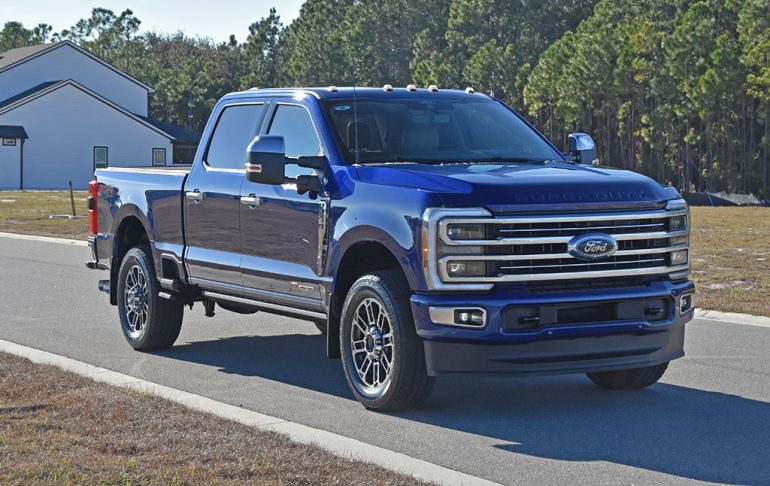
The is built for demanding jobs. Whether it spends its time towing a fifth-wheel trailer, hauling equipment to a worksite, navigating rough roads, or serving as a dependable daily driver, the truck’s size and capability are major advantages. But those same characteristics also make visibility, braking, tire condition, and towing control especially important.
While modern F-250 Super Duty models already offer an impressive collection of factory safety technologies, owners can still make thoughtful upgrades that improve everyday confidence behind the wheel. The best safety modifications aren’t necessarily the most complicated or expensive. In many cases, they involve improving the areas that directly affect a driver’s ability to see hazards, maintain control, stop effectively, and monitor a heavy load.
Here are five safety upgrades worth considering for your Ford F-250 Super Duty.
Good visibility is one of the simplest ways to improve driving safety, particularly if you regularly drive at night, on rural roads, in bad weather, or while towing.
The Insurance Institute for Highway Safety (IIHS) notes that nighttime visibility is critical because a substantial share of traffic deaths occur in darkness or around dawn and dusk. Its research also emphasizes that better headlight performance can help reduce nighttime crashes. However, simply choosing a bulb because it is labeled “LED” does not guarantee better performance. Beam pattern, aiming, glare control, and compatibility with the vehicle’s headlamp housing all matter.
For F-250 owners with replaceable halogen bulbs, an appropriately matched LED replacement can be a practical way to modernize the truck’s lighting system. Before purchasing, always confirm the correct bulb size for your specific model year and trim. The owner’s manual and original bulb are useful references.
Owners looking for vehicle-specific options can explore LED lights for Ford F-250 Super Duty, which includes headlight, fog light, brake/tail, backup, turn-signal, and other lighting options designed around vehicle and bulb compatibility.
For drivers whose F-250 uses 9005 and H11/H9/H8 applications, the SEALIGHT S7S 9005/H11 LED headlight bulbs are another option to investigate. The S7S listing specifies a 6500K white output, IP68 weather protection, and a plug-and-play design. As with any replacement bulb, compatibility should be confirmed before installation.
Most importantly, don’t confuse brightness with safety. Excessive glare can create problems for other road users. After installing replacement bulbs, verify that the headlights are properly aimed and that the beam pattern remains appropriate for the original housing.
Safety takeaway: Improve usable road illumination, not simply the number printed on a marketing specification sheet.
An F-250 can carry and tow significantly more weight than a typical passenger vehicle, which makes tire condition particularly important. A tire problem on a heavily loaded truck or towing combination can quickly become a serious handling issue.
NHTSA identifies proper tire pressure as one of the most important parts of tire safety. The agency recommends checking tire pressure when the tires are cold and following the vehicle manufacturer’s recommended pressure rather than the maximum pressure printed on the tire itself. It also recommends regularly inspecting tread, sidewalls, and overall tire condition.
For an F-250 owner, a worthwhile “upgrade” isn’t necessarily a more aggressive tire. It can simply be choosing tires appropriate for the truck’s actual workload and maintaining them correctly.
Consider the following:
TPMS is valuable, but it shouldn’t replace physical inspections. NHTSA specifically points out that TPMS warns when pressure is significantly low; it isn’t a substitute for routine tire maintenance.
If you frequently tow, consider taking your tire checks one step further. Check pressures before a long trip, inspect the trailer tires as well as the truck’s tires, and pay attention to any change in handling, vibration, or steering feel.
Safety takeaway: A properly maintained tire is one of the most important safety components on an F-250, especially when the truck is loaded or towing.
For many F-250 owners, towing is the reason they chose a Super Duty in the first place. That makes trailer braking one of the most important safety systems to understand and maintain.
A trailer adds considerable mass to the combination, so the truck’s brakes aren’t the only brakes that matter. A properly functioning trailer brake system helps the trailer contribute to stopping instead of forcing the tow vehicle to do all the work.
Ford offers an integrated trailer brake controller on applicable Super Duty configurations. Ford describes its trailer brake controller as helping provide smoother braking control, while the owner’s manual emphasizes checking trailer brakes and electrical connections before towing.
If your F-250 is equipped with an integrated controller, learn how to adjust its gain for the trailer you’re towing. The setting shouldn’t simply be left untouched from one trailer to another. Trailer size, brake condition, load, road conditions, and braking characteristics can all affect the appropriate adjustment.
Ford’s towing guidance also reinforces the importance of staying within the truck’s specific towing configuration and limits. For example, the 2026 Ford towing guide lists configuration-specific requirements and limitations for F-250 towing applications.
Before a major towing trip, inspect:
If your trailer has electric brakes, don’t wait until an emergency to discover that the controller or wiring isn’t working correctly.
Safety takeaway: More towing capability doesn’t eliminate the need for proper trailer braking. It makes a well-maintained braking system even more important.
The F-250’s size is useful when you’re hauling large loads, but it can also create larger blind areas around the truck. Adding or optimizing visibility equipment can make maneuvering in parking lots, job sites, driveways, and towing situations considerably easier.
Modern Super Duty models can be equipped with advanced camera and mirror technology. For example, Ford lists features such as a 360-degree camera and available PowerScope trailer tow mirrors with heating, turn signals, and memory on the 2026 Super Duty lineup.
If your particular F-250 doesn’t have all of these features, there are several ways to improve situational awareness depending on the vehicle’s configuration:
This is particularly useful when reversing with a trailer. A clear view of the trailer’s sides and rear can help identify pedestrians, posts, vehicles, curbs, and other obstacles before they become a problem.
Driver-assistance technology can also complement—not replace—direct observation. NHTSA recommends technologies such as rear automatic braking, blind-spot intervention, lane-keeping assistance, and automatic high beams as useful driver-assistance features.
Safety takeaway: The more information you have about what’s happening around a large truck and trailer, the easier it is to make safer decisions.
A final safety upgrade doesn’t have to be an electronic device or mechanical component. Building a proper emergency kit for the way you actually use your F-250 can be one of the most practical improvements you make.
A truck that regularly travels long distances, remote work areas, construction sites, hunting locations, or rural roads may spend more time away from immediate roadside assistance than a typical commuter vehicle.
Consider carrying equipment such as:
The exact equipment should reflect your truck, driving environment, and level of mechanical experience. Recovery equipment must also be properly rated and used according to its manufacturer’s instructions. Improvised recovery methods can be dangerous.
If you frequently travel in severe weather or remote areas, preparation becomes even more important. A small amount of preparation can make a breakdown significantly less stressful while helping you remain visible and safe until assistance arrives.
Safety takeaway: Safety isn’t only about preventing an accident. It’s also about being prepared when something unexpected happens.
Not every F-250 owner needs every upgrade immediately. The smartest approach is to prioritize improvements based on how the truck is actually used.
For a driver who frequently travels after dark, lighting and visibility may offer the greatest immediate benefit. For someone who routinely pulls a heavy trailer, tire condition and trailer braking should move to the top of the list. A work truck operating around construction sites may benefit most from improved cameras, mirrors, and emergency equipment.
Before installing aftermarket components, always verify compatibility with your specific model year and configuration. Changes to lighting, suspension, wheels, tires, towing equipment, or electrical systems can affect how other vehicle systems operate.
It’s also important to distinguish a safety upgrade from a repair. If a factory component is subject to a recall, the recall should be addressed through the appropriate manufacturer or authorized repair channel rather than simply replacing the component with an aftermarket product. Owners should check for applicable recalls using their VIN.
The Ford F-250 Super Duty is already designed to handle demanding driving and towing conditions, but responsible ownership goes beyond horsepower and payload numbers. Visibility, tires, braking, trailer control, and emergency preparedness all contribute to a safer driving experience.
The five upgrades worth considering are straightforward:
The goal isn’t to modify an F-250 simply for the sake of adding equipment. It’s to identify the areas where your truck’s safety performance can be improved based on your driving habits.
For many owners, better lighting is one of the easiest places to start. When properly matched to the vehicle and correctly aimed, quality lighting can make it easier to identify road hazards, obstacles, and changes in road conditions after dark. Combined with good tires, properly maintained brakes, effective towing equipment, and improved visibility, these upgrades can help make an already capable Ford F-250 Super Duty even more confidence-inspiring on the road.