General Motors is taking the Chevrolet Silverado into some unexpected territory, and this time, there won’t be anyone behind the wheel. GM Defense, the automaker’s military-focused division, has revealed an autonomous vehicle concept based on the Chevrolet Silverado 3500HD, designed to handle dangerous military missions without putting a driver in harm’s way. Unveiled at the 2026 Association of the United States Army (AUSA) Annual Meeting and Exposition in Washington, D.C., the new Unmanned Ground Vehicle (UGV) offers an interesting glimpse into how familiar pickup truck technology could play a significant role in the future of military transportation.
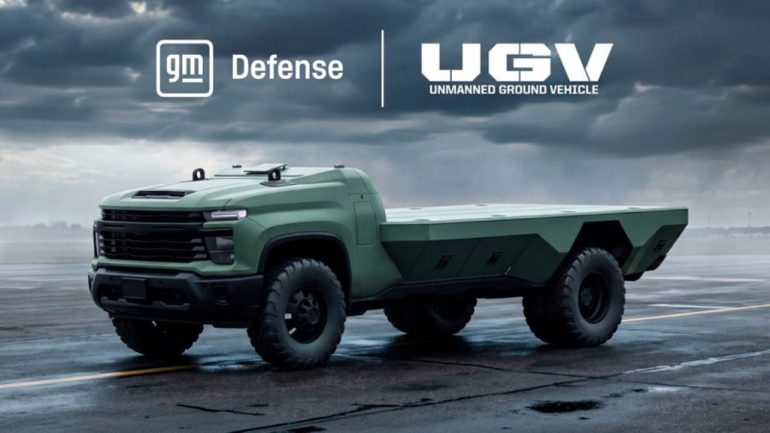
At first glance, there’s still some recognizable Silverado DNA in this futuristic military machine, particularly up front, where Chevrolet’s heavy-duty truck styling remains noticeable. Beyond that, however, things look dramatically different. GM Defense has essentially eliminated the conventional passenger cabin and replaced the traditional pickup layout with a low-profile, flatbed-style platform. The vehicle rides on a heavy-duty, dual-rear-wheel skateboard architecture derived from the Silverado 3500HD, giving it the rugged foundation needed to transport equipment and supplies across challenging terrain. With no occupants to accommodate, the design prioritizes cargo capacity, versatility, and military functionality rather than comfort or convenience.
What’s especially interesting about this driverless Silverado is its intended purpose. Instead of being developed primarily as a frontline combat vehicle, the UGV is designed to perform military logistics operations, including transporting supplies and evacuating wounded personnel from dangerous areas. These are missions where eliminating the need for a human driver could make an enormous difference. GM Defense is also emphasizing quieter operation, which could help reduce the vehicle’s acoustic signature during sensitive military movements. The concept demonstrates how autonomous technology could potentially take over some of the most hazardous transportation duties soldiers face while maintaining the heavy-duty capabilities expected from a Silverado-based platform.
Of course, making a truck operate without a driver requires considerably more than simply removing the steering wheel. According to Motor1, the Silverado-based UGV incorporates drive-by-wire technology along with Scout AI’s Gx Ground Agent autonomous driving system. Together, these technologies are intended to give the vehicle the ability to navigate and carry out assigned tasks without someone physically controlling it from the driver’s seat. The project also highlights GM’s approach to military vehicle development, using established commercial truck engineering as a starting point rather than designing every component from scratch. That could prove valuable when it comes to manufacturing, servicing, and eventually deploying these vehicles on a larger scale.
This latest military Silverado also builds on GM Defense’s growing relationship with the U.S. Army. The company already produces the Infantry Squad Vehicle (ISV), a lightweight military transporter developed using components from the Chevrolet Colorado ZR2. That program has expanded significantly, with Army plans now calling for nearly 12,000 vehicles as part of a broader effort to improve troop mobility. GM Defense is also pursuing additional military vehicle opportunities, including a heavier Infantry Squad Vehicle variant potentially utilizing Silverado underpinnings. The new autonomous UGV represents another step in that direction, extending Chevrolet’s truck technology beyond conventional personnel transportation and into increasingly sophisticated unmanned operations.
For now, the driverless Silverado remains a prototype rather than a military vehicle ready for widespread deployment. GM Defense is targeting functional trials in 2027, with additional testing expected to determine how well the platform performs under real-world military conditions. There’s still plenty to prove, particularly when it comes to autonomous navigation, reliability, and operating in unpredictable environments. Nevertheless, it’s fascinating to see how a truck platform originally developed for demanding civilian jobs could evolve into something capable of supporting soldiers without requiring anyone onboard. If the technology delivers as intended, the Chevrolet Silverado name could eventually become associated with an entirely new kind of military workhorse, one that gets the job done without anyone ever climbing into the driver’s seat.