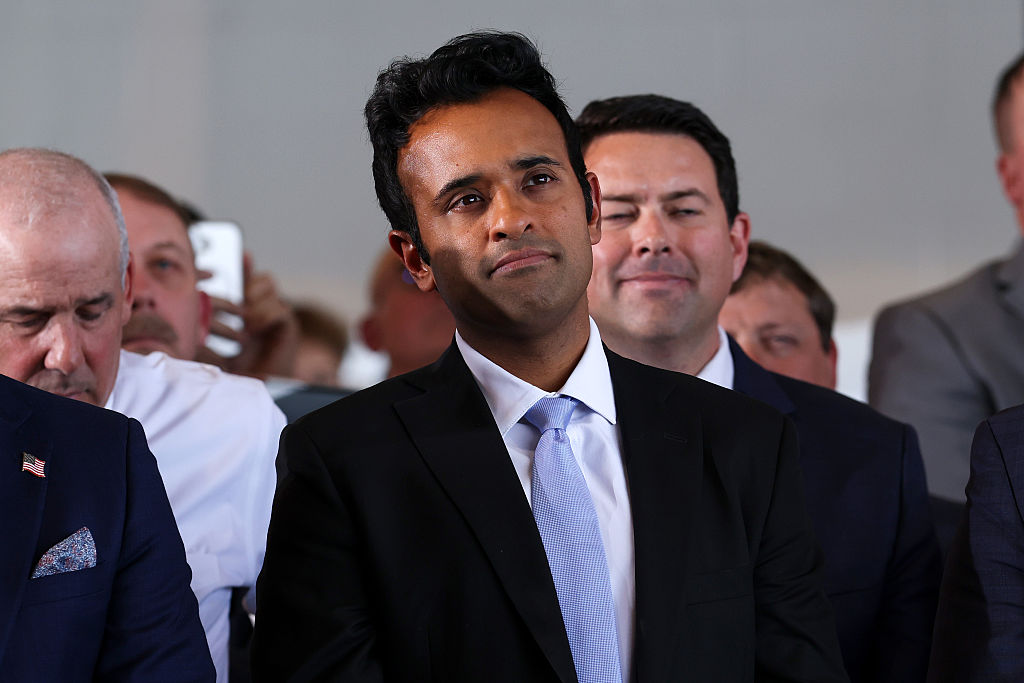
On the day Vivek Ramaswamy made official his run for Ohio Governor, President Donald Trump did not dally.
“He will be a GREAT Governor of Ohio, will never let you down, and has my COMPLETE AND TOTAL ENDORSEMENT!” the President wrote on Truth Social on Feb. 24 of last year, within hours of Ramaswamy kicking off his campaign.
Trump’s post essentially cleared what had been expected to be a crowded GOP field, boxing out the likes of state Attorney General Dave Yost, state Treasurer Robert Sprague, and Lieutenant Governor Jim Tressel in a state where Republicans felt dominant. It also effectively gave Ramaswamy almost two years to focus on keeping the Governor’s mansion in GOP hands. But the very connections to Trumpism that fueled Ramaswamy’s fast political rise are now giving his party reason to worry, as polls show him trailing Democrat Amy Acton, a former state health chief and a first-time candidate.
“Something is happening here. I just can’t tell you what,” says one Ohio Democratic strategist, reflecting the apprehension pervasive in both parties right now.
On the campaign trail, Ramaswamy occasionally moderates his image as the brash MAGA warrior railing against “the woke left,” pitching tax cuts and economic development when he’s with suburban crowds and chamber of commerce types. But he can still come off at times as a pugilistic troll. He has promised to be "the most conservative Governor in Ohio's history,” defying Ohio’s history of moderate conservatives who have governed the Heartland homebase. He has embraced AI data centers in a state where they are far from popular. And he has not shrunk from Trumpian hardline immigration policies, especially when he appears with Trump.
"As Americans, we believe in merit, that the best person gets the job, regardless of their skin color, that you are judged not on the color of your skin, but on the content of your character and your contributions,” Ramaswamy said during an Oct. 12 rally with Trump in Youngstown, where Acton grew up. “That is who we are as Americans."
Ramaswamy has not developed a thicker skin than when he ran for the White House just two years ago. In July, when confronted by hecklers at Xavier University in Cincinnati, he simply walked off stage: “Peace out, see you guys.”
The polls still show a close-range contest, but in the increasingly nasty ad war, the spending suggests a far more lopsided fight. Ramaswamy and his supporters have now run $101 million in ads against Acton, with $36 million of that coming from Ramaswamy himself.
Acton and groups supporting her have spent about one-third of the Ramaswamy media wave, much of it describing Ramaswamy as a “swindler” who conned his way to a fortune and harnessing anti-billionaire sentiment.
“This is a guy who has been flying around the state on his corporate jet. Ohio is not a huge state geographically. It’s a state that’s incredibly driveable,” says David Cohen, the director of the Applied Politics Program at the University of Akron. “He was the worst possible choice for Republicans, not that they really had a choice.”
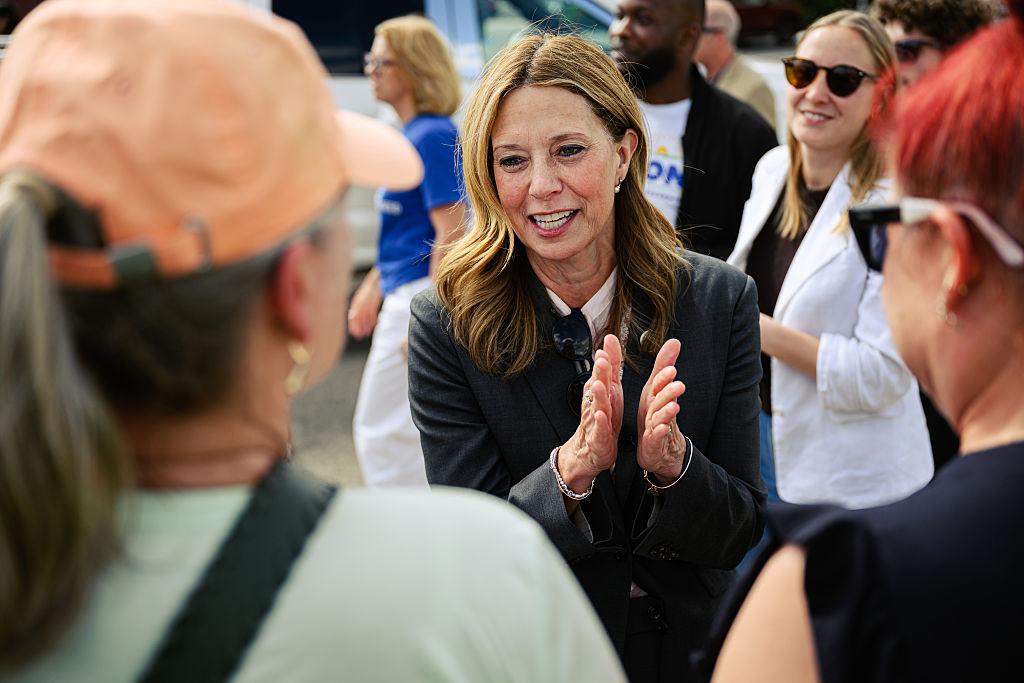
A loss for Ramaswamy would be a stunning reversal of fortunes for Ohio Republicans. Once seen as a quintessential swing state, Trump won Ohio during all three of his presidential bids with margins between eight and 11 points.
If Democrats can show a rebound in Ohio, the state may actually wind up back on the must-visit list for 2028 contenders from both parties. After all, states like Georgia and Arizona were also once solidly red until break-out candidates—backed by party spending—upended those assumptions.
“Calm down,” says a consultant who has worked with Ohio candidates in past cycles, when asked about Democrats’ optimism. “It’s still Ohio.”
For a while there two years ago, Ramaswamy seemed like the most obvious heir to Trumpism. When he launched his presidential bid in 2025, he couched it in effusive praise for the then-former President, to the point that he sometimes sounded like a Trump surrogate in the GOP debates that Trump refused to attend.
After a weak showing in Iowa, Ramaswamy ended his campaign and quickly folded into the broader MAGA-verse. He was chosen by Trump to help Elon Musk upend the federal government at the Department of Government Efficiency, before dropping out of that partnership.
But the talent for going viral that helped Ramaswamy gain a national profile has proved less successful this election cycle in Ohio. Social media videos of him hitting tennis balls and baseballs while listing his policy proposals have provided a font of online mockery. He hastily left Ohio State’s season opener after being booed and heckled. Later, he faced criticism for having worn a knock-off Ohio State jersey to the game.
Ramaswamy has also struggled to navigate his identity as a Hindu and the son of immigrants from India in the modern GOP. In the gubernatorial primary, auto entrepreneur Casey Putsch ignored Trump’s endorsement of Ramaswamy and vied for the nomination, pitching himself as an “America First” alternative to Ramaswamy. In one YouTube spot, Putsch hoisted a rifle and challenged Ramaswamy to a game of “cowboys and Indians.”
While Ramaswamy easily won his party’s nomination, almost one-in-five votes in the primary were for Putsch, a hint that Ramaswamy’s appeal had its limits even within his own party. “One of the storylines here is a man who is Indian American and whose religion is Hindu,” says Christopher Devine, a political science professor at the University of Dayton, says. “There are a lot of members of the Republican base who may have difficulty voting someone of his demographic profile.”
Amid efforts by both campaigns to push policy ideas like tax cuts and education reform, the ad war has boiled down to attacks portraying Ramaswamy as a conman and Acton as a drunk. The latter is based on an August 2019 incident in which police responded to an incident in Acton’s home that Acton has accused Ramaswamy of dramatically mischaracterizing, to the point that she refused to share a debate stage with him. Ramaswamy has also refuted allegations his fortune came from misleading investors.
Devine says the tone of the attacks is a shift from the Senate race, where former Democratic Sen. Sherrod Brown and current Republican Sen. Jon Husted both have extensive records for each side to focus on. “In the Governor’s race, there’s no record to pick apart. Without much of a track record in politics to run on, they’re focusing on personal attacks against the other,” Devine says.
As polling consistently shows an advantage for Acton, Republicans are increasingly arguing that the polls may be wrong by just enough to give Ramaswamy the win. One proof point is 2018, when some polls showed Brown winning re-election by double digits. By the time votes were cast, Brown won by less than seven points
Republicans, heading into a make-or-break stretch of voting, are repeating those statistics to make the case that the polling once again is under-counting Republican voters.
Cohen, the political science professor, doesn’t share that view of skewed polling: “I’m not skeptical at all. All of the polls are trending in the right direction for Acton.”
Democrats, for their part, are viewing the race as a tie, at best. Among their reasons for concern is Ohio’s poor track record when women are on the ballot. The state’s voters have never elected a woman as Governor and rejected both Hillary Clinton and Kamala Harris as presidential contenders.
Yet given the strong headwinds against Republicans’ national brand, they can’t hide their bullishness toward the races for Governor and Senate, where polls show Brown up over Husted. “I haven’t felt this good, like we have a chance, in a while,” says a second Ohio Democratic strategist. But, he adds, given how tight both races may be, no one should expect an early race call once the polls close.