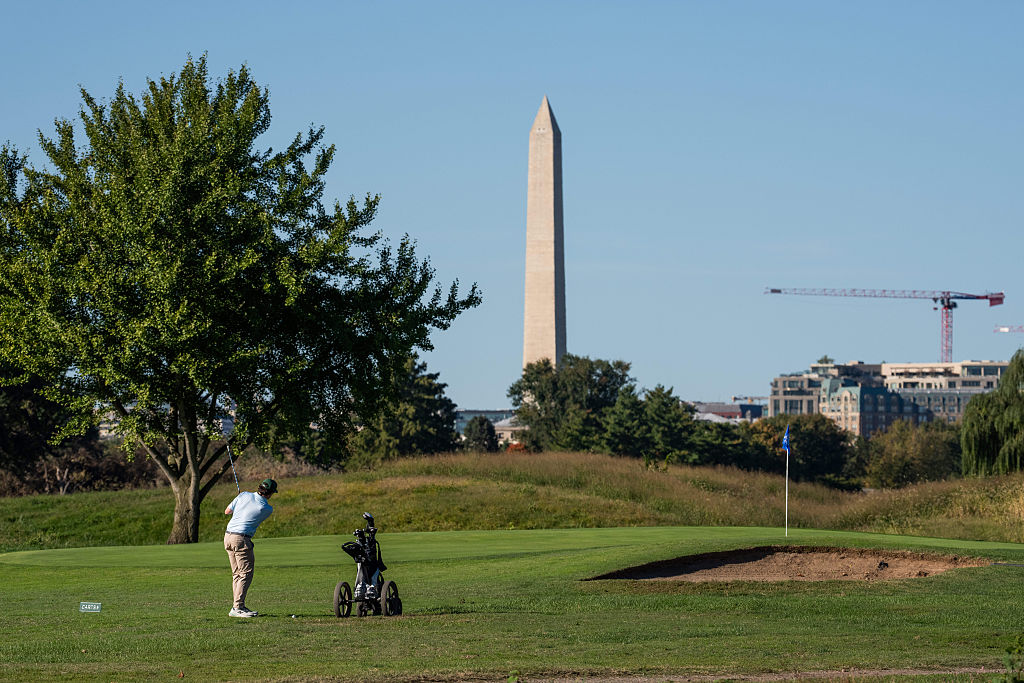
The legal battle over the Trump Administration’s plans to redevelop a golf course in Washington, D.C., escalated Monday after President Donald Trump said the Department of the Interior’s work would start “immediately”—despite a court order to temporarily halt tree removal.
“The United States Department of Interior wants to take a terrible and very unsafe golf course, and make it into a great, safe, and prestigious golf course. They have an absolute right to do so,” Trump wrote in a Truth Social post Monday morning.
Read More: All the Things Trump Has Put His Name and Face on as President
He went on to attack Judge Ana Reyes, who is overseeing the case in the U.S. District Court for the District of Columbia, saying that she is a “crazed lunatic” and “may be insane.”
About 430 trees had been cleared from the site as of Oct. 13. Reyes said that additional removals must halt while the case, filed by the DC Preservation League and two golfers earlier this year in hopes of stopping the renovation, underwent further review. The suspension is in place through Oct. 26.
On Sunday, Trump announced a plan to close the “old, broken, dilapidated” golf course and said that work would begin Nov. 15. He claimed that a new golf course would open in approximately 15 months.
The golf course redevelopment is the latest project that Trump has taken on during his second term as he looks to leave his stamp on the nation’s capital. But the precedent of past legal disputes and rising tension between the President and Reyes leave some experts wondering if this project will advance.
The Trump Administration filed a motion on Oct. 16 looking to disqualify Reyes, accusing her of “conduct [that] continues a pattern of animus against the Trump administration.”
Associate Attorney General Stanley Woodward Jr. accused Reyes of having “repeatedly belittled and shouted at” a Justice Department lawyer during a heated hearing on Oct. 12 in which Reyes sought to understand who had instructed employees to begin the tree removal process despite her earlier demands for advance notice of significant changes at the site.
Reyes refused to recuse herself, writing in a 13-page opinion filed Sunday that it’s “easy to weaponize selective quotations to bring a baseless recusal motion.”
“But it is much harder to meet the demanding legal standard against a full record,” she continued.
On Monday, Reyes grilled Trump Administration officials about the government’s plans. She accused officials of failure to communicate with the court amid ongoing proceedings and said they were acting in “bad faith.”
The Administration, however, claimed the removal had nothing to do with renovating the golf course; it pointed to a 2019 Cultural Landscape Report calling for the removal of dead and hazardous trees in the park.
“There is no universe in which all of this just coincidentally happened at the same time,” she told the lawyers on Monday according to The New York Times. “There just isn’t.”
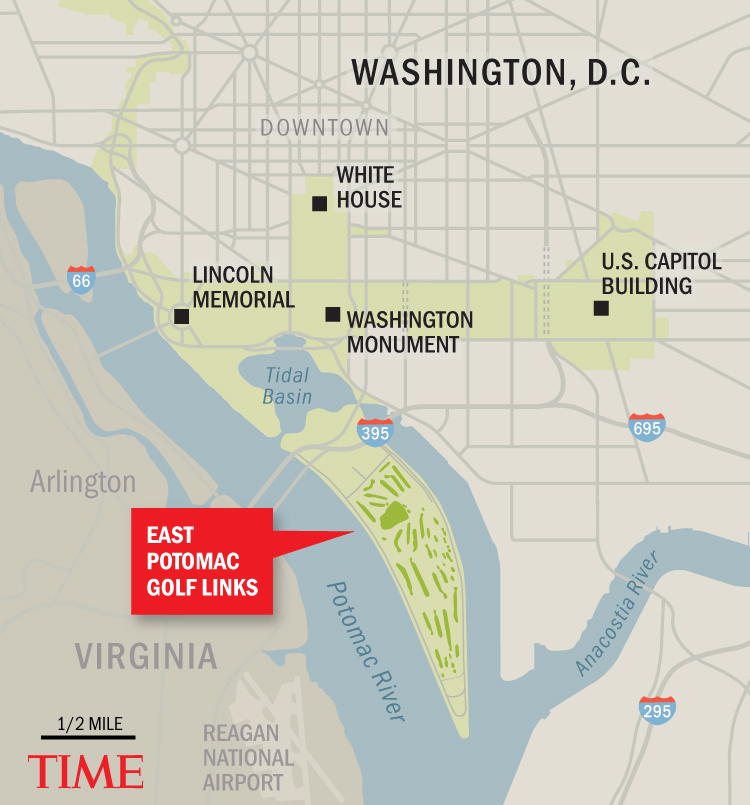
The legal battle began on Feb. 13, when the DC Preservation League and two local golfers sued the Administration over its redevelopment plans for East Potomac Park. They alleged that the government had dumped potentially hazardous debris at the site and begun pursuing the overhaul without legally required reviews of its environmental impact and effects on the park’s historic character.
The golf course is 106 years old, and its miniature golf course, which opened later in 1931, is one of the oldest continually operating miniature golf courses in the United States. It is currently open to guests of all income levels, and some golfers have rebuked Trump’s plans to turn the site into a luxury golf course.
“The finished product will be World Class, and bring income and great prestige back to D.C.,” Trump said in his Truth Social post on Monday, repeating sentiments he has shared since the renovation plan was announced.
In May, Democracy Forward, a legal advocacy nonprofit representing the plaintiffs challenging the plan, filed an emergency motion asking Reyes to block the Administration from beginning work while the lawsuit was pending.
At the time, Reyes declined to issue a temporary restraining order on the project, since the golf course remained open and the government had not announced any closures. She told the government’s lawyers that she was giving them the “benefit of the doubt that we’re not gonna be in a situation where we have bulldozers bulldozing down trees and no one has alerted me first.”
The Trump Administration felled over 400 trees at the East Potomac Golf Links on Oct. 10.
Marissa Piropato, an attorney for the government, said it had given notice in a court filing shortly before 5 p.m. on Oct. 9.
Reyes called the Trump Administration’s actions “inexcusable.”
“What has happened has cost the government all of its credibility,” Reyes said at the Oct. 12 hearing according to NBC News.
David Super, a professor at Georgetown Law, tells TIME that Reyes had done the Trump Administration a “favor” by not issuing a temporary restraining order in May.
“Out of respect for the Executive Branch, because the Justice Department told her that no action was planned imminently, she only ordered them to give enough notice for her to decide the legal questions before they did irreplaceable damage,” Super says.
He adds: “I suspect judges in future cases will just enter injunctions, rather than trusting the Administration to keep their word.”
The golf course renovation is the latest Trump Administration project to land in court.
According to The New York Times, Trump has undertaken at least 18 renovation projects in the city with the potential to cost over $1.2 billion. That includes plans for a ballroom at the former site of the White House East Wing, restoring and renaming the Kennedy Center, and constructing a towering Triumphal Arch.
The Administration has invoked national security in defending other projects. In the case involving the Triumphal Arch, it said that construction came at the “request” of the U.S. military “for National Security purposes.” The Administration similarly argued that the ballroom at the White House will be part of a military complex that is “vital” to national security.
Peter Byrne, a property and land use expert and a professor at the Georgetown Law Center, tells TIME that he would not rule out the possibility of repeating that strategy with the golf course.
“I'm sure the golf course will be important for national security in some way,” Byrne predicts. He says that judges are reluctant to dismiss outright claims of national security, so it has become a catchall for projects seeking latitude in the courts.
Trump has already said the golf course is “dangerous”—implying that it requires immediate intervention for safety purposes.
In a June Truth Social post, Trump described the course as “dilapidated, worn out, and very dangerous and outdated.” Then, in his Monday morning post, he reiterated that it was a “very unsafe golf course.”
Plaintiffs in the case have expressed concern that the planned renovation will introduce more issues than it would solve.
To bring a case like this in federal court, plaintiffs must show that the proposed renovation has harmed them or poses an imminent threat of concrete harm. They must also show that a favorable court ruling would likely remedy that harm—despite Trump’s claims that they have “ZERO STANDING.”
“In this case, you have all kinds of people who are suffering direct harm in the golf course case, you have golfers, you have bikers, you know, you have people who use the park and won’t be able to use it,” Byrne says.
Those alleged harms could help distinguish the golf course case from the challenge to the White House ballroom. In August, the Supreme Court allowed construction to continue, finding that the preservation group likely lacked the right to sue based solely on its objections to the ballroom’s appearance.
After Trump’s announcement on Sunday, Democracy Forward said the course is a “national park and golf course for everyone to enjoy.”
“Our litigation is intended to protect this community jewel for the people and communities it serves,” the statement continued, “and we will continue to work with our plaintiffs to defend it from unlawful and harmful intrusion.”