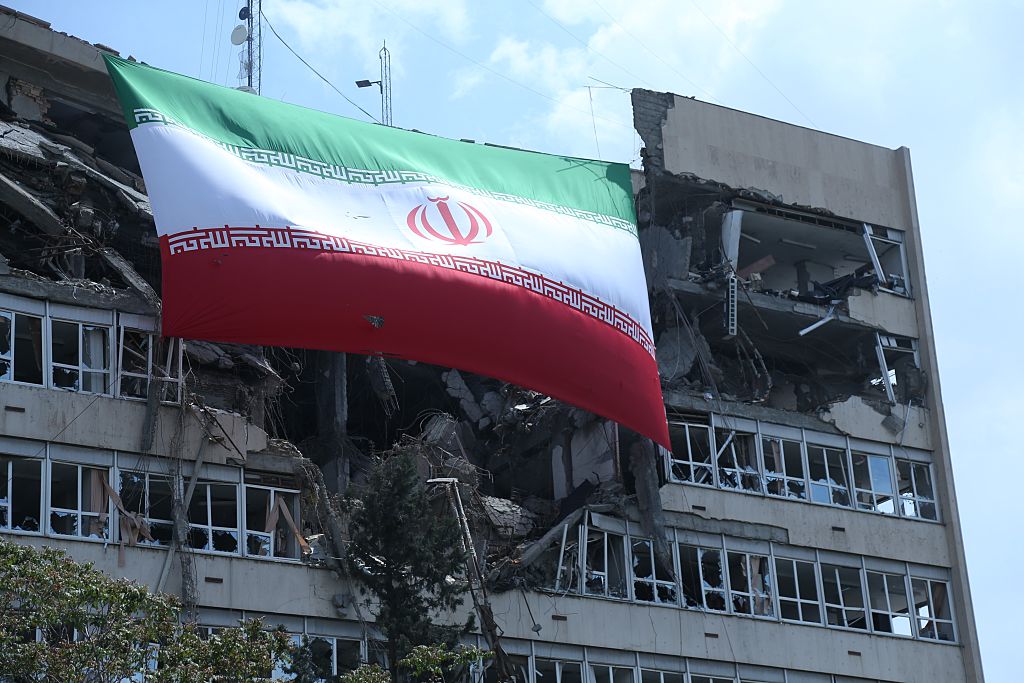
The U.S. and Israel are reportedly developing plans for major strikes on Iran after the U.S. midterm elections in November.
Citing people familiar with the deliberations, the New York Times reported on Wednesday that Defense Secretary Pete Hegseth discussed the possibility of renewed strikes on Iran with Israeli Prime Minister Benjamin Netanyahu in Israel this week. Possible targets of the strikes reportedly include Iran’s energy infrastructure, nuclear facilities, and missile and drone arsenal. TIME has reached out to the White House for comment.
U.S. officials have repeatedly asserted that the Iranian Islamic Revolutionary Guard Corps are teetering on the edge of collapse but are deliberately prolonging the war in an effort to meddle with Republican prospects in the midterm elections. Once the elections are over, President Donald Trump promised last month, the Iranian regime would quickly capitulate.
“I think the war is going to end immediately after the election,” Trump said. “They can’t hold out any longer.”
Renewed strikes could complicate that outlook.
Some officials have reportedly argued that resuming attacks for an intense but limited campaign would hasten Iran’s economic collapse, especially as the country has been squeezed by an ongoing U.S. blockade on Iranian ports and economic sanctions campaign. The officials hope the blow will make Iran more amenable to negotiations.
Trump has at times shared that view.
Last week, Trump told Newsmax he was considering additional military action in Iran, including a possible strike on Iran’s Pickaxe Mountain, a nuclear facility deep underground. His comments came amid reports that he was weighing deploying a 22,000 GBU-43/B Massive Ordnance Air Blast bomb, also known as the “mother of all bombs.”
The President added the war would end soon, be it through negotiation or escalation.
“Do I annihilate the Islamic Republic and do it quickly, never giving them a chance to kill and destroy people and countries again? Do I drive them into hell with no chance of survival and no hope of future greatness or generations?” he said in a speech to the United Nations General Assembly last month.
“But I believe we’ll make a deal,” he added, “right after the election.”
Intensified fighting between the Iran-aligned Houthi rebels and the Saudi and Yemeni governments has threatened to create a broader regional crisis that could be harder to disengage from. The State Department on Wednesday ordered nonemergency government employees and their families to leave Saudi Arabia amid escalating attacks by the Houthis on Saudi infrastructure.
Houthi attacks on Saudi airports and Aramco facilities, as well as their attempts to disrupt shipping through Bab El-Mandeb, which has become an important alternative to the Strait of Hormuz for energy trade, could prompt direct U.S. strikes in support of Saudi Arabia, analysts have said. Trump said earlier this month that the U.S. “may” join Saudi strikes on the Houthis, although that has yet to transpire.
Israel’s Oct. 27 election could also raise the stakes of additional military action. Netanyahu, whom Trump has endorsed, would remain in office until a new government is formed, even if his bloc loses the election, and his government would retain the authority to order strikes during that transition. But renewed strikes before the election, or after an electoral defeat, could invite scrutiny. “One ordered in the last weeks of a deadlocked campaign would be judged in Israel as politics as well as strategy,” Gregg Roman, executive director of the Middle East Forum, wrote in a September analysis.
Nevertheless, the forum assessed that a large-scale Israeli strike on Iranian territory, with or without U.S. participation, was probable before the end of the year. Analysts told the Times Netanyahu could use the prospect of joint strikes to form a unity government that could allow him to stay in power.
“The larger constraint,” Roman argued, “is Washington.”
Trump has not yet approved the proposed strikes, the Times reported.
Trump has also called off plans to renew attacks on Iran before. He reportedly blocked an Israeli plan for a multi-day offensive against Iran earlier this month, and rejected five proposals for major operations against Iran or the Houthis in recent months.
The U.S. and Iran have not exchanged major fighting in recent weeks. The last reported U.S. strikes on Iran were on Sept. 8, even as Iranian attacks on commercial shipping have continued. Earlier this month, Trump ruled out attacking Iran before the midterms.
Read More: What Is the Status of the U.S.-Iran Peace Talks? Here's What Both Sides Are Saying
Tehran’s reluctance to make concessions to the U.S. appears to have strengthened, rather than weakened, over the course of the war. Iranian leaders reiterated this week that they will not directly negotiate with the U.S. unless Washington accedes to certain demands, which include ending its naval blockade and releasing frozen Iranian funds.
The initial U.S. and Israeli bombing campaign on Iran that began the war on Feb. 28, as well as June 2025 attacks during an earlier round of U.S.-Iran nuclear diplomacy, also hardened the Iranian view that the U.S. is not serious about negotiating. Iranian Foreign Minister Abbas Araghchi said in March that the previous disruptions of negotiating rounds had increased distrust in Washington.
Last month, the IRGC published an open letter appealing to American voters to “wrest control” from their government. In the letter, the IRGC said: “Despite all the hardships that our enemies impose on us, we will continue fighting, as we have done for the past 47 years.”
Both the U.S. and Iran appear to believe they hold enough leverage to achieve their goals, and those “dueling perceptions” have impeded progress towards a deal, according to an Oct. 1 analysis by the New York-based nonpartisan research organization The Soufan Center.
Iran’s key point of leverage is its blockade of the Strait of Hormuz, a narrow waterway vital to global energy trade. Iran’s militarization of the strait has disrupted global oil and liquefied natural gas supplies, leading to soaring energy prices and inflation.
Analysts previously told TIME that the higher prices are politically costly for Trump. In recent weeks, a growing number of Republicans have broken with Trump on Iran. The President has also seen his lowest approval ratings of his second term.
Iran’s ability to choke off regional oil exports, however, appears to be waning. Middle East oil exports topped prewar levels last week as shipping companies use alternative routes to bypass the Strait of Hormuz. HSBC Group Chief Executive Georges Elhedery also projected that Hormuz could be “redundant” in five years thanks to investment in alternative logistics routes.
Iranian officials told the Times that they are aware of the U.S. and Israel’s war planning and are developing their own tactics.
Earlier this week, IRGC spokesperson Hossein Mohebbi told the Tehran Times that “even a limited” attack from Washington would provoke a “serious energy crisis” for the world. Iranian Foreign Ministry spokesperson Esmail Baghaei said that an attack on Pickaxe Mountain would be met with a response “just as hard,” if not “stronger.”
And earlier this month, Iranian officials said Iran had prepared potential retaliatory operations that would depart from the U.S. and Israel’s assumptions. Security Chief Mohsen Rezaei told Press TV that Iran could respond to renewed attacks by targeting new targets, including U.S.-linked data centers and AI facilities in the Gulf, as well as subsea communications cables. Last month, Iran threatened to retaliate against any further U.S. attacks by targeting U.S. oil and gas assets in the Gulf.
Read More: ‘One of the World’s Most Critical Digital Bottlenecks’: How the Iran War Could Threaten Global Internet Access
In a post on Telegram on Sunday, Mahdi Mohammadi, a senior adviser to Iran’s negotiator Gen. Mohammad Bagher Ghalibaf, said, if the U.S. and Israel attack, “they may want to keep it short, but we will not allow it.”
He added on Wednesday: “The war will continue longer and across a wider geography than the enemy calculates.”