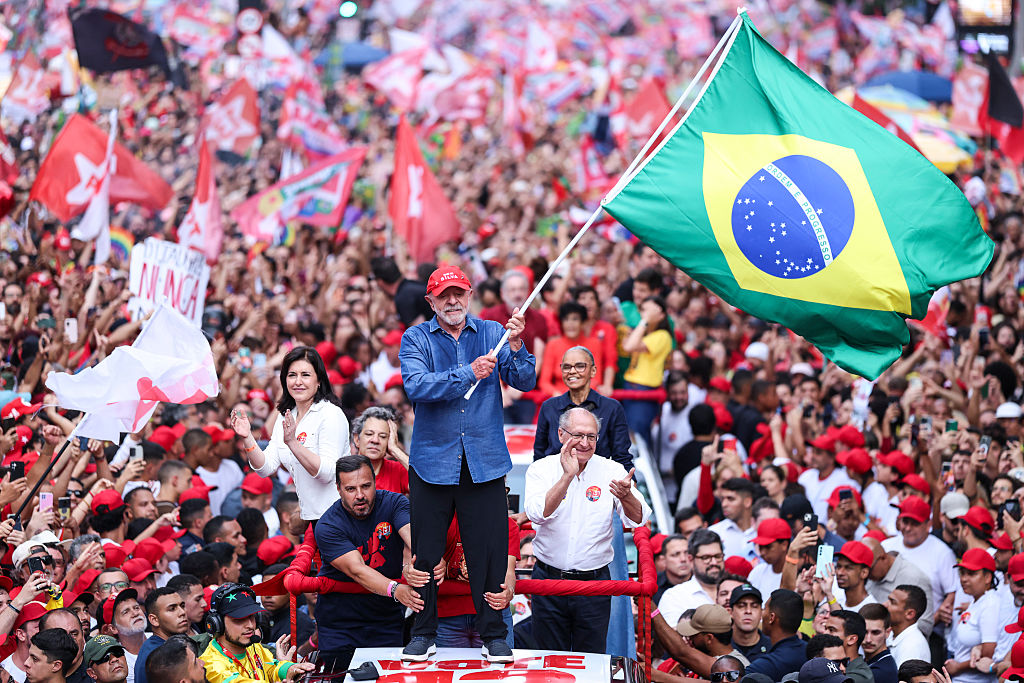
Luiz Inácio Lula da Silva has been re-elected to a historic fourth term as Brazil’s President after a tight race with far-right opponent, Flávio Bolsonaro, the son of former President and Donald Trump ally Jair Bolsonaro.
Lula won with 51.8% of the vote to Bolsonaro’s 48.2%, Brazil’s Superior Electoral Court announced. Sunday’s vote was a rematch after neither reached an outright majority in the first round on Oct. 4. Lula had trailed then, becoming now the first presidential candidate since Brazil’s return to democracy in 1985 to finish second in the initial vote and win the run-off.
The election also marks a remarkable win for the global left, as it bucks a trend of right-wing electoral victories across Latin America. Lula will serve for another four-year term beginning on Jan. 5, 2027.
“I want to thank the generosity of the Brazilian youth who took to the streets, who went to the streets to defend democracy,” Lula said in his victory speech on Sunday night. “I want to thank the elderly. I saw scenes today of people being carried by their grandchildren to vote, people unable to move around, people with cancer and other illnesses. And people went to vote because we managed to convince them that voting was very important to ensure democracy in the country.”
“This election was a defeat for denialism, a defeat for lies,” he continued.
Bolsonaro, however, said late on Sunday that he would not concede defeat to Lula and would seek an annulment of the result. The senator for Rio de Janeiro said a ruling by the Supreme Court to extend voting for two hours, citing public transport issues, was “unacceptable.”
Nevertheless, several liberal leaders around the world have already lauded the result.
“Long live democracy, the people of Brazil won,” Mexican President Claudia Sheinbaum said.
Canadian Prime Minister Mark Carney posted, “The relationship between Canada and Brazil has flourished under our partnership. Let’s seize this opportunity to make it even stronger, together — to create major new trade opportunities, protect the environment, and build greater prosperity for both our peoples.”
Several U.S. lawmakers have also congratulated Lula on the result, including Vermont Senator Bernie Sanders, Rep. Ro Khanna (D, Calif.), California Gov. Gavin Newsom, and New York City Mayor Zohran Mamdani.
A former metalworker and union leader, Lula co-founded the Workers’ Party in 1980 and continues to serve as its honorary president. He served as Brazil’s President between 2003 to 2011, before he was jailed from 2018 to 2019 on corruption convictions that were later annulled. He went on to defeat incumbent President Jair Bolsonaro in 2022, winning his third presidential term.
Lula’s campaign focused on labor reform, welfare benefits, and affordability. At a time when public debt as a share of GDP has risen to its highest level since the pandemic, Lula cited his achievements in lowering poverty rates, as well as reducing unemployment, illiteracy, and deforestation to record lows. He pledged to make public transit free on the weekends, a program that would need congressional approval. He also increased benefits under his signature Bolsa Família program and championed a landmark constitutional amendment shortening the working week, which Congress approved.
Bolsonaro, meanwhile, campaigned on harsher criminal penalties, tougher policing, lower taxes, and cuts to government spending. His campaign highlighted a corruption investigation involving Lula’s son and a pension fraud scandal that spanned both Lula’s and Jair Bolsonaro’s administrations.
Bolsonaro also called for amnesty for his father, Jair Bolsonaro, who is serving a 27-year prison sentence under house arrest after being found guilty of plotting a coup to overturn his defeat in the 2022 election.
In his election night speech, Lula pledged to strengthen federal involvement in public security, expand education and healthcare, and develop Brazil’s technological and artificial intelligence industries.
“This country will not be built by me,” he said. “But by you.”
Lula’s win pumps the brakes on the broader political shift towards the right in Latin America. Colombia, Peru, Costa Rica, and Chile elected right-wing presidents in recent election cycles, reversing an earlier “pink tide” of left-wing governments.
Lula’s victory also denies Trump another political ally in Latin America, which include Argentinian President Javier Milei and Salvadoran President Nayib Bukele.
Bolsonaro had portrayed himself as an ally of Trump, courting closer ties with Washington and backing U.S. terrorist designations for Brazil’s major criminal gangs. Reuters reported on Saturday, citing current and former U.S. officials, that two U.S. State Department officials had pushed sanctions and other measures intended to weaken Lula and help return the Bolsonaros to power. The State Department did not comment specifically on the reported efforts but told Reuters that “all actions taken by the United States against narco-traffickers and to protect free speech are to defend the rights and lives of the American people. The Brazilian people have the right to choose their leaders through free and fair elections.”
Trump previously expressed support for Jair Bolsonaro and labelled Lula a “radical left lunatic” during Brazil’s 2022 presidential election. He also criticized the criminal prosecution of Bolsonaro, calling it a “witch hunt” and demanding it end.
Trump has not reacted to the election results as of early Monday. After Bolsonaro led in the first round on Oct. 4, Trump called the result “close, but a very, very big victory.” His son, Donald Trump Jr., posted earlier criticizing the Supreme Court’s decision to extend voting hours and what he described as the lack of American mainstream media coverage of it.
Lula had warned that Bolsonaro would surrender Brazil’s sovereignty to Trump.
Lula has publicly sparred with Trump on multiple occasions. He accused the Trump Administration of interfering in Brazil’s election and imposing punitive tariffs on Brazil under alleged pressure from the Bolsonaros. The Bolsonaro family and the U.S. State Department denied the allegations.
At the same time, Lula has pursued closer ties with China, Brazil’s largest trading partner and the U.S.’s geopolitical rival, although he rejected subordination and said Brazil was not choosing between the two countries.
“This country will not accept being anyone’s backyard,” Lula said on Sunday night.
Analysts, however, warned that Lula’s political influence could wane despite his re-election. Earlier this month, Brazil elected its most conservative National Congress since the 1980s. Bolsonaro’s Liberal Party (PL) and allied parties could control majorities in both chambers, with more than 280 of 513 seats in the lower house and up to 50 of 81 seats in the Senate.
That could make it difficult for Lula to pass his legislative agenda, analysts said.
But Lula shrugged off those concerns and promised to work with the more conservative Congress to govern for all Brazilians.
“The day after tomorrow, the 27th, I turn 81 years old, and I want to make a commitment in front of the press and in front of you,” Lula said. “I will have the best term a President has ever had in the history of this country”