Israel appears to be on the brink of a political deadlock, with neither Prime Minister Benjamin Netanyahu nor his main rival, former Israel Defense Forces chief of staff Gadi Eisenkot, projected to gain a parliamentary majority.
While partial results show that Netanyahu's Likud party has edged ahead slightly, if the embattled leader is to forge a path for another term, he will likely need to secure a coalition. Such alliances can take weeks or months to form, meaning the future leadership of Israel’s parliament, the Knesset, remains unclear.
As of Wednesday evening in Israel, authorities had counted more than 88% of ballots cast at polling stations across the country. Another set of ballots logged at special polling sites, including military bases, have yet to be counted. Authorities estimate that somewhere between 430,000 and 480,000 votes were cast in this way. As such, it could still take another day or two for the final election results to be released.
Israel's three leading broadcasters have projected that Netanyahu's bloc of right-wing parties is on course to win 53 seats in parliament, with the opposition bloc of Eisenkot looking at 48. Both are short of the 61 seats required for a majority. Parties representing Arab Israelis are projected to secure 19 seats.
Once all the votes have been tallied, Netanyahu looks set to remain as caretaker while President Isaac Herzog holds consultations with all the political factions to determine the formation of the next government—a process that could take weeks.
"Next week, I will invite the representatives of the factions to consultations ahead of assigning the mandate to form the next government," Herzog said on Wednesday. "With the publication of the results, I ask one important thing from everyone who arrives—arrive with an open mind."
Both Netanyahu and Eisenkot have stated their own intentions to form the next coalition.
In a defiant speech made after the polls closed, Netanyahu called for a "strong, right-wing" government."
Eisenkot, in a social media update late Wednesday, said: "Long workdays still await us, but we are focused on the heavy task entrusted to us—bringing change to Israel and establishing a Zionist mobilization government."
While results remain inconclusive, Netanyahu’s longstanding ally, U.S. President Donald Trump, who gave a last-minute endorsement to the longest-serving Israeli premier, already appeared to take credit for Netanyahu’s election performance.
“You know, it's pretty close, which was very well,” Trump said when asked about it by reporters early Wednesday. “Because I think when the endorsement went out, it helped him a lot, but I actually heard he did pretty well. It might be winning or tie. The tie is sort of considered a win in that case because it’s a big chess match.”
As the vote count continues, here’s what to know about the pivotal election—and what comes next.
Israelis flocked to polling stations on Tuesday to decide Netanyahu’s political fate. The election was widely seen as a referendum on Netanyahu’s leadership and Israelis’ willingness to change course amid uncertainty.
It was the first election in the country since the Oct. 7, 2023 terrorist attacks by Palestinian militant group Hamas and the subsequent Israeli war in the Gaza Strip. Since then, Israel under Netanyahu has pursued an aggressive military campaign across the Middle East—going to war with Iran, backing settler attacks and displacement in the West Bank, and carrying out strikes against militant groups in Lebanon and Yemen
From 7 a.m. to 10 p.m. local time on Tuesday (1 a.m. to 4 p.m. EDT), Israelis were able to cast votes for representatives in the Knesset. Numbers from Israel's Central Elections Committee reflected a strong turnout, with 77.7% of eligible voters reported to have cast their ballots by 10 p.m., local time—the highest turnout logged since 1999.
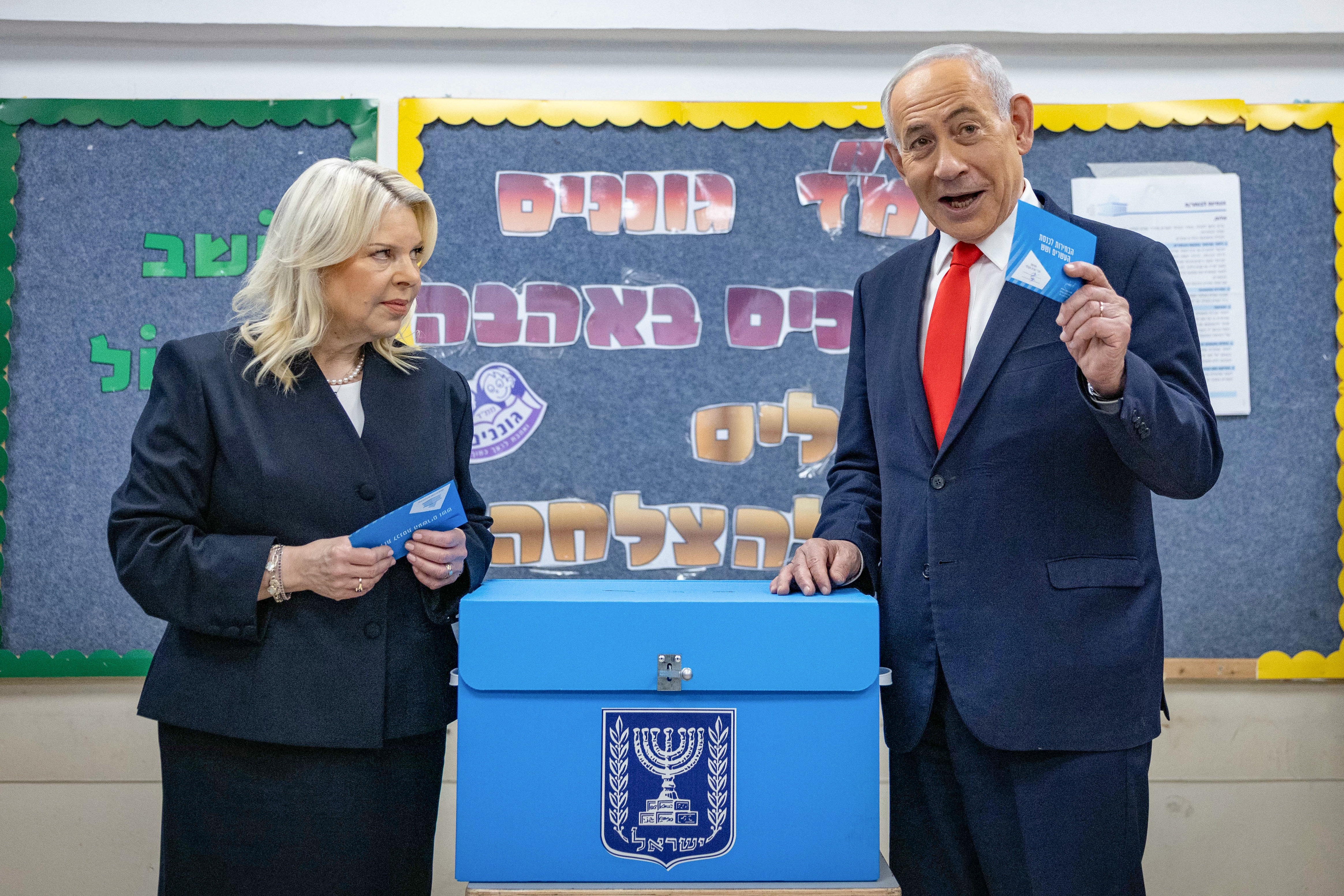
Netanyahu was joined by his wife Sara as he cast his own ballot at a polling station in a Jerusalem school. “This is a very moving and fateful moment. My wife and I are truly overwhelmed,” Netanyahu told reporters after voting. “We know what is at stake, and since I am not allowed to say things explicitly, I will say: Vote correctly.”
Not long after, Netanyahu told his supporters that "buses are heading to the polling stations and huge lines are being reported in the Arab settlements." Complaining that "the right-wing strongholds are not waking up," he again urged people to go out and vote.
Netanyahu’s Likud party said in a statement that it had submitted a request to the Central Elections Committee to extend voting hours past 10 p.m. The committee later announced it would not be extending voting hours past the scheduled closing time.
Read More: Israel's Choice
Two main political blocs are contending to form Israel’s next government. The first is the pro-Netanyahu coalition led by Netanyahu’s Likud party. The coalition includes far-right and ultra-Orthodox parties, such as Otzma Yehudit (Jewish Power) led by national security minister Itamar Ben-Gvir and Religious Zionism-Zehut led by finance minister Bezalel Smotrich. Their ultranationalist policies have found an audience in younger right-wing Israelis.
On the other side are the Jewish-led opposition movements—with Eisenkot and the centrist Yashar (Straight) party at the forefront. Eisenkot, who entered politics in 2022, joined Netanyahu’s emergency war cabinet after the Oct. 7 attack on Israel. But after having lost a son in combat in Israel’s wars, Eisenkot left his post in 2024. Two of his nephews also died fighting in Gaza, a prominent campaign talking point.
The opposition also includes a joint ticket led by former Prime Minister Naftali Bennett and Knesset opposition leader Yair Lapid, the secular nationalist party Yisrael Beiteinu (Israel Our Home) led by former finance minister Avigdor Lieberman, and the Democrats led by former IDF deputy chief of staff Yair Golan.
The Democrats party on Tuesday said Golan had been “approached in a threatening manner” by a man who was found to be carrying a knife. The lawmaker was attending a voting-day mobilization tour in Tel Aviv's HaMesila Park at the time of the incident.
"Golan’s security guards blocked the man, and as they moved toward him, a large knife slipped from beneath his clothing and fell to the ground," the party said in a statement shared with the Guardian. "Police were called to the scene and arrested the suspect." Golan, in his own statement, vowed that "incitement and violence will not deter us" and encouraged people to go out and vote.
Meanwhile, some polls had suggested that Eisenkot’s Yashar party may garner slightly more support than Netanyahu’s Likud, but they also projected that neither the Prime Minister’s right-wing bloc nor the opposition were likely to win the 61 Knesset seats needed to form a government.
Including Arab parties such as United Arab List (Ra’am) and the Joint List, or fringe parties, could be necessary to form a government. Both pro-Netanyahu and anti-Netanyahu coalitions have so far ruled out teaming up with the Arab-led parties. Arab citizens of Israel make up about 20% of the population, though they receive fewer government services and endure higher poverty and unemployment rates. Discrimination and disappointment have historically depressed Arab-Israeli voter turnout. However, on Tuesday, there appeared to be strong turnout in some of Israel’s largest Arab-majority towns.
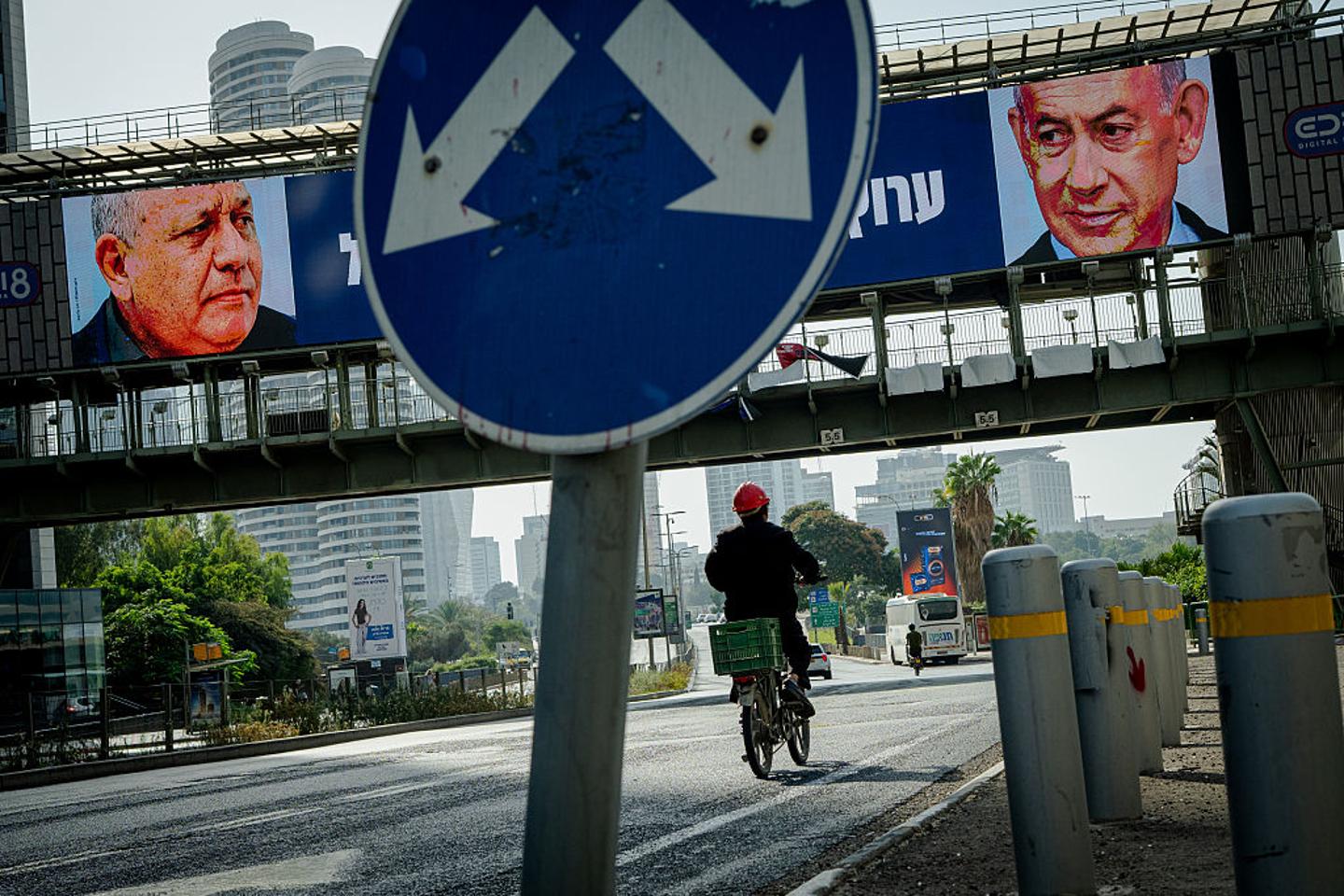
Netanyahu has brought attention to the support he received from Trump, who only announced his endorsement days before the election as conflict in the Middle East has tested their friendship.
In a late-night TV appearance on Oct. 25, Netanyahu boasted of Trump’s endorsement and said that Trump was willing to take action “that would finally, finally, remove the Iranian threat” so long as Netanyahu stayed in power. Netanyahu added that he has already instructed Israel’s national intelligence agency Mossad as well as the IDF to “bring down” the Iranian regime. Trump remains very popular in Israel.
By contrast, U.S. Vice President J.D. Vance declined to endorse Netanyahu for re-election, just a day after Trump put his “complete and total” support behind the Israeli leader.
“The President has the most effective endorsement in American, or international, political history,” said Vance, when asked in an interview if he would also be extending an endorsement of his own. “I endorse American candidates and that’s where I'm focused on, is the midterms, so I'm not getting involved in the Israeli elections.”
When pushed for an answer, Vance added: “I'm not anti-endorsing [Netanyahu], I'm not pro-endorsing him.”
At stake for Netanyahu could be more than his continued leadership. The premier faces an international arrest warrant for alleged crimes related to the Israeli military campaign in Gaza. And even domestically, critics have demanded an inquiry into Netanyahu’s decision-making around Oct. 7. The attack, which resulted in over 1,200 people in Israel killed and around 250 hostages taken, is considered by many to be indicative of a major security failure.
The Gaza health ministry reports that since Oct. 7, 2023, more than 74,000 individuals have been killed. In the absence of independent monitoring on the ground, Gaza’s health ministry is the primary source for casualty data relied upon by humanitarian groups, journalists, and international bodies. Its figures do not differentiate between civilians and combatants and cannot be independently verified by TIME.
Another issue driving the election is public fury over ultra-Orthodox communities’ exemption from military conscription for men engaged in religious studies. Despite a shortage of soldiers, less than 10% of eligible ultra-Orthodox men enlist, amid demands from Netanyahu’s allies to exempt them. Eisenkot, Netanyahu’s main rival, has promised to end the de facto exemptions.
Netanyahu’s repeated attempts to reform the judiciary have also factored into this election, with critics slamming his undermining of democratic institutions and connecting it to his legal interests. Netanyahu is in the middle of a yearslong corruption trial, which he and his allies—including Trump—have claimed is politically motivated. He sought, but didn’t receive, a presidential pardon from Herzog.
About 7.3 million Israeli citizens were eligible to vote on Tuesday. The election fills the Knesset’s 120 seats through proportional representation—which means parties, not personalities, are on these voters’ ballots.
After polling stations closed at 10 p.m. (4 p.m. EDT), local media broadcasted initial exit polls. The final vote tally is expected by Oct. 30, with official results published on Nov. 4.
But getting a clear picture of the Israeli government is likely to take longer.
No single party has ever claimed 61 seats to form a government, meaning Israel has always been governed by coalitions. What those coalitions may look like will depend on the election outcomes for smaller parties, which each need 3.25% of the votes to secure a seat in the Knesset.
Once the election winners are determined, President Herzog will refer to party leaders to choose a preferred Prime Minister and will ask the strongest candidate to form a government within 42 days. If a coalition cannot be formed after multiple attempts, the current Likud-led coalition government will continue to serve as caretaker before another round of elections is held in the coming months.