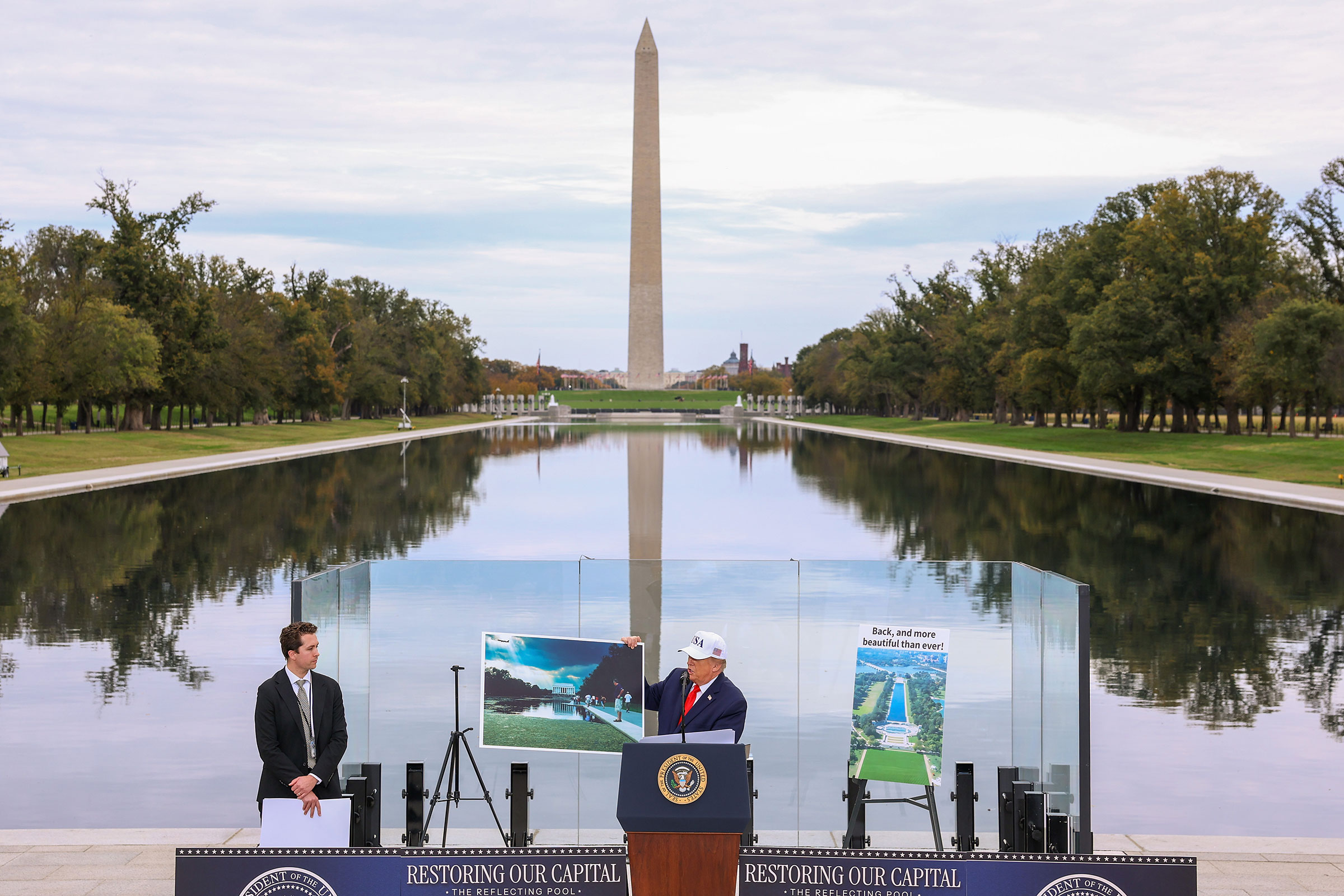
On the eve of an election that threatened to upend his presidency, Donald Trump went to the Lincoln Memorial Reflecting Pool, where he had overseen a multimillion-dollar renovation that went awry when its new coating peeled and algae turned the water green. Aides hoped the President would focus on the concerns weighing on ordinary Americans: soaring gas prices, expensive groceries, a new war in the Middle East. Instead, Trump spent much of his 53-minute speech talking about construction projects rather than the struggles of the nation he had been elected to serve.
It was a bewildering capstone to a strange campaign. Allies marveled at Trump’s inability to stay on message as he crisscrossed the country. He boasted that oil companies were making a fortune as Americans struggled with energy costs. He claimed New Yorkers were no longer allowed to call their mothers “mom,” suggested renaming New Mexico “New America,” and repeatedly mimicked a Democratic Senate candidate vomiting at the sight of meat. Time and again, he veered into bizarre digressions about men's physiques. As one Trump aide put: “It’s hard to reach voters who can’t afford gas when your candidate keeps talking about Arnold Palmer’s endowment and Jon Husted’s ass.”
The scale of the Democrats’ victory was staggering. They seized control of both the House and Senate with ease. They captured governorships and Senate seats by commanding margins in traditionally Republican states, and prevailed in House districts gerrymandered to favor the GOP. The wipeout was a clear repudiation of Trump. Across the country, the President’s handpicked candidates went down to resounding defeats, including scandal-plagued Ken Paxton in Texas and Darlene Graham, the sister of the late Senator Lindsey Graham, in South Carolina—nominees he had elevated over the objections of party leaders who believed other Republicans stood a better chance. By night's end, Trump acknowledged the opposition's victory and recognized that the war in Iran was a factor in his loss. "We actually have the greatest economy," Trump told Fox News. "But because of the gasoline prices people don't see it as much as they would have without it. And the gasoline was caused by Iran."
Trump’s confidantes often remarked that he cared little about the outcome of the midterms. He regarded his party's loss of seats in Congress as an inescapable historical pattern. He had a point: Barack Obama's Democrats took a beating in consecutive midterms, and George W. Bush's Republicans were drubbed in 2006. Trump himself oversaw the loss of dozens of House seats in 2018. Advisers tried convincing the President that he had some agency over the election’s trajectory, but “he had trouble getting past the history,” one of Trump's top advisers says. He grew resigned to the gridlocked slugfest ahead and dismissive of the investigations and potential impeachment proceedings Democrats could embark upon. “They’ll probably go after me,” he told TIME in late September, “and I’ll go after them.”
For more than a decade, Trump has commanded a degree of loyalty from Republicans unmatched in modern politics, bending lawmakers to his will and making dissent a career-ending proposition. The trouncing the GOP suffered on Nov. 3, coupled with the growing perception that Trump has become a political liability, could usher in a very different final two years for a lame-duck President, causing his grip on the GOP to finally slacken. An NBC News exit poll on Tuesday revealed that 43% of voters said they cast their votes to express disapproval of Trump.
Presidents in the final two years of their second terms often pivot toward foreign policy, where they can exercise executive power with fewer constraints from Congress or the courts. Trump was already signaling his readiness to resume military strikes against Iran. Another senior Administration official says Trump plans to concentrate even more heavily on the Western Hemisphere in the final years of his presidency, where a succession of pro-Trump heads of state have risen to power and where he and his allies see an intensifying competition with China and Iran for regional influence. “It's such an opportunity to align,” says one senior Administration official. “There'll be an expanded focus there.”
But after two years wielding executive authority freely, there will be new checks on Trump’s power. He will struggle to secure confirmation for his nominees. Aides anticipate Supreme Court battles over his expected reliance on officials serving in an acting capacity in positions that ordinarily require Senate confirmation. And yet those closest to Trump insist he will be anything but constrained. They predict him to grow more brazen, more defiant, and more determined to fight at any cost. “Don’t expect a kinder, gentler Trump,” one close ally says. “This may be the end of one chapter of Trump’s presidency, but it’s also the beginning of another. ”
With the midterms ramping up in late September, Trump's aides thought he seemed more checked out than usual. He had yet to dip significantly into the $400 million war chest of his allied super PAC. Republicans were pleading with him to pour money into one particularly desperate contest: the fight to defend Ken Paxton in ruby-red Texas. Trump eventually authorized the two men he had tapped to oversee his outside political operation, Chris LaCivita and James Blair, to begin spending heavily to preserve Republicans' chances of maintaining control of the Senate and limit their losses in the House.
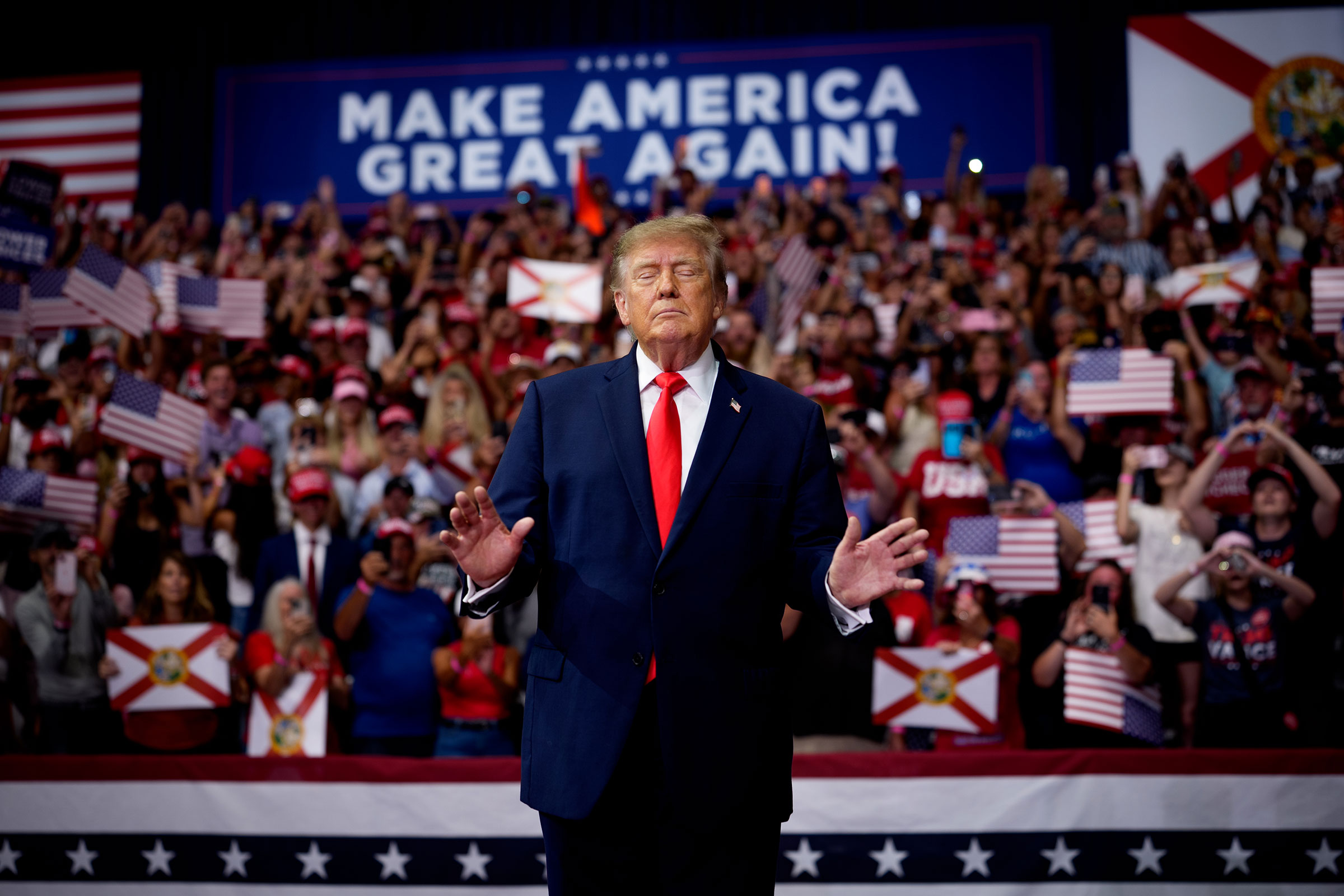
Chief of staff Susie Wiles and other advisers urged Trump to hit the campaign trail, appealing to him as a savior. He planned an ambitious campaign sprint to help Republicans stave off a midterm disaster: 32 competitive congressional districts in a single month, a rush of the trademark rallies that had powered his political rise. But even as Trump returned to the trail with renewed intensity, he repeatedly veered off message, generating the kinds of controversies his advisers hoped he would avoid. At a rally in South Carolina, he praised a supporter who appeared to punch a protester, comparing him to former heavyweight boxing champion Evander Holyfield. He even seemed to mock the unquestioning loyalty of his own supporters. “I could say the stupidest things and you’d clap me,” he told one crowd in Clarksville, Tenn.
Trump tried to recreate a strategy from his 2024 campaign, seeking to reach low-propensity voters through nonpolitical channels and the alternative media platforms that Americans were increasingly consuming. Aides enlisted professional athletes and other celebrity validators who could lend local appeal at campaign stops. They brought Baltimore Ravens players to an event in Maryland and University of Georgia football legend Todd Gurley to a rally in the Peach State. They brought the boxer Jake Paul to another in Youngstown, Ohio. They brought Nicki Minaj, the best-selling female rapper of all time, onto the campaign trail in Michigan, where Trump praised her for having “one hell of a beautiful ass” that was “hard to miss.” Later, aides mischievously floated the prospect of Minaj serving as Trump’s next White House press secretary.
Throughout the midterm cycle, Trump’s political instincts seemed increasingly out of step. He promised Americans $5,000 checks if they kept Republicans in control of Congress, drawing condemnation from ethics watchdogs who likened the offer to an attempt to buy votes. He replaced White House press secretary Karoline Leavitt with Katie Zacharia; the untested Newsmax personality who lasted just five days after a disastrous press conference and revelations that she had presented herself as a lawyer despite having passed the bar in China but not the United States. Against the advice of advisers, including Vice President J.D. Vance, Trump endorsed Israeli Prime Minister Benjamin Netanyahu for re-election, despite the Israeli leader’s unpopularity among Americans. The endorsement came only after two of Netanyahu’s staunchest American allies—U.S. Ambassador to Israel Mike Huckabee and Fox News host Mark Levin—personally urged Trump to intervene, according to a source familiar with the matter. (Huckabee and Levin did not immediately reply to requests for comment.) Trump joked about withholding disaster aid from states that failed to elect Republican senators. As often as not, his interventions compounded his political troubles. A Washington Post–Ipsos poll found that 67% of Americans believed he did not carefully consider important decisions.
The dismal performance of Republicans closely aligned with Trump, despite his personal interventions and nearly half a billion dollars in spending by Elon Musk, offered a stark measure of the backlash against his aAdministration. Voters were grappling with record-high gas prices, an unpopular war in the Middle East, and persistent economic hardship as the Administration faced scrutiny over its handling of the Epstein files and allegations that Trump and his allies had profited from their positions of power. The discontent extended beyond the cost of living. An October Fox News poll found that 60% of registered voters were extremely concerned about government corruption, surpassing even concerns about inflation and high prices.
As the returns rolled in on Tuesday night, allies at the White House knew they were witnessing the end of one period of Trump's radical, norm-shattering second presidency. But they also understood that another, potentially more perilous phase was beginning. The voters had rendered their verdict on Trump and the party that had enabled him for the past two years, delivering a resounding demand for change.
Read more: Inside the Democrats' Plans to Take On Trump
But those closest to him expected the President to grow only more ferocious and less conciliatory in the face of Democratic oversight. Advisers suggest Democrats will overplay their hand, allowing him to recast himself as the victim of political persecution rather than the architect of his own predicament. “Historically, he has always done well when he’s the target,” says one aide. “He knows better than anyone how to use that to his advantage.”
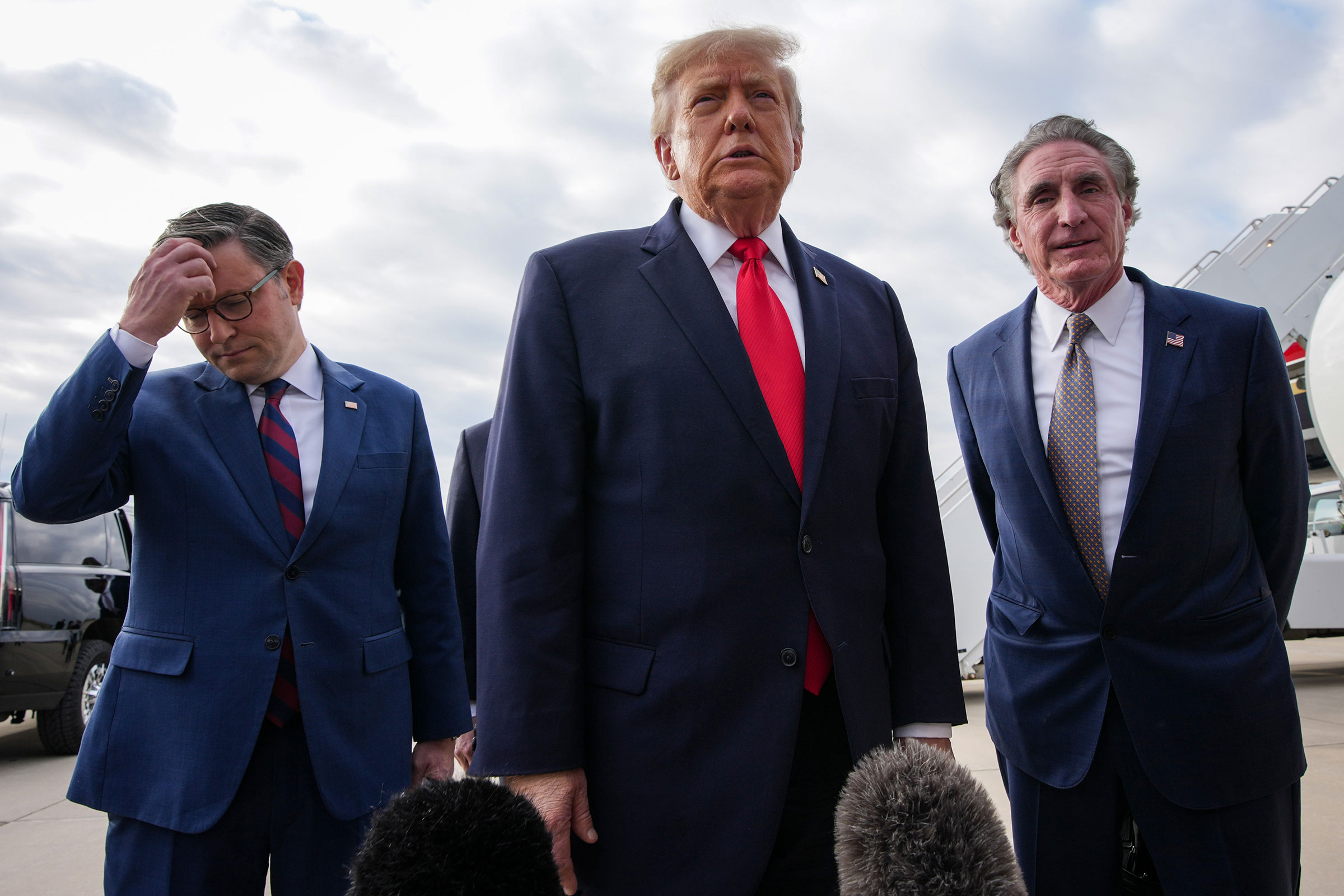
Aides are bracing for a wave of staff turnover, a combination of attrition and Trump dispensing with officials who have frustrated him. The result could be a further retreat into an insular circle of loyalists who are unable or unwilling to deliver bad news or curb his impulses. Inside the White House, advisers have been contemplating the implications of divided government. “His natural inclination is to work with Democrats or Independents or whatever,” says another senior aide. “But he’s aware of the investigations and the games the other side will play, and he’s prepared to fight back.” Already, the Democratic wave had already emboldened the party’s leaders. The expected incoming chair of the House Oversight Committee delivered a succinct warning on X: “LAWYER UP.”
But the road ahead will be unlike any Trump has traveled before. Constitutionally barred from seeking another term, the President may find that Republicans face a new political calculus as they begin contemplating a post-Trump future. As the 2028 presidential race takes shape, Vice President J.D. Vance will confront the delicate task of forging an identity independent of Trump without alienating the man whose endorsement he may still need. Those tensions could strain not only their relationship but the broader coalition Trump has spent a decade assembling—one already showing signs of fracture as once-loyal allies like Tucker Carlson and Marjorie Taylor Greene have turned against him. The question is whether the fear and loyalty that have sustained Trump's dominance of the GOP will endure as his party begins looking beyond him.