Democrats won the House and Senate, including by flipping key Senate seats in Iowa, Kansas, Maine, Ohio, North Carolina, South Carolina, and Texas.
Nevada's Attorney General Aaron Ford defeated Republican incumbent Joe Lombardo to become the state's first Black governor.
Democrat lawmakers have hinted at the legal challenges they plan to launch against Trump and his Administration as they prepare to take control of both chambers.
For the past year, a faction of the AI industry bent on unfettered development looked poised to use its wealth to tip the 2026 midterms in its favor. But on Nov. 3, that accelerationist wing could hardly have had a worse night.
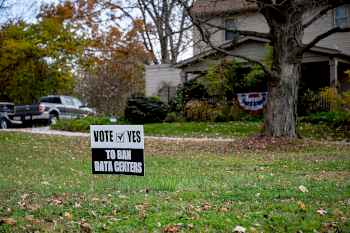
An NBC exit poll found that 56% of voters said that AI and data centers were a “crucial or major factor” in their vote for Congress. Democrats spent more than $100 million on broadcast ads casting their Republican opponents as being overly cozy with Big Tech and data centers—and decisively won in many of those races, including Ohio, Kansas, and Iowa.
Data center bans or moratoriums passed in counties across the country, from Edgewater, Fla., to Bloomington, Ill., while the mayors of Piqua, Ohio and Yukon, Oklahoma were recalled for their previous support of data center projects.
Data center and accelerationist super PACs failed to make a major dent in influencing elections through spending. One of the key candidates they spent money on, Darline Graham, lost to Annie Andrews, who nicknamed Graham “Data Center Darline” and called for a two-year moratorium on new projects. The accelerationists' ineffectiveness opened a pathway for “pro-safety” PACs to outspend them in key races. Several candidates backed by those groups, including Michigan’s Abdul El-Sayed and Colorado’s Manny Rutinel, won.
The election served as the stunning capstone in a year of mounting anti-AI populism.
Read the full story here. —Harry Booth
James Talarico's stunning victory in the Texas Senate race was one of the biggest midterm accomplishments for Democrats, marking a significant shift in a state that has not elected a Democratic Senator since 1988.
Speaking on the TODAY show Wednesday morning, Talarico said his win was a clear “message to this corrupt political system” that Texans “are ready for change.”
He went on to frame his victory in the Lone Star State as a call for voters to come together across party lines.
“The real fight in this country is not left versus right; it's top versus bottom, because all of us are getting screwed,” he said. “Last night, the people of Texas sent a crystal clear message that they want change and they expect change.”
Looking ahead, Talarico, who defeated Trump-backed Republican Ken Paxton, also vowed to hold the executive branch to task.
“We have to establish checks and balances. We have to hold the executive branch accountable,” he said.
Opening the door for collaboration, Talarico emphasized his willingness to “work with President [Donald] Trump to deliver for working people across Texas and across this country.” —Tiago Ventura
After the expected blue wave turned into more of a tsunami, Republican leaders are reflecting on the results, and making vows for the future, as they prepare for the reality of losing control over both chambers of Congress.
Senate Majority Leader Thune touted what he views to be successful hallmarks of President Donald Trump’s first two years, citing border security and tax hike prevention’s.
Looking ahead to the next two years, Thune insisted that Republicans “will not stand idly by as the far-left, socialist wing of the Democrat Party attempts to unwind everything we’ve done” Hailing Trump’s presence in the White House, he said the party will work with the President “to stop the worst impulses of Democrat extremism,” arguing that “we cannot let their fringe positions become the mainstream.”
House Speaker Mike Johnson was equally defiant in his response to the Democrats’ overwhelming gains. He admitted he was “disappointed” by the results, but vowed to battle on against what he called an “insurgent socialist movement.”
“I’m not going to exaggerate when I tell you that there’s not a single American, not a single American family anywhere, that’s going to be made better off if Democrats turn Congress into a circus,” Johnson said in the early hours. “If they make the next two years about retribution and lawfare and partisan games, every American will suffer by that. And I tell you what we will do. We will put a firewall of House Republicans standing in their way to ensure that doesn’t happen,” he said.
Despite the significant setback, Johnson expressed hope for the future of Republicans in the House.
“We will continue pressing forward with our agenda of common sense and our vision to make America great again. And come 2028, we will take back the House, and we will finish this job,” he vowed.
Johnson will likely be handing over his gavel to Hakeem Jeffries, the current House Minority Leader, who heralded the election gains for his party as “not a blue moment,” but rather “a red, white, and blue moment.”
With their newly-acquired majority, Democrats are prepping to take control of the House committees. This will give them a new subpoena power and the ability to conduct oversight investigations of Trump’s Administration, family and business ventures, immigration enforcement, and more.
California Rep. Robert Garcia, who is set to become the next chair of the Oversight Committee of the House of Representatives, shared a two-word warning for Republicans as the results came in Tuesday night. “Lawyer up,” he said.
The Oversight Committee’s primary function is to hold the federal government to account. It will serve as the core body for lawmakers to mount legal challenges against the Trump Administration.
Garcia previously said that, if Democrats were to win, he would lead investigations into the Trump family’s business dealings, the conduct of Immigration and Customs Enforcement (ICE), and the Jeffrey Epstein scandal. He also vowed to look into Elon Musk’s former role in the “Department of Government Efficiency (DOGE).”
Elsewhere, the X account belonging to Democrats on the House Homeland Security Committee told Department of Homeland Security (DHS) Secretary Markwayne Mullin to “clear” his calendar.
Homeland Security operations under the Trump Administration have come under fierce condemnation by Democrats, who have raised the alarm over fatal shootings carried out by federal agents in Trump’s second term.
The Trump Administration is also set to face challenges within the Senate now that Democrats have retaken the chamber. Sen. Rob Wyden of Oregon, a ranking member of the Senate Finance Committee, hinted at future investigations when he shared a one-word statement overnight, simply saying: “Subpoenas." —Callum Sutherland
The Democrats’ sweeping victories in the midterm elections are being viewed by some European leaders as a rebuke of President Donald Trump and his Administration’s policies.
“American society voted against the policies that only impoverish. Against hate. Against machismo. Against climate denialism and against the privileges of the elites,” said Spanish Prime Minister Pedro Sánchez, who has previously clashed with Trump.
Others viewed the Democrats’ reclaiming of both chambers of Congress as an opportunity to improve U.S.-Europe relations, which have faltered significantly since Trump returned to office, with divides over the Iran war, NATO spending, and tariffs proving especially damaging.
Christel Schaldemose, vice president of the European Parliament, said she was “cautiously optimistic on Europe's behalf, not because everything now changes for the better, but because it could benefit the support for Ukraine, the green transition, and relations with the rest of the world.”
Norwegian Prime Minister Jonas Gahr Støre viewed the results as “a powerful political signal about a change of course among American voters.” In a statement to Reuters, he said that “voices are now emerging in American politics that are closer to us than the President and the Administration have stood for,” citing environmental matters and foreign policy as two such examples.
Outside of Europe, Iranian Parliament Speaker Mohammad Bagher Ghalibaf argued that the results were a reflection of Americans’ rebuke of war. “Conscience or the cost of living, Americans said NO TO WAR, and we endorse this message,” he said.
The Iran war, which started on Feb. 28 when the U.S. and Israel launched strikes against Iranian targets, is currently in its ninth month and remains deeply unpopular with Americans, who have had to shoulder soaring diesel prices and other financial ramifications as a direct result of the conflict. —Tiago Ventura
On an Election Day when national Democrats had monumental momentum, the results in Texas were a breed apart and could redefine the path to the White House in 2028.
Both James Talarico and Gina Hinojosa broke the Republican Party’s hold in deep-red Texas. But the losses didn’t stop there. When all the ballots are counted, Texas Republicans may be on the receiving end of something approaching a wipeout. It’s a stunning turn that proves in one fell swoop that years of Democrats’ optimism in someday flipping Texas were not foolhardy. Even Texas Republicans gifted last-minute gerrymandered districts in U.S. House races were not immune to the national mood.
For Democrats, it was a dividend long invested. Year after year, Democrats kept insisting that this would be the cycle that would break the Republican fever in the state. And year after year, they woke up the day after Election Day feeling like Charlie Brown trying to kick Lucy’s football.
Still, Democrats have long insisted that Texas is not a state of Republican voters. It’s a state of non-voters. Tuesday’s results finally proved that thesis.
The shift could have seismic consequences for the 2028 presidential map. Texas has 40 votes in the Electoral College, or roughly 15% of the haul needed to win the White House. If Democrats can sustain their success in Texas, that suddenly means other traditional swing states could prove optional. And both parties may find themselves having to invest heavily in the massive and pricey state to pin down Texas’ electoral votes every four years.
Read the full story here. —Philip Elliott
Nevada’s Attorney General Aaron Ford, a Democrat, has won the hotly-contested race for governor, defeating Republican incumbent Joe Lombardo to become the state’s first Black governor, the AP called.
With Nevada set to play a pivotal role in the next presidential election, Ford's win is a significant boost for the Democrats.
As the campaign race heated up over the summer, Ford's team criticized Lombardo after police body camera footage showed him dropping his own name during a traffic stop in Las Vegas and avoiding a ticket.
On the eve of the midterm election, Ford honed in on his criticism of Lombardo, linking him to the affordability crisis concerning many Americans.
"Joe Lombardo and Donald Trump have been working together to raise your gas, groceries, housing, and health care costs," he argued, advising people to "vote like your wallet depends on it." —Olivia-Anne Cleary
Several election-winners on Tuesday have broken historic identity barriers for the U.S.
New Hampshire Democrat Chris Pappas will be the first openly gay male Senator. Michigan Democrat Abdul El-Sayed will be the first Muslim U.S. Senator. Minnesota Democrat Peggy Flanagan will be the first Native American female Senator. Georgia Democrat Keisha Lance Bottoms will be the first Black female governor. New Mexico Democrat Deb Haaland will be the first Native American female governor. And Rep. Hakeem Jeffries, after Democrats won control of both chambers of Congress, could become the first Black Speaker of the House.
Read the full story here. — Chad de Guzman
Dr. Abdul El-Sayed, a progressive Democrat with a background in public health, has defeated Republican former Rep. Mike Rogers in Michigan’s open Senate race on Tuesday, according to the Associated Press, making him the first Muslim elected to the United States Senate.
The election of El-Sayed, 42, the son of Egyptian immigrants who was born and raised in suburban Detroit, represents a milestone in American politics and a potentially consequential shift within the Democratic Party. An outspoken critic of Israel who has championed an ambitious progressive agenda, he joins a growing contingent of left-wing Democrats who have prevailed in elections this year.
Read the full story here. — Nik Popli
"Guess my election-interfering space lasers didn’t work this time," Elon Musk, the world's richest man, posted on his platform X early Wednesday.
The on-and-off ally of President Donald Trump poured a tremendous amount of money into the Republican effort to retain their congressional majorities: The New York Times previously reported that Musk contributed some $474 million into the midterms, making him the single largest disclosed donor in modern American politics.
In a separate post, Musk, who is the CEO and part-owner of companies Tesla and SpaceX, wrote: "Data centers in space looking pretty appealing right now." Democrats, who will take control of both chambers of Congress, have made the AI boom and data centers a key campaign issue. — Chad de Guzman
The AP has called the House majority for Democrats, having already called the Senate majority for the same party. Moments earlier, President Trump congratulated Democrats on their Election Day success in a phone interview with Fox News, but he went on to say that he didn't think the blue wave was a rebuke of his presidency.
"They did a good job. They’ve been looking for this one for 11 years, and they finally got it," Trump said about Democrats. "But I don’t view it as a hit on me. I think we’ve done ... We’ve had the greatest two years in the history of the presidency.”
This year's midterm election has been described by many politicians and political experts as a referendum on the Trump Administration. About a month before Election Day, Trump's approval rating fell to a historic low of 30%, according to the Pew Research Center. — Chantelle Lee
Democrat Brian Poindexter has defeated two-term incumbent Republican Rep. Max Miller, whose campaign was roiled by domestic violence allegations from his ex-wife and former White House Press Secretary Stephanie Grisham, whom he worked and shared a romantic relationship with during Trump's first term. Miller has denied all wrongdoing.
Both Ohio Senators, including Miller's former father-in-law, urged Miller to exit the race. The House Ethics Committee announced in August it was actively reviewing allegations against Miller.
Poindexter, a union worker and local councilman, appealed to working-class voters and centered his campaign around lowering the minimum age to qualify for Medicare, regulating data centers, and limiting funding for the war in Iran. — Connor Greene
Republican Sen. Susan Collins, who has represented Maine in the U.S. Senate for nearly three decades, lost her re-election bid to her Democratic challenger Troy Jackson, the AP has called—the latest stunning result in a midterm election that has become a blue wave.
AP reported that Collins conceded the race to Jackson before the news outlet had officially called it. Jackson, a logger and former president of the Maine Senate, posted a victory statement on social media early Wednesday morning, before the race was officially called by AP.
"Maine, I owe you everything," he said. "I’m ready to get to work for Mainers in the U.S. Senate, and I promise you this: I’ll never forget where I came from or who I’m fighting for. Thank you. Let’s go build a government that works for all of us."
A victory by Jackson would not just be remarkable because he's unseating a five-term Senator but also because he entered the race relatively late, after Graham Platner, who won the Democratic primary, withdrew from the race in July amid allegations of sexual assault, which he denied. — Chantelle Lee
Read the full story of Jackson's victory here.
All polls in the U.S. have closed. Polls in Alaska and Hawaii were the last to close, at 1 a.m. and midnight EST, respectively. — Connor Greene
The President railed against Democrats' victories in the midterms on Tuesday evening in a series of Truth Social posts.
Shortly before midnight, Trump posted a photo of a red hat reminiscent of the ones often worn by MAGA supporters and by the President himself—but this one had the word "Veto" printed on it. The image appears to be a threat that the President will use his veto power against the House and the Senate, the latter of which AP called for Democrats on Tuesday evening. AP has not yet called control of the House, but other news outlets have projected that Democrats will win the majority in the lower chamber as well.
In another social media post, Trump levied an attack against Texas Gov. Greg Abbott, who lost his re-election bid to Democratic candidate Gina Hinojosa on Tuesday evening—a stunning result in a state that has not elected a Democrat governor since 1990.
Trump had endorsed Abbott in the race. But after Abbott's loss on Tuesday, the President accused the Texas governor of being a "RINO," which stands for "Republican In Name Only."
"If Greg Abbott, the Governor of Texas, hadn’t become a RINO in the last six months of his Political Life, he wouldn’t have lost," Trump said in a Truth Social post. "He went back to his original formula, and it wasn’t pretty!"
A few minutes later, the President posted again, saying, "I’m going to become a Political Pundit, both good and bad, on the reasons these Candidates won and lost!" — Chantelle Lee
AP called the Senate for Democrats shortly before midnight, in a stunning rebuke of the Trump Administration and the Republican Party.
As of Tuesday evening, AP has called 51 seats in the upper chamber for Democrats and 39 for Republicans. AP has yet to call 10 races for the upper chamber. The news outlet hasn’t yet called the House majority for Democrats, but others, including CNN, have projected that Democrats will win control of the lower chamber. Democrats capturing both chambers of Congress would mark only the fifth time since World War II that a political party was able to flip both the Senate and the House in a midterm election. — Chantelle Lee
Read the full story here.
House Democrats are rejoicing over their election victories, including projections from CNN and NBC that they have regained control of the chamber. The AP has not yet called the majority.
In Minority Leader Hakeem Jeffries’ election-night headquarters just south of the Capitol, a crowd of roughly 100 people erupted in cheers when CNN announced the projection. Supporters broke into chants of “Jeffries! Jeffries! Jeffries!”
Rep. Suzan DelBene of Washington state, who chairs the Democratic Congressional Campaign Committee, said in the headquarters: “The American people have spoken decisively all across the country. They have had enough of the broken promises from house Republicans, and they are ready for new leadership in Congress, and they're going to get it.” — Chad de Guzman with reporting contributed by Nik Popli
Democratic state representative Josh Turek has been elected as U.S. Senator for Iowa, the AP called, beating Republican Rep. Ashley Hinson to take the seat to be vacated by GOP Sen. Joni Ernst, who is retiring after two terms.
Turek, a paralympian gold medalist, is the first Democrat Iowa has sent to the Senate since Tom Harkin was re-elected in 2008. — Chad de Guzman
House Minority Leader Hakeem Jeffries hailed a "great American comeback" in Washington, D.C., on Tuesday night after several outlets projected that Democrats had won back the lower chamber.
"America is back...I learned very early on that a setback was nothing more than a setup for a comeback. Today begins the great American comeback," he said. "This is not a partisan moment. This is a patriotic one. This is not a blue moment or a red moment. It's a red, white, and blue moment because America has won tonight." — Connor Greene
For the first time since 1932, voters in Kansas have elected a Democrat to the U.S. Senate.
Democrat Adam Hamilton, a United Methodist pastor, has won the Senate race, AP called on Tuesday evening, defeating the Republican incumbent Sen. Roger Marshall. Marshall, who had been seeking a second term, had been backed by the President. He is among several GOP Senate candidates, including Sen. Darline Graham, who received Trump's endorsement in this midterm cycle—but were still toppled by their Democratic opponents on Tuesday evening.
Read the full story here. — Chantelle Lee
Texas Governor Greg Abbott has been defeated by Democratic gubernatorial candidate Gina Hinojosa, the AP has called.
Abbott’s stunning defeat marks the end of a long streak of Republican governorship since 1995, including George W. Bush who governed Texas from 1995 to 2000 before becoming President.
Abbott, who has been governor of Texas for three terms, previously spent more than two decades in the Texas judicial system. In 1995, then-Governor Bush appointed Abbott to the Texas Supreme Court. He was then re-elected twice in the late 90s. In 2014, he ran for Texas governor and won by more than 20 points against state senator Wendy Davis. — Philip Wang
John Cornyn, the outgoing Republican senior Senator for Texas, congratulated Democratic candidate James Talarico, the state representative who defeated GOP nominee Ken Paxton for Cornyn’s seat.
“The voters have spoken, and I want to extend my congratulations to James Talarico on his election to the U.S. Senate,” Cornyn posted on X, before the AP had called the race, though it did less than an hour later. “I look forward to meeting him and offering my assistance with his transition as he prepares to serve Texans in the U.S. Senate.”
Talarico is the first Democrat to win a statewide race in Texas since 1994 and is also the first Democrat to be elected Senator by Texans since 1988. — Chad de Guzman
Read the full story here.
The President told the New York Times on Election Night that he will accept the results of the midterms.
"I am absolutely willing to accept those results," he told the news outlet. "We’ll work with the Democrats, and we’ll, you know, look forward to working with them. We’ll probably work something out." — Chantelle Lee
Polls in California, Idaho, Oregon, and Washington have closed, leaving only those outside of the contiguous U.S. in Alaska and Hawaii.
California’s 22nd district, a toss up race between incumbent Republican Rep. David Valadao and Democrat Randy Villegas, presents a pick-up opportunity for Democrats. The state’s 48 district is also leaning towards Democrats flipping an open Republican-held seat.
Oregon’s gubernatorial race, where Tina Kotek seeks reelection, is also a competitive race, and leans Democratic. — Connor Greene
Democratic candidate Dr. Amy Acton will be Ohio’s next governor, the AP called, defeating the Trump-backed Republican Vivek Ramaswamy in a heated race.
The race entered the national spotlight in the lead-up to Election Day after Ramaswamy’s campaign released a controversial attack ad against Acton that featured her estranged mother. While the President and Vice President defended Ramaswamy amid backlash generated by the ad, other members of the Republican Party slammed the campaign for the move.
Acton’s win is a stunning result in a state that has not elected a Democrat to the governor’s residence in 20 years.
Read the full story here. — Chantelle Lee
The President seemed to express his frustration with the results coming in on Election Night.
"I wasn't on the Ballot and if I was, we would have won IN A LANDSLIDE!" he said in a Truth Social post.
The midterms have largely been viewed as a referendum on Trump’s presidency, which faces record-low approval ratings. — Chantelle Lee
In South Carolina, Democratic Dr. Annie Andrews will defeat Republican Sen. Darline Graham for a seat in the U.S. Senate race, the AP has called—a stunning upset in a staunchly red state that has not elected a Democrat to the upper chamber this century.
The race for the seat, was upended after longtime Sen. Lindsey Graham died unexpectedly in July. His sister, Darline Graham, was appointed by the South Carolina governor to finish out the rest of her brother's term. At the urging of the President, Darline Graham later announced her intention to run for a full term in the midterms.
But polls leading up to Election Day showed that the race was a much closer fight than it was before Lindsey Graham's death, when he was running for re-election. Andrews, a pediatrician, received widespread support from the Democratic party and even secured bipartisan endorsements, while Darline Graham faced criticisms from within her own party over her minimal political background.
Read the full story here. — Chantelle Lee
Voters in Virginia passed an amendment to the state’s constitution that creates multiple protections for reproductive health.
The amendment constitutionally protects abortions taking place during the first two trimesters of pregnancy and provides protections for pregnant women’s health later in their pregnancies, among other rights regarding fertility health.
“Every individual has the fundamental right to reproductive freedom,” the amendment says, including decisions related to “prenatal care, childbirth, postpartum care, contraception, abortion care, miscarriage management, and fertility care.”
Two other abortion rights protection measures are on the ballots in Idaho and Nevada, while another measure in Missouri would repeal abortion rights protections voted for in 2024. — Connor Greene
Polls have closed in Montana, Nevada, and Utah, with some but not yet all in Idaho and Oregon.
Montana and Nevada are home to closely watched House races. Republican Aaron Flint is facing off against Democrat Sam Forstag in Montana’s first district, where Democrats have a chance to flip a seat being vacated by Republican Ryan Zinke in a race deemed a toss up. In Nevada’s second district, Republican David Flippo and Democrat Teresa Benitez-Thompson are competing for retiring Republican Rep. Mark Amodei’s position in a race favoring Republicans.
Also in Nevada, Republican Gov. Joe Lombardo faces Democratic Attorney General Aaron Ford in a toss up. Lombardo had come under fire during his campaign after video showed him using his name in a traffic stop before being let go without a ticket. — Connor Greene
New polls conducted in all 50 states show that the Democratic Party is expanding its lead among young voters and Latino voters.
The polls, conducted by SSRS in partnership with a consortium of media outlets, show a sharp Democratic shift among young voters: 71% of those ages 18 to 29 identify as Democrats, compared with 25% as Republicans. In 2024, Democrats led Republicans among that age group by 54% to 43%.
Latino voters have also shifted toward Democrats, with 60% identifying as Democrats and 35% as Republicans. That 25-point advantage is up from a five-point lead in 2024, when the split was 51% to 46%.
The poll surveyed more than 100,000 at voting locations, online, and by telephone. — Philip Wang
Democrat Keisha Lance Bottoms has won the Georgia gubernatorial race, beating Republican billionaire Rick Jackson to replace the term-limited GOP Gov. Brian Kemp.
The Associated Press called the race at 9:24 p.m. ET. Bottoms’ victory also flips the state, marking the first time Georgia has had a Democratic governor since 2003.
A former mayor of Atlanta and a former Biden Administration official, Bottoms’ election makes her the state’s first Black and first female governor, as well as the U.S.’s first Black female governor. — Chad de Guzman
The latest polls have now closed in Arizona, Colorado, Iowa, Kansas, Louisiana, Michigan, Minnesota, Nebraska, New Mexico, New York, North Dakota, South Dakota, Texas, Wisconsin, and Wyoming.
Iowa marks another key Senate race to replace outgoing Republican Sen. Joni Ernst. In one of the tightest races this midterm cycle, Republican Rep. Ashley Hinson, a former broadcast journalist, is facing off against Democratic state Rep. Josh Turek, a paralympic gold medalist.
Trump won Iowa by 13 points in 2024, but the race is considered a toss up.
Other key Senate races are taking place in Nebraska, which leans Republican, and in Minnesota, which leans Democratic. — Connor Greene
Incumbent Republican Sen. Ashley Moody has defeated democratic socialist state Rep. Angie Nixon in Florida’s special Senate election.
The Associated Press called the race for Moody, who entered the Senate last year after being appointed by Gov. Ron DeSantis to replace Secretary of State Marco Rubio when he left the position to join the Trump Administration in Washington.
Moody was forecasted to win by the Cook Political Report, which categorized the race as “likely Republican.”
Nixon had called for Moody to be arrested during the campaign over accusations that she mishandled taxpayer funds as the state’s attorney general. Moody has denied wrongdoing. — Connor Green
Two Florida Democrats have won in House districts that were recently redrawn in Republicans’ favor, The Associated Press has called.
Rep. Kathy Castor has won more than 51% of the vote, with 97% of votes counted by Tuesday evening, AP reported, successfully securing an 11th term in Florida’s 14th District. Republican Mike Beltran, who was previously a state legislator and attorney, has earned less than 46% of the vote.
Rep. Jared Moskowitz has won more than 51% of the vote in Florida’s 25th District, defeating his Republican opponent Scott Singer, a previous mayor of Boca Raton who earned less than 47% of the vote, AP reported, with 96% of the vote counted. Moskowitz currently represents the 23rd Congressional District in the House. — Chantelle Lee
Democrat Roy Cooper has flipped a key Senate seat in North Carolina, defeating Republican Michael Whatley to claim the open seat being vacated by Republican Sen. Thom Tillis.
Cooper's win marks a key pick up for his party in its fight to wrest back control of the upper chamber from Republicans.
Cooper, a former governor and state attorney general, will succeed Tillis, who decided not to seek reelection.
The Associated Press called the race just after 8:20 p.m. EST. — Connor Greene
Polls have closed in Arkansas, with more—but not yet all—also now closed in Kansas, Michigan, North Dakota, South Dakota, and Texas.
In Arkansas, a solid red state, Republicans are favored in every congressional and gubernatorial race. The Cook Political Report ranks all races across the Senate and House, as well as the contest for Governor, as “solid Republican,” among the seats it deems least likely to flip, with the exception of one ranked as “likely Republican” in the state’s second district. — Connor Greene
Four-term Rep. Chris Pappas has become the first openly gay man to be elected in to the U.S. Senate after defeating former Sen. John Sununu in New Hampshire.
The Associated Press called the race for Pappas, whose opponent is a well-known name in the state. Sununu’s brother served as governor until last year and his father was also governor.
New Hampshire marked another possible opportunity for Republicans to pick up an open seat, that of long-time Democratic Sen. Jeanne Shaheen. — Connor Greene
Most polls on the East Coast have closed. Throughout the day, there have been sporadic reports of technical difficulties, but the Election Day vote has been running smoothly by and large.
Secretary of Homeland Security Markwayne Mullin told reporters on Tuesday that ICE has not been deployed to the polls today. Earlier in the day, ICE posted on X that it would “track down” any illegal voting.
Election officials in Fulton County, Georgia, said that more than 1,000 ballots cast in Fulton County may need to be rescanned as a result of two ballot scanners malfunctioning. Secretary of State Brad Raffensperger said that the scanner issues would not delay election results.
Polls will close at 9 p.m. as scheduled in Westchester County, New York, where a technical failure has led to polling stations across the county to switch to emergency ballots. The tabulation will be delayed because of this failure, which will affect a close-fought House race. — Philip Wang
Democratic Sen. Jon Ossoff has won reelection in Georgia against Republican Rep. Mike Collins, in another victory for Democrats in their effort to win back control the upper chamber.
The Associated Press called the race less than an hour after polls closed in the state on Tuesday.
Georgia marked a potential opportunity for Republicans to pick up a Senate seat in a state that Trump won by a slim margin in 2024. Ossoff consistently led in polling leading up to Election Day, however, and also had a serious cash advantage over his opponent throughout the campaign. — Connor Greene
Polls have closed in several more pivotal battleground races, including in Maine, Kansas, Texas, Michigan, New Hampshire, Pennsylvania, and more.
In perhaps the most closely watched midterm contest, James Talarico, who is vying to become Texas’ first Democratic Senator since 1993, is facing off against Republican Attorney General Ken Paxton in a toss-up race.
Another tight race in the state’s fifteenth district is testing the GOP’s support among Hispanic voters, with whom Trump made gains in the 2024 presidential election. Republican Monica De La Cruz, who flipped the district in 2022, is seeking to keep her seat against Democrat Bobby Pulido, a popular Latin Grammy-winning Tejano musician.
Other toss-up races are playing out in Kansas, where incumbent Sen. Roger Marshall is defending his seat against Democrat Adam Hamilton, and Maine, where Republican Sen. Susan Collins is seeking her sixth term. Collin’s opponent, Democrat Troy Jackson, became the party’s nominee after Graham Platner, who won the primary, dropped out of the race amid sexual assault allegations, which he has denied.
Michigan’s Senate race is also closely watched, with the Cook Political Report rating it as “lean Democratic” in favor of progressive Abdul El-Sayed, who is facing off against Republican Mike Rogers.
In Michigan’s seventh district, meanwhile, Republican Rep. Tom Barrett is facing off against progressive William Lawrence in a toss-up race that ranks as one of the most expensive House races in the country.
Another toss-up is taking place in Pennsylvania’s first district, where incumbent Republican Rep. Brian Fitzpatrick is going head-to-head with Democrat Bob Harvie. — Connor Greene
Democratic Virginia Sen. Mark Warner has been reelected to a fourth term, defeating Republican challenger Bert Mizusawa.
The AP called the race for Warner, whose seat was considered among the safest in the country this midterm cycle, just minutes after polls closed in Virginia at 7 p.m. EST. It marked the first call of the night in the closely watched battle for control of the Senate.
Votes are now being counted in multiple states with more tightly contested Senate races where polls have closed, including Georgia, North Carolina, Ohio, and South Carolina. — Annika Neklason
Polls have closed in Ohio and West Virginia. Most polls have also closed in North Carolina, where some precincts received an extension due to minor technical issues at certain localities.
Ohio and North Carolina are home to a handful of closely watched Senate and House races.
In an Ohio toss-up, former Democratic Sen. Sherrod Brown is seeking to unseat Republican Sen. Jon Husted, who was appointed by Republican Gov. Mike DeWine to replace Vice President JD Vance when Vance went to the White House in 2025. North Carolina is now ranked “likely Democrat” by the Cook Political Report in what was considered a much more competitive race before Republicans pulled out to focus on other contests.
In Ohio’s seventh district, meanwhile, Democrat Brian Poindexter could have a chance to flip incumbent Republican Rep. Max Miller’s seat. The race has received outsized national attention amid domestic abuse allegations against Miller, who has denied all wrongdoing.
A House toss-up is also playing out in North Carolina’s first district, where incumbent Democratic Rep. Don Davis is being challenged by Laurie Buckhout, who he beat by only a slim margin in 2024. — Connor Greene
All polls have now closed in Georgia, Indiana, Kentucky, South Carolina, Vermont, and Virginia, while some have closed in Florida and New Hampshire. In some of those states, key races could help determine which party will control the House and the Senate.
In deep-red South Carolina, Darline Graham, the sister of late Republican Sen. Lindsey Graham, is running against Annie Andrews in a Senate race The Cook Political Report ranks as “lean Republican,” just one step removed from a toss-up. In another closely watched Senate race, incumbent Democratic Sen. Jon Ossoff is facing Republican Mike Collins in Georgia, which has been rated “likely Democratic.”
A handful of toss-up House races are also playing out in some of those states, including in Virginia and South Carolina’s first districts and Florida’s fourteenth.
In Virginia’s first district, Democrat Shannon Taylor has the chance to oust a longtime Republican incumbent, Rep. Rob Wittman. An open Republican-held seat is meanwhile up for grabs in South Carolina’s first district, which is being vacated by Rep. Nancy Mace. Republican Jenny Costa Honeycutt and Democrat Nancy Lacore are vying for the spot. And in Florida’s fourteenth district, incumbent Democrat Rep. Kathy Castor is fighting to retain her seat against Republican Mike Beltran after new electoral maps changed the district’s composition.
More polls are expected to close every half hour until 9 p.m. EST, and then every hour until 1 a.m. — Connor Greene
The FBI on Tuesday debunked a claim that it has uncovered more than 20,000 fraudulent ballots in favor of Democratic candidates at a warehouse in Houston, Texas, on Monday night.
In a statement, the FBI said no election-related operation occurred in Houston and that information is false.
The unproven claim of an raid first began to surface on Tuesday afternoon and was quickly shared among conservative online users. The post also features three photos purported to show the scene of raid. Fact-checking outlet PolitiFact reported that the three images were taken in three different states and none of them were related to a FBI raid in Houston. — Philip Wang
President Donald Trump’s approval rating reached a historic low in the weeks leading up to Election Day: According to the Pew Research Center, his approval rating dropped to 30% at the beginning of October. The last time a sitting President’s approval rating fell to a comparable level that close to a midterm election was when Harry Truman was in the Oval Office in 1946.
Surveys show that the public’s dissatisfaction with the President stems largely from the economy; about 26% of adults in the country approve of how Trump has been dealing with the issue, according to polling from The Associated Press-NORC Center for Public Affairs Research last month. And the Pew Research Center’s survey revealed that 84% of registered voters felt that the economy was a “very important issue” for them in this election.
Midterms already tend to be difficult for the party in control of the White House, which historically loses seats in these elections. But political experts have told TIME that this year’s midterms are an especially challenging environment for Republicans. Many generic ballot polls have indicated that voters backed Democrats over Republicans heading into Tuesday's elections, and even polling in deep red states has suggested that GOP candidates have experienced trouble keeping leads over their Democratic opponents.
“I think we can expect Republicans to be facing an uphill battle at the polls,” Costas Panagopoulos, a professor of political science at Northeastern University, previously told TIME. “We can expect that they will likely lose seats in the House and also the Senate. And the question is will they lose enough seats to lose the majority in either or both those chambers. That is entirely within the realm of possibility. And that has to do both with Trump’s relatively low approval rating, historically speaking, but also the constellation of candidates in the mix.”
Read the full story here. — Chantelle Lee
The first polls of the 2026 midterm elections have closed in parts of Kentucky and Indiana.
In a couple districts in those areas, tight House races could provide initial glimpses into how Democrats and Republicans are faring in the fight for Congress. The Cook Political Report rates Kentucky’s sixth district, where Republican Ralph Alvarado faces off against Democrat Zach Dembo, a toss-up. And in a race considered slightly less close, it ranks Indiana’s fifth district, where Democrat JD Ford is challenging incumbent Republican Rep. Victoria Spartz, lean Republican.
Polls across the rest of the country will close in the coming hours. At 7 p.m., polls will close in Georgia, Indiana, Kentucky, South Carolina, Vermont, Virginia, Florida, and New Hampshire. — Connor Greene
Most polls around the country close around 7 p.m. or 8 p.m. local time. Because the U.S. is divided across several time zones, however, those closures are spread over several hours on Election Day.
Here is when the latest polls close in each of the 50 states and Washington, D.C., in Eastern Standard Time.
Some races are likely to be called on Tuesday night, while in other, tighter contests it could take multiple days—if not longer—to determine a winner. It all comes down to the states, which the U.S. Constitution empowers to establish the times, places, and manners of holding elections and counting ballots.
“There are all these differences, both in process and deadlines, and geography, and who the voters are, and who the candidates are, that make a difference in what this looks like,” Mitchell Brown, a professor of political science at Auburn University and the author of “How We Vote: Innovations in American Elections,” tells TIME.
Read the full story here. — Connor Greene
Republican Rep. Mike Lawler of New York and Democrat Cait Conley, who are facing off in a close-fought House race, have both called on Tuesday for voters to stay in line after ballot scanners failed at polling locations in Westchester County, New York.
During a press conference, Lawler said both parties are working with the county and New York State board of elections to come to a solution.
“Do not leave the polling place without voting,” Lawler added. “Every vote is going to be counted, and is going to be counted tonight.”
Conley also addressed the technical issues at polling locations in a social media post and said, “don't be dissuaded and have your voice heard.”
According to New York State Board of Elections, because the ballot scanners across Westchester County are unable to scan ballots immediately, the ballots need to be temporarily placed in orange bags which will be transported by local police to a secure location. The ballots will then be scanned under supervision of attorneys from both sides and it will take several hours to scan them all in, which could delay the results of a competitive congressional district. County Executive Ken Jenkins said the machines were not hacked and there was nothing of that nature wrong with the voting process. — Philip Wang
Immigration and Customs Enforcement (ICE) on Tuesday threatened to arrest people who vote illegally in the midterms.
“If you vote illegally, we will find you. We will track you down, arrest you, and prosecute you,” the agency wrote on X. “There will be no escape.”
The post quickly drew a rebuke from California Gov. Gavin Newsom, who threw the same threats back at the agency, echoing the agency’s language: “If YOU show up to the polls illegally, we will find you. We will track you down, arrest you, and prosecute you. There will be no escape.”
Newsom in a later post issued another warning to “DONALD TRUMP’S THUGS: If you violate California’s laws, if you interfere with the vote, you will be prosecuted.”
Trump last month threatened California election officials with jail time amid his administration’s push to set aside ballots from voters it identified as possible noncitizens.
Homeland Security Secretary Markwayne Mullin also said Tuesday that “only American citizens should be deciding American elections.” The Department of Justice and Homeland Security Investigations added to the chorus, touting arrests of people accused of voting illegally.
The comments fall in line with Trump’s repeated claims of widespread noncitizen voting, though research has found it to be exceedingly rare. — Connor Greene
A federal appeals court on Tuesday made a stunning reversal and allowed the Department of Justice to continue its pressure campaign telling state governments to not count mail-in ballots from noncitizens.
In a 6-5 decision, the Ninth Circuit Court of Appeals ruled that the Trump Administration can continue asking state election officials to set aside from voters it identified as possible noncitizens. It also said the DOJ can continue warning state election officials that knowingly counting unlawful ballots could result in federal prosecution.
On Monday, the same appeals court blocked the move.
The court's decision, which is separate from the legal saga between the DOJ and the state of California, will not affect states’ tabulation and certification processes, given that states are not legally required to comply with the department’s request, according to Jonathan Diaz, the Director of Voting Advocacy and Partnerships at Campaign Legal Center. — Philip Wang
An Oklahoma City resident faces charges of conveying false or misleading information and hoaxes and mailing threatening communications, according to court documents unsealed Tuesday in the U.S. District Court for the Western District of Oklahoma.
The unsealed records show that Robin Martin was arrested Monday for allegedly sending threatening letters containing white powder ahead of the 2024 and 2026 elections, with investigators linking more than 700 mailings to him this fall alone.
According to the court filings, the white powder that has been tested so far was determined to be nonhazardous—likely either yeast or flour—but the accompanying messages included references to treason. One envelope back in 2024 had the return address of “U.S.T.E.A., United States Traitor Elimination Army, Takoma Park, MD.”
The affidavit alleges that in 2024, Martin “described perceived issues with the 2020 election” in his letters, claiming “that President Donald Trump won the 2020 election, and voiced concerns regarding some of the same issues recurring in the then-upcoming 2024 election.”
The letters also threatened election officials, including one that told the Oklahoma State Election Board to “stay on the right side of history your life might depend on it!”
The arrest comes less than a month after the FBI announced its investigation into letters with “suspicious substances” that had been mailed to congressional and election offices. In October, NBC News reported state election offices in Louisiana, Ohio, and Oklahoma were sent packages containing mysterious powders.
Martin was expected to make an appearance in the U.S. District Court in Oklahoma City on Tuesday. — Rebecca Schneid
Major political figures ranging from President Donald Trump to former President Bill Clinton appealed to Americans on Tuesday: Go vote.
Trump posted frequently to Truth Social throughout Election Day, urging voters to cast their ballots for GOP candidates in a number of states, including Alaska, Arizona, Arkansas, and California.
The day before, Trump said that if his base voted on Election Day, Republicans “will win in a landslide.” He went on to say: “Now, that doesn’t happen because usually, whoever the sitting President is, Republican or Democrat, good or bad, good President, great President, bad, for some reason, the sitting President doesn’t win the midterms. But we gave this a very strong shot.”
Vice President JD Vance also posted encouragement to the Republican Party on X on Tuesday.
“Today’s the day America. Get out there and send a message to the radical left that we don’t want their bulls—,” he wrote, adding: “We have an amazing slate of Republican candidates nationwide, it’s your job now to make sure they get elected.”
Former Presidents also urged voters to turn up to the polls on Tuesday.
“You deserve a government that works as hard for you as you do for your family,” Clinton said in a social media post. “Democrats will lower costs, protect health care, end senseless wars, and stop tariffs that make life more expensive. If you haven’t already, I hope you vote today. It’s high time we put people first again!”
Former President Barack Obama, who has endorsed several Democratic candidates in this midterm election cycle, encouraged people to look up their polling place at IWillVote.com.
“This Election Day, you have the power to change the direction of this country, but only if you vote,” he said in a post on X. “Reach out to your family and friends to make sure they vote today, too.” — Chantelle Lee
According to AAA tracking, the national average for regular unleaded gasoline stood at $4.15 per gallon on Nov. 3—the highest ever on an Election Day.
Prices for unleaded gas are up 46% since the start of the year, and up almost 40% since the start of the war in Iran. Soon after the U.S. and Israel first launched an aerial attack on Iran on Feb. 28, Iran’s leadership restricted access to the Strait of Hormuz, the waterway through which roughly one-fifth of the world’s oil once passed.
Americans saw a similar spike when Russia invaded Ukraine and sent gas prices soaring to $5.02 per gallon in June 2022. By Election Day that year, however, gas had dropped down to an average of around $3.80 per gallon.
Republicans worry that high prices at the pump could translate to voter frustration. A Pew Research Center study released in early October found that 74% of U.S. adults were very concerned about gasoline and energy prices, up more than 30% from January.
Lowering costs was one of Trump’s major campaign promises when he ran for a second term in 2024. In the weeks leading up to the midterms, he has homed in on fuel prices. In early October, he pushed for the Group of Seven countries to release 100 million barrels of oil and fuel products in the coming months; he signed an executive order on Oct. 5 to temporarily permit highway use of red-dyed diesel; and on Oct. 13, he announced a surprise agreement with Russian President Vladimir Putin to supply millions of tons of Russian diesel to U.S. and global markets.
For Republicans, the question is whether those efforts will be enough—or whether higher prices at the pump will cost the party at the polls. — Rebecca Schneid
California is sending its own election observers to polling locations across the state as the Department of Justice deploys election monitors to all 50 states.
In a post on X, state Attorney General Rob Bonta says that state election observers are being sent to key polling locations to ensure that “no one was discouraged from casting a ballot.”
Earlier on Tuesday, the DOJ announced in a press release that it is sending election monitors to all 50 states for the first time. In California, the department is monitoring voting in Los Angeles, Alameda, Sacramento, and San Diego. Federal law prohibits DOJ employees from engaging in partisan political activity while on duty or using their official authority to influence an election’s outcome.
The Trump Administration sought to require California to set aside ballots from roughly 20,000 registered voters it identified as possible noncitizens until their citizenship could be verified, despite concerns from state officials about errors in the list. On Monday, the Supreme Court rejected the DOJ’s emergency request, leaving lower-court decisions denying the requested intervention in place. — Philip Wang
Democratic candidate for Ohio governor Amy Acton told reporters that an ad released by her Republican rival Vivek Ramaswamy's campaign "crossed a line."
“I have felt all along that there's no low he won't go to. I think he is out of touch. He's out for himself,” she said, after casting her ballot at Capital University in Columbus, Ohio.
The ad featured Acton’s mother, who has not spoken to her daughter since 1978 when she defended Acton’s stepfather who was indicted for raping Acton as a child.
The campaigning move sparked controversy and condemnation across both sides of the political aisle.
Ramaswamy has doubled down on the ad, receiving the support of President Donald Trump and Vice President J.D. Vance. However, other Republicans, including Ohio Sen. Jon Husted, who is facing a tight re-election bid against Democrat Sherrod Brown, said they would not have run the ad.
The race to succeed Gov. Mike DeWine, who is barred from seeking another term, has become unexpectedly competitive in Ohio, a state Trump won by double digits in 2024.
Polling ahead of the midterms suggested a tight race, with Acton holding a slight lead. If she wins, it would be the first time in 20 years that Ohio voters had elected a Democrat as governor. — Tiago Ventura
As Election Day unfolds, Americans are beginning to wait in line at their polling centers. But tens of millions already cast their ballots during their states' early voting periods, and those responses offer a preview into how the midterm elections may play out.
Nearly 60 million people have voted since early voting windows opened in some states over a month ago, according to tracking by the University of Florida’s Election Lab. Around half of those votes have been cast in person, while the other half were submitted by mail.
That figure already represents close to half of the roughly 122 million Americans who voted in the 2022 midterms.
Michael McDonald, a political science professor at the University of Florida who runs the Election Lab, stresses to TIME that early voting data cannot in and of itself be relied on to predict the outcome of the elections. But he says it can reveal other informative aspects of voting behavior.
“Once you start seeing consistency across multiple days of voting and across multiple states, it starts giving us more confidence that whatever we're seeing in terms of relative engagement, that's likely going to carry through to election day,” McDonald says.
Read the full story here. — Connor Greene
Rep. Haley Stevens is standing by her last-minute move to endorse Republican candidate Mike Rogers instead of Abdul El-Sayed, whom she lost the Michigan Democrats' Senate primary to in August.
When asked if her decision was worth all of the backlash she has received, Stephens told NewsNation: “Absolutely, voting is always worth it.”
“It’s the people’s day, I’ve told this to our next Speaker of the House Hakeem Jeffries, its ‘majority maker’s’ day,” she said, pointing to her confidence that the Democrats can flip the House.
Stevens has been widely criticised by fellow Democrats since she announced her shock endorsement over the weekend. House Minority Leader Jeffries led the support for El-Sayed, championing the candidate as someone who “will always put the American people first and fight hard to lower the high cost of living.”
Jeffries went on to describe Rogers as “a partisan hack who represents more of the same MAGA extremism.”
The final set of New York Times/Siena polls released on Nov. 1 showed El-Sayed leading 53% to Rogers’ 42% among likely voters.
While Democrats have labeled Stevens’ move a “betrayal,” Republicans have celebrated it, with President Donald Trump even inviting the Congresswoman to join the GOP. — Callum Sutherland
President Donald Trump said the U.S. is cutting off aid to Israel, citing a deal he reached “months ago” with Israeli Prime Minister Benjamin Netanyahu.
Dialling into Fox News Tuesday morning, as voters across America headed to the polls, Trump said: “We've already agreed that by the end of this year, we won't be paying Israel. Now we'll help Israel if they need it."
It was not immediately clear which funding Trump was referring to or how the Administration planned to halt it, given that the existing Memorandum of Understanding provides for $3.8 billion in annual U.S. military aid to Israel through 2028. Netanyahu earlier in the year said he was eager to "draw down" U.S. financial support for Israel "to zero.”
U.S. aid to Israel and Washington's conflict in the Middle East have been among the most contentious issues leading up to the midterms. Trump's announcement on election day comes amid continued debate over the country's support for Israel.
The Iran war—which started on Feb. 28 when the U.S. and Israel launched strikes against Iranian targets—is currently in its ninth month and remains deeply unpopular with Americans.
The conflict is estimated to have cost American taxpayers around $47.1 billion so far. Furthermore, Americans have had to shoulder the gasoline prices that have soared as a result of the unrest—a point many Democratic candidates mentioned in their campaigns leading up to the midterms.
Asked for his final message to voters heading to the polls, Trump touted his record on immigration and crime while insisting that Americans “have to keep America great.” — Tiago Ventura
After casting his vote in Brooklyn, New York, Senate Minority Leader Chuck Schumer told reporters he was "optimistic that when the polls close tonight, there will be a new Democratic majority in the United States Senate."
Emphasizing a need for caution, Schumer said he would characterize the party's mood as “nauseously optimistic” and noted that a year ago, “no one thought we’d be even close to taking the Senate back."
Democrats are in a strong position to secure a majority in the House and the Senate is also up for grabs. Although polls point to a blue wave, Republicans say they’re wrong. Here's why. — Olivia-Anne Clearly
As polling stations close Tuesday evening, local election officials and voting rights groups are bracing for the prospect of federal officials possibly seizing election materials and voting machines.
In January, the FBI raided the Fulton County election office in Georgia and seized election materials in connection with the 2020 election. In May, a federal judge ruled that the federal government could continue to retain the ballots. The FBI has not announced any wrongdoing stemming from the investigation.
“The lesson of Fulton County was that you have to be ready to be in court literally in minutes,” Norm Eisen, co-founder and executive chair of Democracy Defenders Action, tells TIME. Eisen has been working closely with voting rights groups as well as local and state election officials in multiple states to prepare for any federal interference in next week’s elections. That includes being ready to immediately file lawsuits as soon as any federal officials try to seize any ballots or voting machines.
Other legal scholars are also encouraging judges to consider alternative solutions if federal authorities seek to retain election materials. Rick Hasen, a law professor and director of UCLA’s Safeguarding Democracy Project, published a white paper urging judges who might see warrant applications for ballot seizure to consider ordering copies of the ballot to allow the election certification process to continue.
Read the full story here. — Philip Wang
New York’s Attorney General Letitia James said her office is monitoring an "issue with scanners in Westchester [County] and is in touch with the state and local Boards of Elections as they work on a solution."
She noted that Westchester voters can still safely fill out and turn in ballots at their polling locations, assuring locals: "Your votes will count."
The Westchester County Board of Elections said it was aware of the “issue involving paper ballots that is preventing voting machines from accepting ballots at polling locations throughout the county.”
The technical issues come as voters are set to determine a competitive House race between Republican Rep. Mike Lawler, whose district includes part of Westchester County, and his Democratic challenger Cait Conley.
Lawler said on social media that “there is a problem with every ballot scanner” in Westchester County, but reiterated that “every ballot will be counted,” urging people to stay in line and vote. Conley similarly acknowledged the matter and said the issue is being worked on in a "bipartisan manner." — Tiago Ventura
Long lines can be a strong deterrent to voting, especially for Black and Latino voters, who on average have experienced longer waits than white voters, according to a June 2020 report by the Brennan Center for Justice.
Since polling hours and conditions vary by county, and even within a county, wait times can be unpredictable. But early mornings and after-work hours tend to be the busiest times.
Additionally, lines tend to be longer on Election Day than they are during early voting periods, which do not demonstrate any consistent high-traffic time slots.
However, there is no universally confirmed “least busy” time to vote.
In what it described as its “largest monitoring effort in history,” the Department of Justice (DOJ) said Tuesday it would monitor voting across all 50 states for the first time, with approximately 1,000 election monitors and observers deployed.
The effort will draw personnel from the Civil Rights Division, U.S. attorneys' offices, and federal observers from the Office of Personnel Management, the department said in a press release.
While the department has deployed election monitors under the Voting Rights Act since 1965, the nationwide scope and number of personnel involved mark an unprecedented expansion of its monitoring efforts.
The announcement comes amid the Trump Administration’s forceful approach to election oversight.
The DOJ filed a complaint against California last month, seeking to block the counting of mail ballots registered to voters it alleges are suspected noncitizens. The department also sought to have ballots from those voters set aside, pending confirmation of citizenship, but the Supreme Court rejected the emergency request on Monday.
In Alaska, the department filed a lawsuit seeking to block certification of the Senate race if Republican incumbent Dan Sullivan narrowly lost, amid concerns about confusion with another candidate sharing his name.
A federal judge dismissed that lawsuit, although the DOJ has since appealed.
A federal district judge temporarily halted efforts by the Justice and Homeland Security departments to send election officials lists of alleged noncitizen voters. The order also bars the departments from asking state election officials to separate those voters’ ballots or leave them uncounted until citizenship has been proven.
In the ruling issued late Monday, D.C. judge Tanya S. Chutkan, who was appointed by former President Barack Obama, prohibited the departments from “further disclosing, transmitting, or releasing data purporting to constitute lists of individual potential or actual non-citizen voters or registered voters” in any state or county.
The ruling comes amid the Trump Administration’s attempt to assert federal control over administration of the midterm elections.
In recent weeks, the Justice Department has mounted a legal challenge against the State of California. On Oct. 15, it filed a complaint against the state, seeking to block the counting of mail ballots said to be completed by alleged noncitizens. The complaint has been rejected in a number of courts, and on Monday, the Supreme Court also threw out an appeal from the Trump Administration regarding the legal challenge.
California’s Gov. Gavin Newsom celebrated the Supreme Court's decision, saying: “Democracy won.”
Trump has repeatedly questioned the integrity of U.S. elections while pushing for passage of the SAVE Act, legislation that would require proof of citizenship for voter registration and impose other election-related restrictions.
While the President has claimed mail-in voting is corrupt and noncitizen voting is rampant—research indicates both are incredibly rare.
Polling by the New York Times/Siena, released last week, found that likely voters in South Carolina are essentially evenly split over whether they would vote for the Republican nominee, who was appointed by the state governor to finish the remainder of her late brother’s term after he died in July and later announced that she would run for the seat in the midterms, and Dr. Annie Andrews, a pediatrician who won the Democratic primary in June.
In August, the Cook Political Report rated the South Carolina race as “Solid Republican,” indicating that the GOP was widely expected to retain control of the Senate seat. But the election forecaster later shifted the race slightly in Democrats’ favor to “Likely Republican;” then, on Oct. 20, it changed its rating again to “Lean Republican.”
The race is just one example of how Republicans are apparently struggling to maintain voter support in this election cycle. Most generic ballot polls show that voters are more likely to back Democrats than Republicans in this midterm election. Other polling suggests that GOP candidates are even having trouble keeping leads in states that are typically considered strongholds for the party, such as in Texas, where most surveys have found that the Democratic candidate James Talarico is ahead—by a narrow margin—of Republican Ken Paxton in a heated and expensive Senate race heading into Election Day on Tuesday.
Read the full story here. — Chantelle Lee
Florida officials were forced to find alternative polling stations after heavy rainfall triggered dangerous flash flooding along the midsection of Florida.
Polls in the state opened at 7 a.m. ET Tuesday morning, and as of 7. 15 a.m., at least 19 polling stations have been moved, according to the secretary of state’s office.
Florida’s Gov. Ron DeSantis issued an executive order on Monday declaring a state of emergency in Brevard, DeSoto, Hardee, Highlands, Indian River, Martin, and St. Lucie counties.
Included in the order was a provision allowing supervisors of elections in impacted areas to designate new polling places at sites that are deemed unsafe or where voters can't reach them due to flooding.
In some instances, precincts are being merged into other poll locations which have been able to remain open.
Among other races, Floridians are set to cast their ballots to determine a tight gubernatorial showdown between Trump-backed Republican Byron Donalds and Democrat David Jolly, as Democrats seek to challenge the Republican stronghold in Florida.
After weeks of rallies across the country, President Trump is set to spend Election Day at the White House, as polls suggest his party may be in for a tough night.
Trump gave a final speech ahead of Election Day on Monday afternoon at the Lincoln Memorial Reflecting Pool, the source of a recent troubled renovation, in which his Administration’s achievements while calling Democrats “extreme and dangerous.”
“For whatever reason, the sitting President doesn’t win the midterms, and we gave this a very strong shot,” he said.
The President’s schedule on Monday also had him attending at least nine virtual tele-rallies to stump for Republican candidates across the country. It was the capstone to weeks of campaigning by Trump. Just in October, he attended and spoke at 27 campaign rallies.
On Tuesday, the President is set to remain at the White House into the evening as states from coast to coast tabulate the election results, according to a White House official. Election night is expected to to stretch into the early hours, with the first polls closing at 6 p.m. Eastern on Tuesday and the last in Alaska at 1 a.m. Eastern on Wednesday.
The President, along with First Lady Melania Trump, cast their ballots early in person in West Palm Beach, Florida, two weeks ago.
Read the full story here. — Philip Wang
Polls have now officially opened in states including New York, New Jersey, Maine, Connecticut, and Virginia. Polling stations opened as early as 5 a.m. ET in Vermont, with eager voters heading to cast their ballots.
As more polls continue to open across the country, voters will be deciding who will control Congress for the final two years of Donald Trump's presidency.
With more than 58 million early votes already cast, the stakes are high. While the President himself is not on the ballot, many view the election as a referendum on Trump.
In closing remarks delivered at the Lincoln Memorial Reflecting Pool in D.C. on Monday, Trump referred to the election as "the most important midterm, I believe, in our lifetime."
Trump urged his base to vote on Election Day, telling the crowd: “America is ready to go. They’re ready to vote. I hope they’re ready to do the right thing."
Although he acknowledged that the political party in control of the White House typically loses seats in Congress during the midterms, he insisted, "We gave this a very strong shot.” — Olivia-Anne Cleary
Vice President J.D. Vance delivered his final remarks on the midterms in his home state of Ohio on Monday, where some of the most pivotal races are set to be decided.
Referring to it as the “most important midterm election” of his lifetime, the former Ohio Senator urged rally attendees to cast their votes for Republican Senate candidate Jon Husted and Republican gubernatorial candidate Vivek Ramaswamy.
“I am closing out this midterm campaign right where it all started for me, the great state of Ohio, because I know you're going to choose right tomorrow,” said Vance. "The only game in town for low taxes, for common sense, and for patriotic American values, it’s Vivek’s party, it's Jon’'s party, it's the Republican party, and don't forget it tomorrow.”
Ohio’s gubernatorial election has been one of the most contentious races of the midterms. Ramaswamy faced bipartisan backlash over his decision to feature his Democratic opponent Amy Acton’s estranged mother in a campaign ad.
While some Republicans, including Vance, vehemently defended the ad, others condemned it and called for its removal.
The final set of New York Times/Siena polls before the midterm election showed Democrats with an edge in Ohio's races for Senator and governor. The polls released and partly conducted on Sunday showed Acton leading over Ramaswamy by 49% to 43% among likely voters. — Callum Sutherland
One is a former mayor, White House hopeful, and Transportation Secretary. The other preaches from the pulpit once claimed by the Rev. Dr. Martin Luther King Jr. when he isn’t casting votes in the Senate.
Neither Pete Buttigieg nor Sen. Rafael Warnock of Georgia are on the ballot this year, but both have been all over the campaign trail, stumping for candidates across the country ahead of the midterm elections.
Democratic operatives say they are two of the most in-demand boosters this cycle. Admirers say their efficient and plain-spoken manner cuts across ideologies and generations.
It’s the kind of positive feedback that is sure to gain notice as handicapping for the 2028 presidential race begins in earnest after the midterms.
And, coincidentally, both men’s stump schedules have sent them to places that may prove crucial to anyone with White House ambitions.
Just last month, Warnock made stops in South Carolina, which is due to kick off the Democratic nominating calendar, as well as Nevada, New Hampshire, North Carolina, Michigan, and Wisconsin. He also dipped into Mississippi as Democrats are hopeful that a Blue Wave might just be big enough to flip a Senate seat there.
Meanwhile, Buttigieg has campaigned in 38 states this year—18 of them more than once. His final week of campaign travel alone had him in Michigan and Wisconsin—both recent swing states—as well as Colorado and Minnesota. All told, Buttigieg has campaigned for more than 70 candidates in person this cycle—including 24 House hopefuls in Republican districts marked by national Democrats as top contenders for flipping.
Read the full story here. — Philip Elliott
Democratic congresswoman Haley Stevens of Michigan took to social media Monday night to defend her shocking weekend endorsement of the Republican candidate in her state’s tight U.S. Senate race.
In an 890-word article on X titled “The Decisions We Make,” Stevens described her controversial move, which has been widely condemned by fellow Democrats, as neither “impulsive” nor made for her by anyone else but a “decision of conscience.”
Stevens explained how she came to conclude that Abdul El-Sayed, her former primary opponent, “is not fit to serve in the United States Senate.” She acknowledged that endorsing a Republican “is no small thing,” but she said that she backed Mike Rogers, the GOP nominee, “with the hope that he can serve in the tradition of John McCain.”
She went on to criticize the Democratic Party’s response to her move. “We cannot preach inclusion while punishing dissent,” she said. “I respect Democrats who disagree with my decision and ask for the same respect in return.”
El-Sayed did not respond to Stevens’ post Monday, though he earlier told reporters that he does not think about her. In a closing message to voters published on Fox News on Monday afternoon, El-Sayed made no mention of Stevens, Jewish voters, or the American Israel Public Affairs Committee, though he referred to Rogers as someone who “took millions from Trump-aligned super PACs, then backed Trump’s dangerous war with Iran, even as gas and groceries spike for Michiganders.” — Chad de Guzman
California Gov. Gavin Newsom, a Democrat widely believed to be eyeing the future presidency, warned on the eve of the 2026 midterms that anyone who helps President Donald Trump interfere in the elections will face justice in the state.
“Let me speak clearly and directly to anyone thinking about helping him: If you interfere with our voters, you will be prosecuted with a felony,” Newsom said in a video posted on his social media accounts on Monday. “If you tamper with our ballots, you will face justice. It doesn’t matter who gave the order. Meddle in California’s election, and California will come for you. And don’t count—don’t count on a pardon. The President can’t pardon you out of California justice.”
Read more: How Trump Could Interfere With the Midterms on Election Day, and the Days After
The warning from Newsom, a vocal Trump critic who’s seen as a presidential contender in the 2028 elections, came as the Justice Department filed an emergency request seeking the U.S. Supreme Court’s intervention in a case involving 20,000 people which the Administration has flagged as likely noncitizens on the blue state’s voter rolls. The filing was the latest attempt from the Trump Administration to combat alleged widespread voter fraud, allegations that have been repeatedly debunked.
But just hours after the filing, the top court rejected the Administration’s request. Newsom treated the court ruling as a victory. “Democracy won,” he posted separately on X.
The California governor nonetheless cautioned about potential interference in the midterms, saying that President Trump has been “setting us up for months and months” so that he could call the elections “stolen.” In the clip, Newsom cited how the Justice Department subpoenaed local election workers as a form of intimidation, while in a letter to California judges last week, Newsom raised “grave concerns [that] federal agents will seek search warrants to seize ballots and ballot materials before the election results are certified.”
Election Day is underway, and polling precincts are set to open nationwide for in-person voting to add to the more than 58 million early votes already cast for the 2026 midterm elections that will decide the control of Congress for the final two years of Donald Trump’s presidency as well as numerous state and local contests.
Polling place hours vary by state, but commonly follow a 7 a.m. to 7 p.m. local time schedule. The opening schedules of the following states differ (indicated in local times):
There are also some in-state variations.
Voters may find their polling place by contacting their state or local election office here or checking their voter registration here.