

The 2027 Genesis GV60 receives a meaningful refresh that adds a new rear-wheel-drive entry trim, a 27-inch OLED display, a native NACS charging port, and the brand’s first-ever performance variant in the GV60 Magma. The result is a broader lineup that now spans from $46,250 to $69,950 across four configurations, covering everything from an efficient single-motor daily driver to a 641-horsepower track-ready EV. If you are cross-shopping luxury electric SUVs and the GV60 is on your list, knowing the dealer invoice price gives you the foundation for a fair negotiation. This guide covers what each trim costs the dealer, what you get at each level, and how to approach the transaction.
Before evaluating any configuration, buyers need to account for a significant change in the EV buying landscape. The federal $7,500 EV tax credit was eliminated by the One Big Beautiful Bill Act, signed into law on July 4, 2025. The credit expired for vehicle purchases made after September 30, 2025. The 2027 Genesis GV60 does not qualify for any federal EV incentive. Some states offer their own electric vehicle credits and incentives, so check your state’s current programs, but the federal credit is no longer part of the equation.
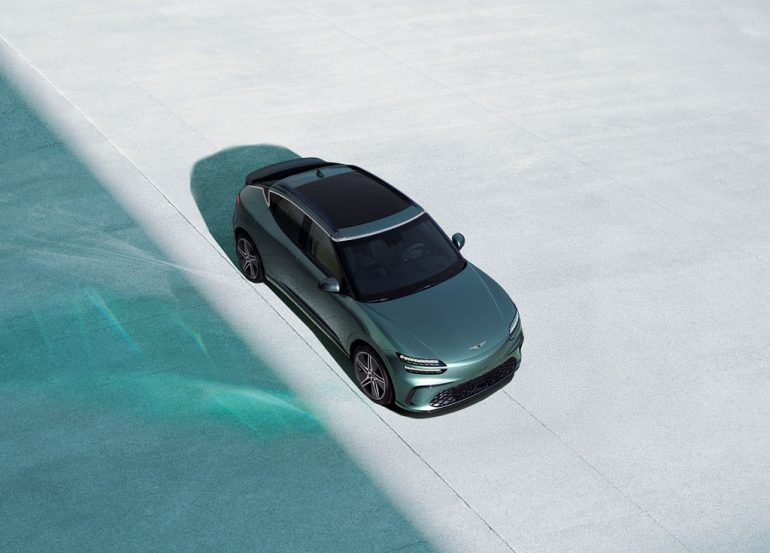
The table below shows MSRP alongside the dealer invoice price for all four 2027 GV60 configurations. All models share an 84 kWh battery. Destination charge is $1,545 and is not included in the figures below.
| Trim | Drivetrain | EPA Range | Horsepower | MSRP | Dealer Invoice | Dealer Margin |
|---|---|---|---|---|---|---|
| Standard | RWD | 306 mi | 225 hp | $46,250 | $44,400 | $1,850 |
| Standard | AWD | 282 mi | 314 hp | $49,950 | $47,952 | $1,998 |
| Prestige | AWD | 267 mi | 314 hp | $57,500 | $55,200 | $2,300 |
| Magma | AWD | 222 mi | 600 hp (641 hp Boost) | $69,950 | $67,152 | $2,798 |
Dealer margins on the GV60 run from $1,850 on the entry RWD to $2,798 on the Magma. Genesis operates on an agency-style retail model in many markets, which can limit traditional negotiating flexibility compared with volume-brand dealerships. That said, these are front-end margins before any dealer holdback, and buyers in markets with multiple Genesis retailers have leverage through competing quotes. At lower-volume luxury brands, inventory age and regional demand can be significant factors — a GV60 that has been on a dealer’s floor for 60 or 90 days is a meaningfully different negotiating situation than a freshly arrived unit.
All 2027 GV60 models share the same 84 kWh battery. The range and power differences between configurations come entirely from the motor setup and drivetrain.

The Standard RWD uses a single rear motor producing 225 horsepower and 258 lb-ft of torque. EPA-estimated range is 306 miles, the longest in the lineup, because a single motor operating on the rear axle draws less energy than the dual-motor AWD configurations. Fuel economy is rated at 119 MPGe city, 101 MPGe highway, and 110 MPGe combined. For buyers who primarily commute and charge at home, the RWD is the efficiency and value case — and 306 miles of range provides meaningful real-world buffer.
The Standard AWD adds a front motor, bringing total output to 314 horsepower and 446 lb-ft of torque. EPA range drops to 282 miles as the second motor draws additional energy. The AWD configuration also includes Boost Mode, which temporarily raises output for sharper acceleration. Fuel economy is 107 MPGe city, 93 MPGe highway, and 100 MPGe combined. For buyers who want all-weather traction or the additional power of the dual-motor setup, the gap from the RWD to the AWD Standard is $3,700 MSRP and 24 miles of EPA range.
The Prestige AWD shares the Standard AWD’s powertrain — 314 horsepower, 282 miles of range — but steps up the equipment level with 20-inch wheels instead of 19-inch, leather seating surfaces, a panoramic Vision Roof, and ventilated front seats. EPA range drops slightly to 267 miles on the larger wheels. The Prestige is the full-luxury configuration of the standard GV60, and at a $55,200 invoice it sits in meaningful competition with the Model Y Long Range AWD and the Volvo EX60.
The 2027 GV60 Magma is a separate performance variant that Genesis developed as its first dedicated high-performance model. It is not simply a GV60 with extra power — it has a wider, lower body with aerodynamic add-ons including front canards, a rear winglet spoiler, and 21-inch forged wheels on wider sport tires. The chassis gets an electronic limited-slip differential, sport-tuned suspension, and unique drive modes including Launch Control, Drift Mode, GT, and SPRINT.
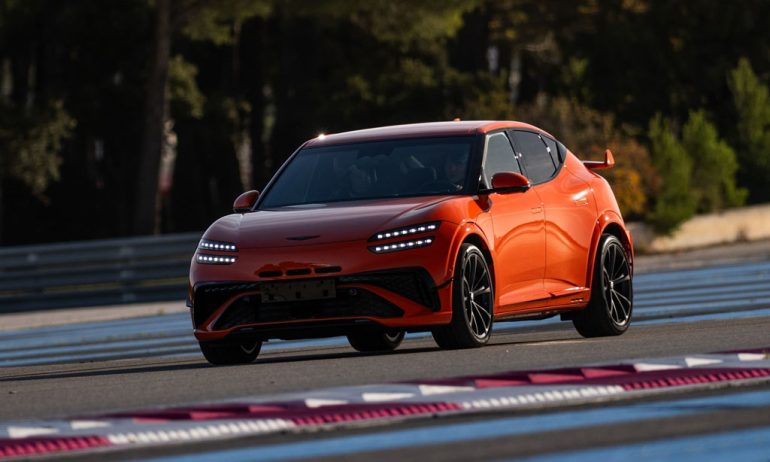
The Magma’s dual-motor system produces 600 horsepower and 546 lb-ft of torque in standard operation. Boost Mode, available for limited bursts, raises output to 641 horsepower and 583 lb-ft. Genesis rates the 0-60 mph time at 3.4 seconds in Boost Mode. EPA range on the Magma is 222 miles, the shortest in the lineup, reflecting the performance-oriented power delivery and wider tire footprint.
Standard Magma equipment includes the 27-inch OLED display, Bang and Olufsen audio, heated and ventilated front seats, surround-view camera, wireless Apple CarPlay and Android Auto, and a full suite of advanced driver assistance technology. At a $69,950 MSRP and $67,152 invoice, the Magma positions itself against performance EVs from Porsche, BMW, and Genesis’s own GV70 lineup. Genesis initially launched the Magma at select dealers in California, New York, and New Jersey before broader rollout.
The 2027 GV60 refresh is the most significant update the model has received since its launch. The new RWD Standard trim is the most consequential addition, lowering the entry price by several thousand dollars compared with the AWD-only lineup of previous years and extending the range ceiling to 306 miles. This configuration did not exist in the previous lineup and directly addresses the criticism that the GV60’s range was compromised by the dual-motor requirement.

All 2027 GV60 models gain a native NACS (North American Charging Standard) port as standard equipment, providing direct access to the Tesla Supercharger network and any other NACS-compatible station without an adapter. The GV60’s 800V architecture supports DC fast charging at up to 350 kW peak, enabling a 10-to-80 percent charge in as little as 18 minutes under ideal conditions.
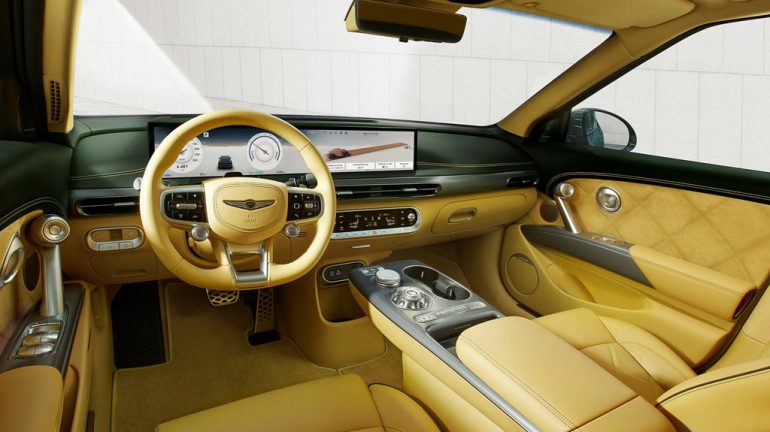
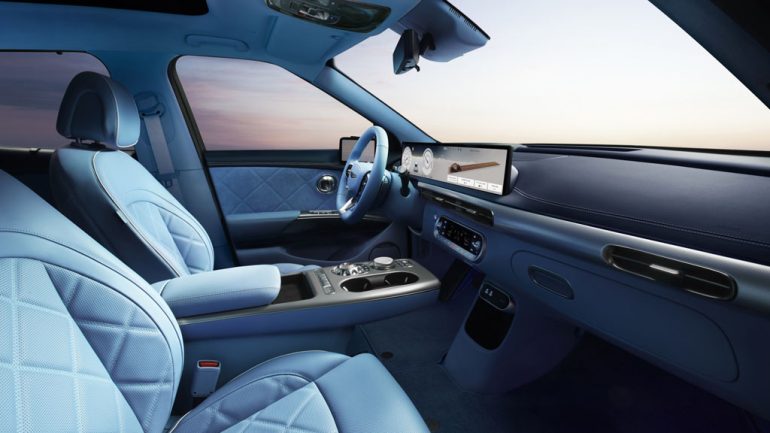
The 27-inch OLED display is new for 2027, replacing the previous screen setup. It spans the instrument cluster and infotainment screen in a single curved panel and runs Genesis’s AI-enhanced voice recognition system. Standard camera-based side mirrors from previous years are replaced by conventional wing mirrors on most trims, which the brand made standard based on customer preference feedback. The GV60’s distinctive Crystal Sphere gear selector is retained.
The GV60 Magma is entirely new for 2027, representing Genesis’s first factory performance variant on any model.
The GV60’s 800-volt electrical architecture is one of its competitive advantages in the luxury EV segment. The 800V system supports peak DC fast charging at 350 kW, which translates to roughly 10-to-80 percent charge in approximately 18 minutes at a compatible ultra-fast charger. This is competitive with or faster than most rivals in the segment. The native NACS port means no adapter is required at Tesla Supercharger stations, which represent the largest and most reliable fast-charging network in the United States.
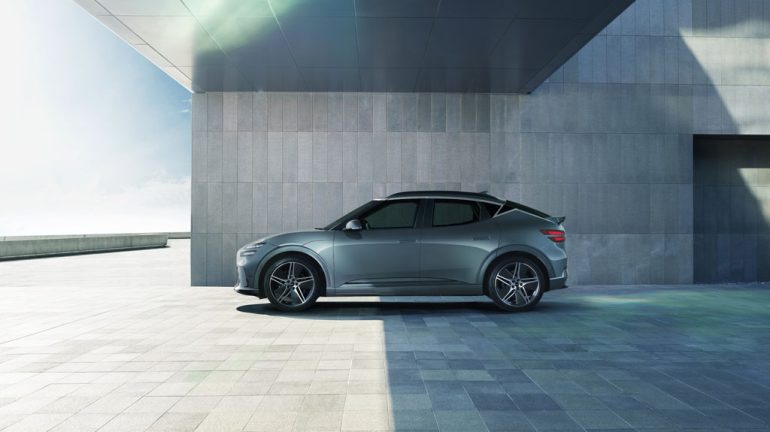
The GV60 also supports Vehicle-to-Load (V2L) functionality, allowing up to 3.6 kW of power export from the vehicle’s battery to run external devices, tools, or appliances via a standard outlet. Home charging on a 240V Level 2 charger will add approximately 20 to 25 miles of range per hour depending on the charger’s output.
All 2027 GV60 models are well-equipped at every level, consistent with Genesis’s approach of including features that most luxury brands charge as options. Across the lineup, standard equipment includes the 27-inch OLED instrument and infotainment display, wireless Apple CarPlay and Android Auto, Genesis’s AI voice recognition, a surround-view camera system, forward collision avoidance, lane keeping and lane following assist, blind-spot collision avoidance, 12-way power-adjustable front seats with heating, dual-zone climate control, and the Crystal Sphere gear selector. All models include the native NACS port and 800V fast charging capability.

The Prestige AWD adds 20-inch alloy wheels, leather seating surfaces, ventilated front seats, and the panoramic Vision Roof over the Standard AWD. The Magma adds everything in the Prestige package plus performance-exclusive features: Bang and Olufsen premium audio, the electronic limited-slip differential, performance bucket seats, Launch Control, Drift Mode, and the aerodynamic exterior package.
Genesis operates differently from traditional volume-brand dealers. Genesis retailers are fewer in number, and the brand has implemented some agency-model retail practices in certain markets that limit dealer pricing flexibility. That context matters going into a negotiation.
Use the invoice prices in this guide as your target. Margins of $1,850 to $2,798 depending on trim are the front-end figures, and the Prestige and Magma offer the most room. Opening your offer at or below invoice is a reasonable position, particularly on inventory that has been sitting at a dealer.
Compare across Genesis retailers in your region. Because Genesis has fewer locations than mainstream brands, buyers sometimes overlook the value of shopping multiple dealers. A GV60 at a dealership in a less urban market, or one that has been on the lot for 60 or more days, is a different transaction than a freshly delivered unit in a high-demand coastal market.
Know what competitor pricing looks like. The GV60 competes with the BMW iX1, Volvo EX60, Audi Q4 e-tron, and Tesla Model Y Performance depending on the trim level. Dealers are aware that buyers are cross-shopping, and a competing quote in hand from one of those rivals is legitimate negotiating leverage even if you ultimately prefer the GV60.
Genesis includes complimentary scheduled maintenance on new vehicles and provides home charger installation support, so factor those benefits into your total cost of ownership picture when comparing against rivals that charge separately for those services.