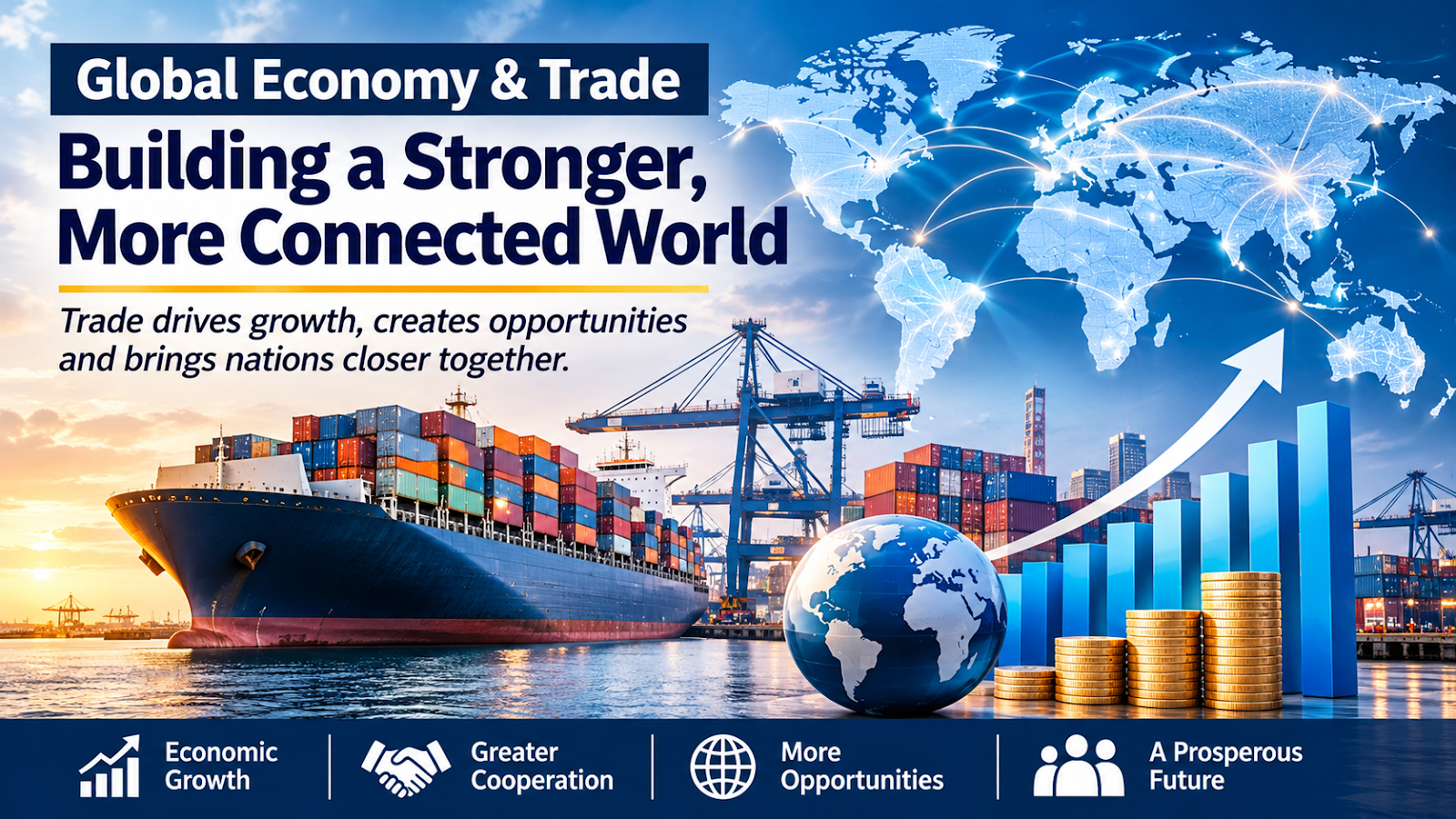
The global economy is entering a new era of transformation as international trade, technological innovation and geopolitical tensions reshape relationships between countries. From manufacturing and energy to artificial intelligence (AI) and digital services, economic developments in one region increasingly influence businesses, governments and consumers around the world.
International trade remains a major engine of global economic activity. However, rising trade tensions, changing supply chains, geopolitical conflicts and economic uncertainty are creating new challenges for the international trading system.
Despite these pressures, global commerce has demonstrated considerable resilience. Businesses are adapting to changing conditions, countries are seeking new trading partners, and investment in emerging technologies is creating fresh opportunities for economic growth.
Global Trade Shows Resilience Amid Economic Uncertainty
International trade has continued to expand despite disruptions affecting global markets.
According to the World Trade Organization (WTO), world merchandise trade volume is projected to grow by 3.9% in 2026, following stronger-than-expected performance during the first half of the year. The organization expects merchandise trade volume to increase by another 4.1% in 2027.
The improved outlook reflects stronger demand for technology-related products, particularly semiconductors, advanced electronic components and equipment used in artificial intelligence infrastructure.
However, the benefits are not evenly distributed. Higher energy costs, geopolitical tensions and transportation disruptions continue to affect international commerce, particularly in regions exposed to conflict and supply-chain instability.
The latest developments demonstrate that international trade remains adaptable, although its future growth will depend heavily on political stability, investment and international cooperation.
Artificial Intelligence Is Transforming Global Trade
One of the most significant developments in the global economy is the rapid expansion of artificial intelligence.
The growth of AI technology has increased demand for semiconductors, computer equipment, data centres and advanced electronic components. These products are becoming increasingly important to international trade.
According to the WTO's October 2026 trade outlook, trade in AI-enabling goods increased by 67% in value during the first half of 2026 compared with the same period a year earlier.
This rapid expansion is creating opportunities for economies with strong technology industries and advanced manufacturing capabilities.
The United States remains an important centre for AI innovation, while China, Taiwan, South Korea and Japan play significant roles in global electronics and semiconductor supply chains.
European countries are also seeking to strengthen their positions in advanced manufacturing, digital infrastructure and artificial intelligence.
However, the concentration of technology production in a relatively small number of economies creates potential vulnerabilities. Disruptions affecting semiconductor production or international technology supply chains could have consequences for businesses worldwide.
US-China Trade Relations Remain a Major Global Economic Issue
The economic relationship between the United States and China continues to influence the direction of international trade.
Both countries are major economic powers with extensive commercial relationships. They are also competing for technological leadership, manufacturing investment and strategic influence.
Trade restrictions, tariffs and investment controls have encouraged companies to reconsider where they manufacture products and obtain essential materials.
Some businesses are diversifying their supply chains by increasing production in countries such as Vietnam, India, Indonesia and Mexico.
This development is creating new opportunities for emerging economies. However, replacing established manufacturing networks can be expensive and complicated.
For multinational companies, the challenge is to balance production costs, market access, political risks and supply-chain security.
The future of US-China economic relations will therefore remain an important factor shaping international business decisions.
Europe Faces Challenges in Competitiveness and Industrial Growth
Europe remains one of the world's most important trading regions, supported by its advanced manufacturing industries, developed financial markets and extensive international trade agreements.
Germany, France, Italy and other European economies have established strong positions in automobiles, machinery, chemicals, pharmaceuticals and industrial technology.
Nevertheless, European businesses face several structural challenges.
High energy costs, international competition, relatively slow productivity growth and regulatory complexity have placed pressure on some industrial sectors.
The transition towards renewable energy and low-carbon production also requires substantial investment.
European policymakers are increasingly focused on improving industrial competitiveness, strengthening strategic industries and reducing dependence on external suppliers.
The European Union's ability to balance environmental objectives, economic competitiveness and international trade relationships will be essential to its long-term economic position.
Developing Economies Are Gaining New Trade Opportunities
Changes in international supply chains are creating opportunities for developing economies.
Countries in Southeast Asia, South Asia, Africa and Latin America are seeking to attract foreign investment and expand their participation in global manufacturing and services.
Vietnam, Indonesia and India, for example, have become increasingly important destinations for companies looking to diversify production networks.
These economies can benefit from employment creation, technology transfers, infrastructure development and increased export opportunities.
However, attracting international investment requires more than competitive labour costs.
Governments need reliable infrastructure, skilled workers, transparent regulations, political stability and efficient transportation networks.
For developing countries, improving education, logistics and industrial capabilities will be essential to achieving sustainable economic growth.
Protectionism and Trade Barriers Threaten International Cooperation
Although international trade provides important economic benefits, protectionist policies have become a growing concern.
Governments sometimes introduce tariffs, import restrictions and subsidies to protect domestic industries or strengthen national security.
These policies may support certain domestic businesses in the short term. However, they can also increase production costs, raise consumer prices and create uncertainty for international investors.
Companies operating across multiple countries depend on predictable trade regulations. Sudden changes in tariffs or market access can disrupt business strategies and investment decisions.
The World Trade Organization continues to provide an important framework for international trade negotiations and cooperation.
However, strengthening the multilateral trading system remains a significant challenge as countries increasingly pursue bilateral agreements and strategic economic partnerships.
Energy Security and Global Supply Chains
Energy remains fundamental to international economic activity.
Manufacturing industries, transportation networks, agriculture and digital infrastructure all depend on reliable energy supplies.
Geopolitical conflicts and disruptions to major shipping routes can increase energy prices and affect the cost of international transportation.
Higher energy prices can also contribute to inflation, reducing household purchasing power and increasing operating expenses for businesses.
Countries are therefore seeking to diversify energy sources, improve efficiency and invest in renewable technologies.
The development of solar power, wind energy, electric vehicles and battery storage is creating new international business opportunities.
At the same time, access to critical minerals and advanced manufacturing technologies is becoming increasingly important to national economic strategies.
What Does the Future Hold for the Global Economy?
The future of the global economy will depend on how governments and businesses respond to technological change, geopolitical uncertainty and environmental challenges.
The International Monetary Fund's October 2026 World Economic Outlook projects global economic growth of 3.1% in 2026 and 3.4% in 2027. However, the outlook remains exposed to risks including geopolitical conflicts, renewed trade tensions, fiscal vulnerabilities and uncertainty surrounding artificial intelligence investment.
Several important developments are likely to shape international commerce in the coming years:
Digital transformation: Artificial intelligence and automation will reshape manufacturing, financial services and international business operations.
Supply-chain diversification: Companies will continue seeking more resilient production and distribution networks.
Emerging markets: Developing economies may attract additional manufacturing investment and expand their export industries.
Green technology: Renewable energy, electric vehicles and battery production will create new international trade opportunities.
Economic cooperation: Countries will need stronger cooperation to address trade disputes and maintain stable international markets.
These developments will not affect every country equally. Economies with strong institutions, skilled workforces, modern infrastructure and competitive industries may be better positioned to benefit from the next phase of globalization.
Conclusion: International Cooperation Remains Essential
The global economy is changing, but international trade remains essential to economic development and prosperity.
Technological innovation is creating new markets, developing economies are gaining opportunities to participate in global supply chains, and established economic powers are adjusting their strategies to address new challenges.
Nevertheless, geopolitical tensions, protectionism, energy uncertainty and unequal economic development could limit future growth.
The challenge for governments is to protect legitimate national interests while maintaining the international cooperation necessary for economic progress.
A stronger global economy will require more than competition between countries. It will depend on investment, innovation, reliable trade rules and cooperation between advanced and developing economies.
As the world enters another period of economic transformation, countries that embrace innovation, strengthen international partnerships and invest in sustainable development will be better prepared to succeed.
Looking Times – Understanding the Global Economy, Business and International Affairs
References and Further Reading
1. World Trade Organization (WTO): https://www.wto.org/
2. International Monetary Fund (IMF): https://www.imf.org/
3. World Bank – Trade: https://www.worldbank.org/ext/en/topic/trade
4. OECD – Global Trade and Open Markets: https://www.oecd.org/en/topics/global-trade-and-open-markets.html