Millions of workers on Wednesday staged Spain’s first general strike in 14 years in protest of the country’s housing crisis.
Around 4 million workers—around 17% of the country’s 23 million-strong workforce—participated in the Nov. 11 walkout, unions said. The strike was organized by Spain’s two largest unions, the General Union of Workers (UGT) and the Workers’ Commissions (CCOO), tenants’ associations, and other unions. In cities across Spain, including Barcelona, Madrid, and Valencia, hundreds of thousands of people took to the streets on Wednesday to demand measures to bring down rental prices.
The last nationwide general strike was in 2012, when workers staged nationwide walkouts and downed tools to protest austerity spending cuts and sweeping labor market reforms during the Eurozone debt crisis.
The strike comes weeks before Spain’s Nov. 29 national election, in which rising rents and cost-of-living have become defining issues. Prime Minister Pedro Sánchez’s government called snap elections last month after the eviction and subsequent death of an 87-year-old tenant in September prompted days of mass protests.
In an unusual move, Sánchez’s government declared its support for the general strike. The administration appears hopeful that it will be buoyed in the election by resentment over the opposition’s block on new housing measures.
Read More: Spain’s Leader Is Betting His Government on the Housing Crisis
“Your eight-hour workday. Your pension. Your public healthcare. None of this fell from the sky. They were collective achievements. We won't let them be taken away. We will keep moving forward,” Sánchez posted on X on Monday, alongside a video describing Spain’s biggest social advances over the last century as the result of collective pressure.
“Every right that workers in this country enjoy was won through struggle and strikes,” Spain’s Social Rights Minister Pablo Bustinduy, an independent politician allied with Sánchez, said on Tuesday, the day before the strike. Second Deputy Prime Minister and Labor Minister Yolanda Díaz, a member of Sumar, the junior partner in Sánchez’s left-wing coalition government, posted on Bluesky on Wednesday: “When our country stops, it is always to move forward.”
Several unions declined to support the strike, citing its proximity to the election. But unions that backed the strike said it was nonpartisan and that their demands were aimed at local and national governments of any party.
“We don’t distinguish between political affiliations,” Valeria Racu, a spokesperson for the Madrid Tenants’ Union, told the Spanish public broadcaster TVE on Wednesday. “The time for politicians is over. We have no more patience. The power is in the streets.”
UGT and CCOO called the strike a success, while the tenants’ union estimated 4 million people had joined the stoppage and said it expected the total to grow to 5 million by the end of Wednesday.
CEOE, Spain’s main employers’ confederation, however, estimated that less than 5% of workers participated. In statements, CEOE said the action was a “failure,” and it argued that employers were being unfairly made to bear the cost of demands over housing policy. The association said the government’s support for the strike projects “a regrettable image abroad.”
Support for the strike was most concentrated in coastal areas, at ports, and in the automotive sector, according to UGT and CCOO. The unions reported a halt to production at Seat’s Martorell plant and majority support for the strike at Volkswagen’s factory in Navarre.
In Barcelona, the regional government suspended metro and public bus services outside peak hours. In Madrid, metro traffic through 10 a.m. local time was 42% lower than the same period last Wednesday.
Large demonstrations in cities across Spain accompanied the strike. In Madrid, protesters linked arms and blocked Gran Vía, the city’s main shopping area, and called for people to stop working and shopping. Shops along the thoroughfare, including H&M and Stradivarius, temporarily closed as protesters passed.
While unions said protests were largely peaceful, police reported at least 75 arrests across the country as of Wednesday night. Officials said there were at least 1,044 incidents linked to the general strike. In Barcelona, police said protesters had smashed shop windows, burned rubbish containers, and launched fireworks at officers.
CCOO Madrid said it planned to file a criminal complaint against the “disproportionate” response by police after riot police used batons and pepper spray against protesters in Madrid, allegedly injuring 20.
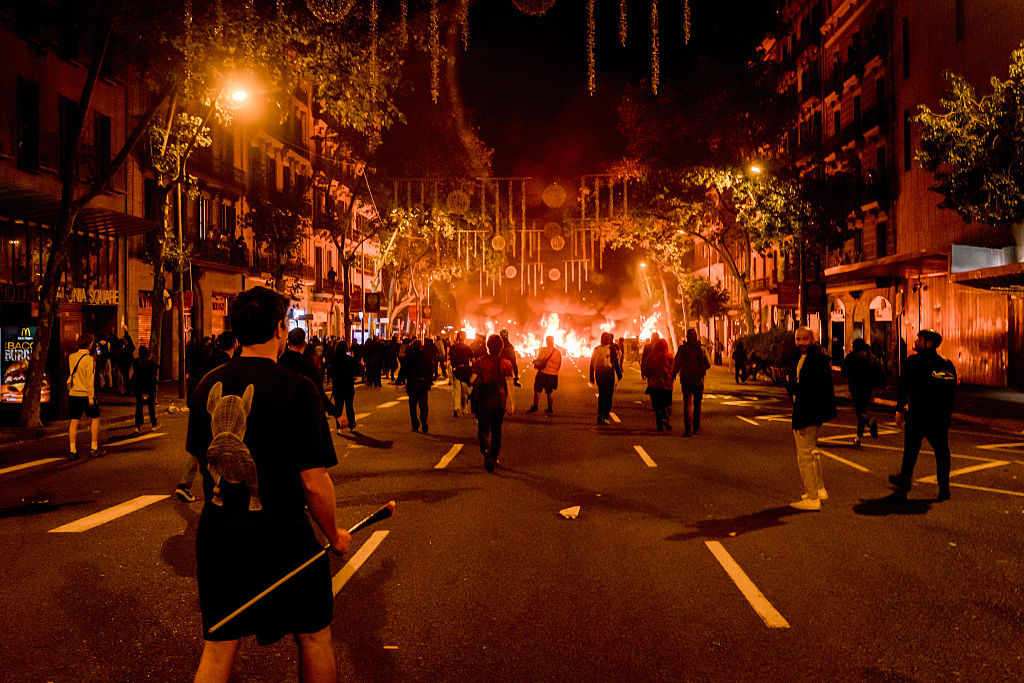

The demonstrations are at the center of political debate ahead of the elections.
Several opposition politicians accused Sánchez’s government of stoking the strike for political gain. “This is an electoral strike,” said Miguel Tellado, secretary-general of the conservative Popular Party (PP). “A preventive strike against the next government.”
“Don’t hold it,” PP leader Alberto Núñez Feijóo warned the unions, “or you will tie your image to Pedro Sánchez forever.”
Feijóo called the strike “a general strike against the opposition.”
Santiago Abascal, leader of the far-right Vox, called the general strike a “campaign for Sánchez.”
Sánchez’s government defended the constitutional right to strike. Sánchez said the action “is not against anyone,” and he argued that all public institutions should act to address the country’s housing needs.
Anger over Spain’s housing crisis came to a head in September, after 87-year-old Maricarmen Abascal was evicted from her home after its owner sought to raise her rent fivefold. While the landlord eventually agreed to let her return without raising the rent, Abascal died in hospital two weeks after the eviction, before she could move back.
The eviction sparked a protest encampment in Madrid’s Puerta del Sol and demonstrations in other cities. Spain has a housing shortfall of around 750,000 homes, which could exceed more than a million by 2028, according to the Bank of Spain.
More people have turned to renting as home ownership becomes increasingly out of reach. But renting also remains expensive. Rents increased 87% between 2015 and 2025, while wages increased around 30%, El País reported. The average monthly rent of €1,176 ($1,315) is equivalent to nearly 99% of the average monthly salary of a worker aged 16 to 29, according to the Youth Council of Spain. The average age that a person moves out of their parents’ home and lives independently is now 30.2 years, while the youth emancipation rate has fallen to a record low of 14.5%, according to the council.
Sánchez’s administration tried to enact legislation to strengthen tenants’ rights and curb the cost of rent in early October, but opposition lawmakers rejected both housing decrees. Congress’s Permanent Deputation, which operates while Parliament is dissolved, is due to vote on revised versions of the decrees on Thursday. Sánchez’s minority government previously passed a 2023 housing law that allowed for rent controls in high-pressure areas. In 2025, it announced proposals for more public housing, incentives for affordable rentals, and tighter restrictions on property purchases by certain overseas buyers.
Despite those efforts, Sánchez, who is seeking reelection later this month, faces criticism over the migration crisis in Ceuta, where at least 75 people died while attempting to cross from Morocco along with tens of thousands of others earlier this summer. An Oct. 28 train crash in Urda, which killed 69 people, and corruption cases involving people close to Sánchez’s government also loom over the coming election. Polls published Nov. 9 showed Sánchez’s Spanish Socialist Workers’ Party trailing PP, and projected that PP and Vox would together secure enough seats to form a majority government.