An American soldier has alleged that U.S. military leaders dismissed concerns ahead of an Iranian attack that killed six servicemembers on March 1.
The complaint, submitted Friday to the House and Senate Armed Services committees and first reported by CBS on Sunday, alleges that U.S. Army leaders did not heed warnings about thin fortifications at a command post at Kuwait’s Port Shuaiba.
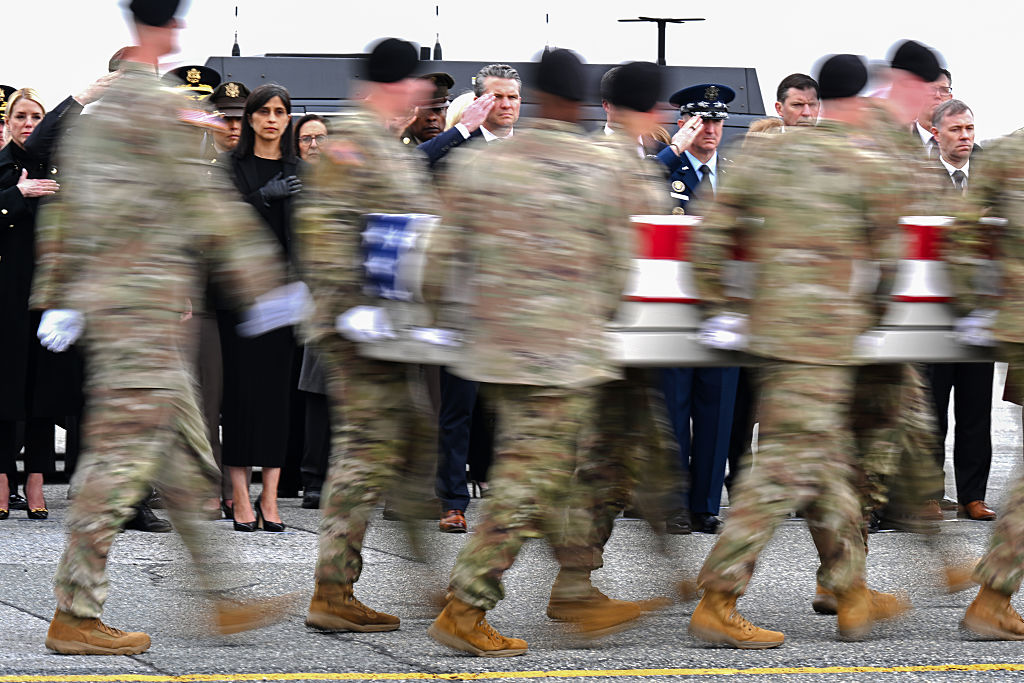
Iran launched a retaliatory drone attack on the command post a day after the U.S. and Israel launched the war on Feb. 28. It remains the deadliest attack on American troops since 2021. Over the eight months of the war, a total of 23 U.S. servicemembers have died.
Maj. Stephen Ramsbottom, who filed the complaint and was among the dozens wounded in the attack, called the event a “tactical failure” by “the Army, our leadership, and myself.”
Ramsbottom said he had twice raised concerns about the lack of protection from aerial attacks to his superiors but was told, “We don’t have to worry about protection.” He said in an interview with CBS that a counter-drone system “never arrived at Shuaiba and we don’t know if it was ever even ordered to or requested.”
He also alleged that the post had “no physician, no fixed aid station, and only one ambulance.”
A day after the attack, Defense Secretary Pete Hegseth said the command post suffered casualties despite its fortifications not because of a lack of preparedness.
“Every once in a while you might have one, unfortunately, we call it a squirter that makes its way through [air defenses]. And in that particular case it happened to hit a tactical operations center that was fortified,” Hegseth said at a press conference. “But these are powerful weapons.”
The Pentagon announced an investigation into the attack on March 3, and the Associated Press reported that it had concluded in June, with a private briefing to families of the slain servicemembers in July. The findings of the investigation have not been publicly disclosed, although widow Michelle Tietjens told CBS that officials acknowledged no mistakes. Ramsbottom’s attorneys separately requested an independent investigation into the attack after filing his Nov. 13 complaint.
TIME has reached out to the Pentagon and U.S. Central Command for comment.
Around a week before the U.S. and Israel launched their attacks on Iran, around 70 members of the U.S. Army’s 103rd Sustainment Command were relocated from Camp Arifjan, a major U.S. base south of Kuwait City, to the smaller outpost at Port of Shuaiba.
Days after the war began, Hegseth told reporters that the Defense Department prioritized protecting U.S. troops and moving “the vast majority … off the X, out of the range of Iranian fire.”
The facility, situated in the civilian port on Kuwait’s southern coast, was within range of Iranian missiles. The Washington Post reported in July that military leaders had ignored intelligence warnings that the post was a probable Iranian target.
CBS reported in March that the post was surrounded by T-walls, steel-reinforced concrete barriers that provide protection from mortars and rockets. Ramsbottom told Colorado news station KOAA in April that the facility was protected from “legacy threats” like mortar fire and car bombs, but not from modern aerial attacks, such as by drones or missiles.
Other survivors of the attack told CBS in April that the unit “was unprepared to provide any defense for itself. It was not a fortified position.” One soldier described the fort as “a bunch of little tin buildings where we can set up makeshift offices.”
The Post reported that a 2021 photograph showed what appeared to be a thin metal rooftop over the building, although it was not clear whether any reinforcement existed underneath.
Pentagon spokesperson Sean Parnell rejected reporting that the position was not well-protected. “A Tactical Operations Center is not a ‘makeshift office space.’ The secure facility was fortified with 6-foot walls,” he posted on March 3.
“Every possible measure has been taken to safeguard our troops — at every level,” Parnell wrote.
Multiple news outlets previously reported that no sirens sounded to alert troops before the deadly strike. CBS reported in March that sirens had occasionally gone off after a drone had already entered the base in previous incidents. CBS reported in April that incoming missile alarms had sounded several hours before the attack, alerting around 60 troops to take cover when a ballistic missile flew overhead, and that an all-clear alert had sounded around 30 minutes before the Iranian drone hit. Troops told the outlet that officers had removed their helmets and resumed work at their desks after the all-clear alert.
Soldiers told the Post that the threat warning system was initially not working when a team was sent to scout the post before troops were relocated there. They said repairs had been made to get it operational before the strike happened.
U.S. Army Central previously said in statements to media outlets that the alarm system at the facility was working at the time of the attack.
The whistleblower complaint adds fuel to the fire as Democrats plan to launch congressional investigations into the Trump Administration’s handling of the war when they take control of both chambers of Congress in January.
In September, Sen. Elizabeth Warren of Massachusetts and Rep. Pat Ryan of New York called for public hearings, citing earlier whistleblower reports about delayed medical care for wounded servicemembers, mistreatment of families, and concerns around the Army’s investigation into the attack. Rep. Maggie Goodlander of New Hampshire described the handling of the attack as “a profound failure of leadership” and said “the Pentagon cannot be allowed to stonewall Congress.”
Democrats and some Republicans have also called for Hegseth to step down or face impeachment, and the latest allegations are likely to intensify scrutiny of his leadership.
Sen. Richard Blumenthal (D, Conn.), the ranking member on the Senate’s Permanent Subcommittee on Investigations, reportedly sent a letter on Sunday to the Pentagon requesting a classified briefing with Hegseth and “all force protection assessments” for the post.
“I’m again demanding full disclosure about the Port Shuaiba attack—an accounting of misjudgments by political appointees likely led to increased vulnerability & greater casualties,” Blumenthal posted on social media on Sunday night.
“The families of the six fallen servicemembers, the wounded survivors, & the American people deserve full transparency & accountability,” he added in another post. “It is time for a reckoning.”