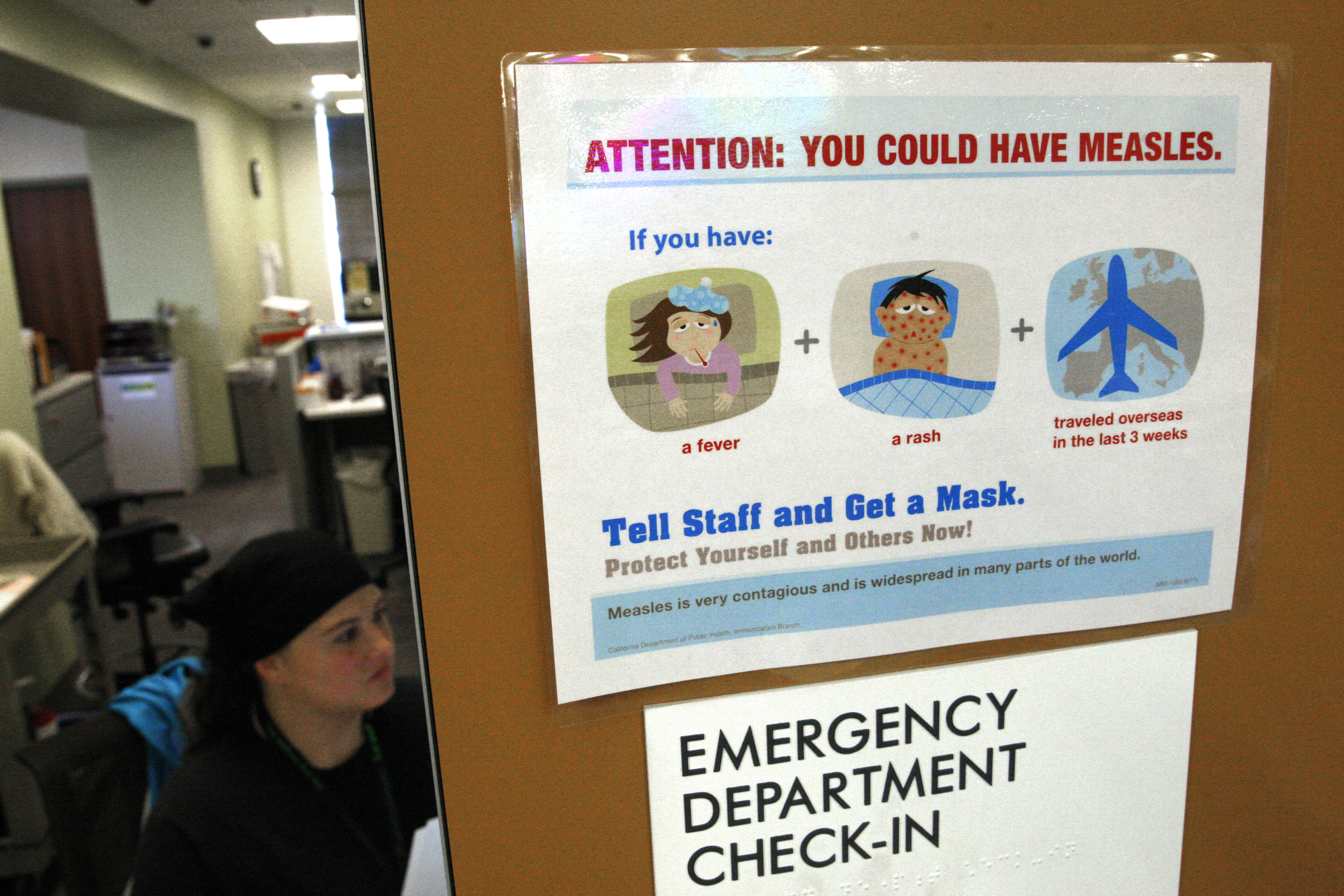
For more than a quarter of a century, the U.S. has held measles-elimination status, meaning the virus was no longer spreading continuously within the country. Prior to the introduction of the first measles vaccine in 1963, nearly all American children contracted the disease before they were 15, for an annual case count of up to four million, including 400 to 500 deaths and 48,000 hospitalizations. But an aggressive vaccination campaign changed all of that, and measles was declared eliminated in the U.S. in 2000. No more.
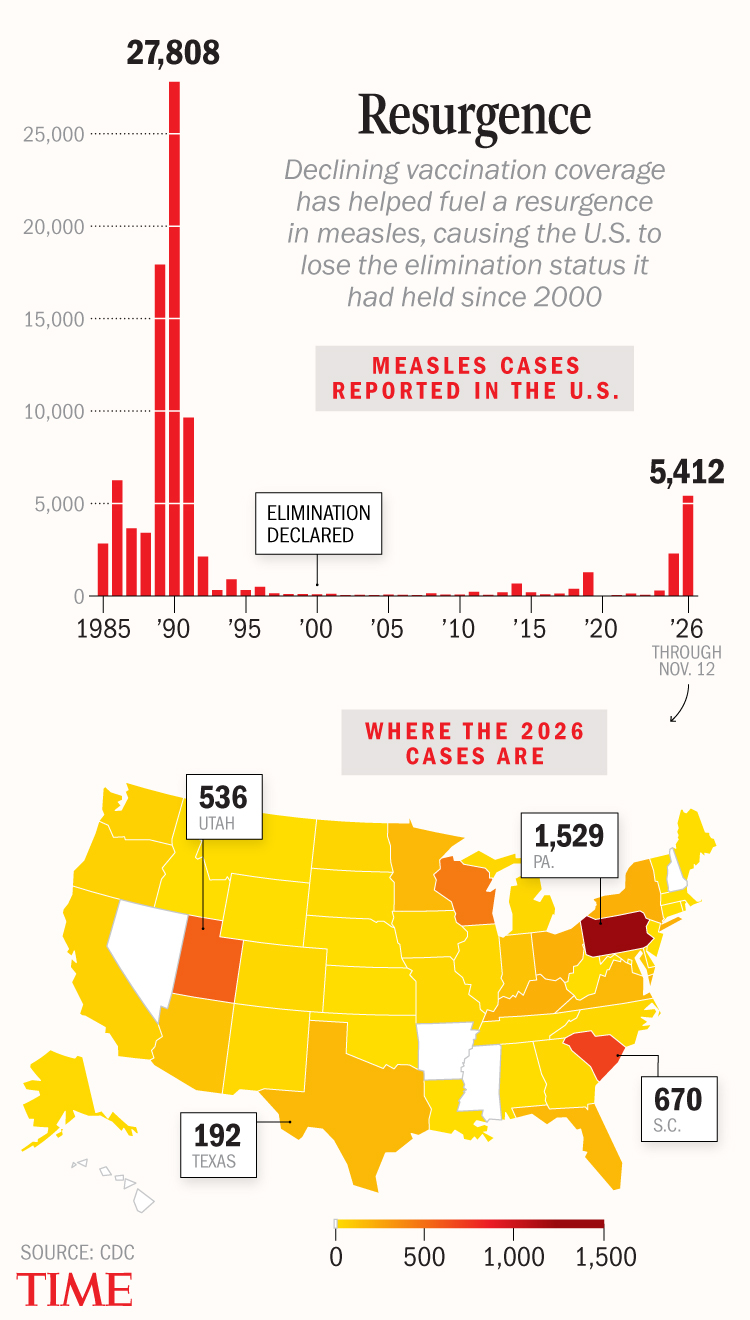
On Nov. 17, the Pan American Health Organization (PAHO) announced that the U.S. had lost that status after at least 12 months of uninterrupted transmission. Falling vaccination rates—fueled in part by antivaccine misinformation spread by a vocal community that includes Robert F. Kennedy, Jr., Secretary of the Department of Health and Human Services (HHS)—have allowed the virus, contained for more than a generation, to spread widely. As of Nov. 12, the U.S. Centers for Disease Control and Prevention (CDC) had recorded 5,412 measles cases in the U.S. in 2026: 5,394 reported by 47 jurisdictions, plus 18 cases among international visitors. That case count is more than twice the 2,289 cases reported in all of 2025, including three deaths—the highest caseload since 1991—and is 19 times greater than the 285 cases in 2024.
“It's a tremendous step backwards for public health in the United States,” says Dr. Paul Offit, attending physician in the Division of Infectious Diseases at Children's Hospital of Philadelphia. “But, in some ways, the ruling is irrelevant. Measles has now established a foothold in this country. It's endemic.”
As with so much else in the field of epidemiology, the standards that must be met to gain or lose elimination status for measles aren't entirely straightforward. For one thing, elimination doesn’t mean zero cases. Measles can still be brought into the country by travelers and spread among people who aren’t protected.
Even cases that appear to have a domestic origin are not necessarily enough to cost a country its elimination status. PAHO considers measles transmission re-established when the same virus genotype and lineage circulate uninterrupted in a country for at least 12 months. In the U.S., the outbreak began on Jan. 20, 2025, and reached that threshold a year later, according to PAHO. Genome sequencing helps scientists identify the genotype and lineage of the virus in a case and determine whether it is linked to an ongoing chain of transmission. In August, Utah health officials published a preprint study documenting sustained transmission in the state. The PAHO commission reviewed the evidence from across the country before determining that the U.S. had lost its elimination status. In 2026 so far, the CDC has reported 43 new outbreaks nationwide, nearly matching the 48 reported in all of 2025.
Vaccination rates don’t have to fall much for outbreaks to take hold, especially in communities with pockets of low coverage. PAHO says communities should aim for at least 95% coverage with both doses of the measles vaccine to help prevent transmission. High vaccination coverage also helps protect people who can’t be vaccinated, including infants too young to receive the vaccine and people with certain medical conditions. MMR vaccination coverage among U.S. kindergartners fell from 95.2% in the 2019–2020 school year to 92.4% in 2025–2026, according to the CDC.
“It’s so tragic that we’ve allowed measles to return to America,” says Dr. Peter Hotez, co-director of Texas Children’s Hospital Center for Vaccine Development. “In the prevaccine era, measles exhibited a distinctive seasonality in late winter [and] early spring. This same pattern has recurred in 2025 and 2026, so the prediction is we will [see] an even larger surge at that time in 2027.”
What makes things worse is that while measles is an easy illness to prevent—two doses of the MMR vaccine reduce the risk of contracting the disease by 97%—it is wildly easy to catch and spread. An unvaccinated person who comes into contact with someone with measles has a 90% chance of becoming infected, according to Johns Hopkins Medicine, and the virus can linger on surfaces or in the air for up to two hours after an infected person has left a room. What’s more, people who are infected with the virus can be stealth carriers before they even know they’re sick. According to the World Health Organization, the virus can spread for up to four days before the disease’s characteristic rash appears and four more days after it has faded.
And the disease can lead to serious, sometimes fatal complications. “Measles is one of the most contagious diseases in the world,” said Dr. Jarbas Barbosa, director of PAHO, at a Nov. 17 press conference. “It can cause pneumonia, encephalitis, blindness, and even death.”
The U.S. is not alone in battling a measles resurgence; the problem extends across the Americas. In Nov. 2025, Canada lost its elimination status following an outbreak that began in Oct. 2024, spread across 10 provinces and the Northwest Territories, and lasted more than a year. Mexico and Bolivia also lost their elimination status on Nov. 17. In these countries, as in the U.S., gaps in vaccination coverage have helped fuel outbreaks.
Regaining America’s lost measles-elimination status won’t be easy. Kennedy’s continued questioning of public-health authorities could complicate efforts to rebuild trust in vaccination. In August, he went so far as to speculate, in a post on X, that the announcement by Pennsylvania Gov. Josh Shapiro of two measles-related deaths in the state “may even have been altogether fabricated by one of the Governor's hopeful staffers.”
Regaining elimination status will require interrupting endemic transmission for at least 12 months, documenting that progress, and strengthening vaccination, surveillance, and outbreak response.
“Measles elimination is not a trophy that is won once and placed on a shelf,” Barbosa said at the Nov. 17 press conference. “It is an achievement that must be safeguarded every day.”
Adds Offit: “We will be dealing with measles this year and next year and the year after that, until we get our immunization rates up.”