

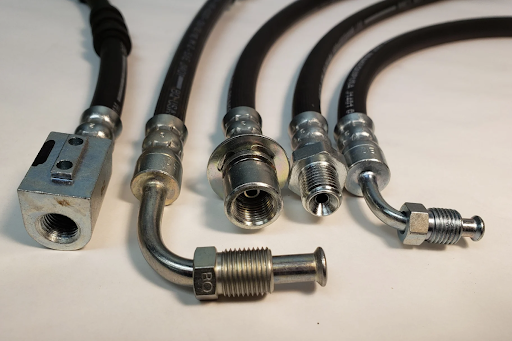
Upgrading factory brake lines is standard procedure in performance and racing builds. The aim is to reduce expansion, prevent leaks, and ensure consistent braking performance in demanding conditions. Apart from PTFE-lined braided steel hoses and copper-nickel hard brake pipes, the connecting components—the brake hose ends—can become weak points when they are incorrectly selected, assembled, or installed.
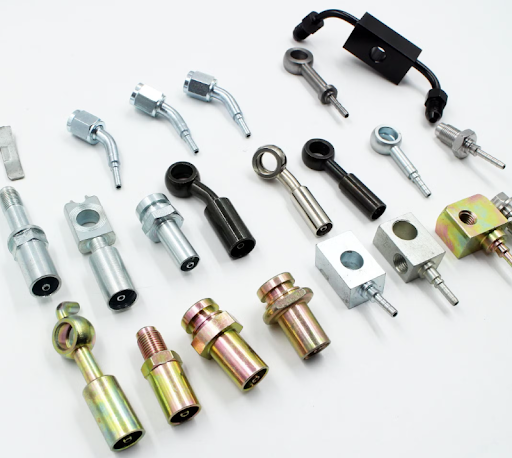
Brake hose ends are metal fittings attached to flexible synthetic-rubber or PTFE-lined braided brake hoses. They connect the flexible hose to calipers, master cylinders, chassis brackets, or hard brake lines while keeping brake fluid sealed inside the high-pressure hydraulic system. Metal hard lines use their own compatible tube nuts, unions, and flared ends.
Parts differ significantly according to their purpose and vehicle application. Passenger cars commonly use factory-engineered crimped assemblies with plated-steel or corrosion-resistant end fittings. Problems can develop because of corrosion, physical damage, deteriorated flexible hose, incorrect routing, poor installation, or incompatible components. The metal end fitting itself does not swell, although the flexible portion of an old or unsuitable hose can expand under pressure.
A restricted flexible hose can contribute to brake drag or a caliper that does not release properly. Fluid loss or air entering through a damaged connection can produce a soft or spongy pedal. Gauge Magazine’s guide to common brake system failures and their warning signs explains other problems that can cause uneven braking or a vehicle to pull to one side.
Custom and performance car builds address many of these concerns with carefully selected hose assemblies and fittings. Aftermarket brake hose ends may use stainless steel, plated steel, or anodized aluminum to provide different routing, corrosion-resistance, and weight characteristics. However, the fittings do not prevent hose expansion by themselves. Expansion resistance depends on the construction and condition of the complete hose assembly.
Pressure and temperature ratings vary by manufacturer, hose construction, fitting design, attachment method, and intended application. Buyers should not assume that every braided hose or machined fitting has the same pressure, temperature, or corrosion resistance. Check the specifications and test information for the complete assembly rather than relying on a generic material claim.
For road-going vehicles in the United States, choose a complete hose assembly whose manufacturer identifies it as compliant with Federal Motor Vehicle Safety Standard No. 106. The standard establishes labeling and performance requirements for brake hoses, assemblies, and end fittings. Reusable or field-assembled hydraulic hose ends may be intended for competition use and should not automatically be assumed legal for public-road use.
Switching to a properly specified brake hose assembly engineered for aggressive street or track use can provide several benefits:
Real-world benefits may include more consistent stopping control, improved pedal feedback, longer component service life, and a reduced likelihood of fluid leaks. These benefits depend on using compatible parts, installing them correctly, bleeding the system thoroughly, and routing the hoses without tension, twisting, kinking, or abrasion.
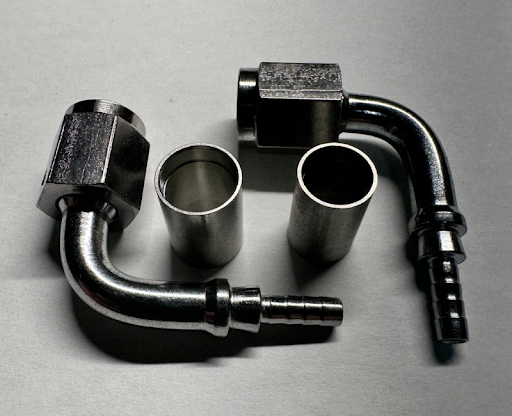
Straight hose ends and connectors provide a compact, direct route where the brake line does not need an immediate bend. Their simpler geometry can make routing and inspection easier while creating a clean appearance. They do not meaningfully increase brake-fluid velocity because a hydraulic brake system transmits pressure rather than depending on continuous high-speed fluid flow.
AN-style fittings are common in some motorsport brake systems using compatible PTFE-lined braided hose. Approved steel or copper-nickel hard lines require the correct tube nuts and flare types rather than a hose fitting designed for flexible line.
Forty-five- and 90-degree brake fittings can prevent kinking, reduce rubbing against wheels or suspension components, and provide clearance around aftermarket calipers, handbrakes, master cylinders, exhaust piping, and control arms. Choosing the correct angle can reduce twisting and avoid forcing a hose through an excessively tight bend.
Banjo brake hose ends are circular, ring-shaped fittings secured to master cylinders or calipers with hollow banjo bolts and sealing washers. They are commonly used where a conventional fitting would require too much clearance.
A banjo fitting can be clocked into the required position before the bolt is tightened. It must not rotate freely after installation. The bolt must be tightened to the manufacturer’s specification, and sealing washers should be replaced when required by the component manufacturer.
Y-piece adaptors divide one hydraulic line into two paths and may be used in purpose-designed systems, including certain dual-caliper arrangements. They do not automatically reduce pressure loss, eliminate turbulence, or equalize braking force.
Dividing a brake circuit can affect system volume, pedal travel, hydraulic balance, and failure protection. A Y-piece should therefore be used only when it is compatible with the engineered brake-system design. It should not be installed as a casual substitute for the vehicle’s original circuit layout or proportioning hardware.
The post Brake Hose Ends: Types, Materials and Buying Tips appeared first on Gauge Magazine.