
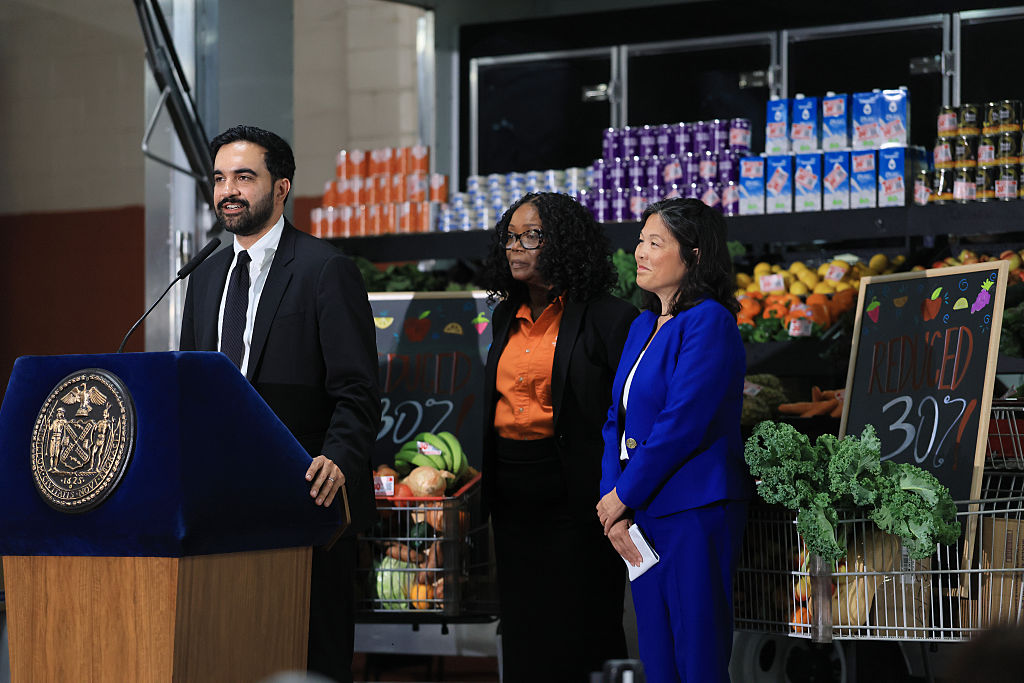
As New York Mayor Zohran Mamdani works to implement his campaign promise to create public grocery stores, the initiative has been met with significant criticism, especially from economists. The criticism is, I believe, badly misplaced, based on the very models of the economy that have contributed to our slow growth, increasing inequality, and today’s affordability crisis.
There is indeed a strong economic argument for doing something along the lines that Mayor Mamdani proposes.
Traditional economists typically begin with the presumption that private, competitive markets are efficient and the desirable way to provide ordinary goods like groceries. Government should stick to where it is needed, these economists believe, like providing defense and environmental regulation.
But over the past 50 years, this presumption has been totally undermined, as we’ve come to understand better the many ways in which markets “fail,” especially in the presence of imperfect information. Even in the simple area of groceries, market incentives direct consumers to more profitable but less nutritious foods, contributing, for instance, to the childhood diabetes crisis. Public grocery stores, whose objective is to provide better, more affordable goods for all citizens—rather than just maximizing profits—hold out the promise of a healthier population and a more productive labor force.
The argument for private markets begins with unrealistic assumptions about perfect markets, with perfect competition and perfect information. Even seemingly competitive markets like grocery stores are better described by monopolistic competition than perfect competition. In a series of papers, I showed that the market equilibrium in such markets was not, in general, efficient. This is true even if profit margins of grocery stores are thin. Indeed, part of the problem is that to maintain even these thin margins, grocery stores often have to engage in exploitative activities that encourage the consumption of high-margin and often less-nutritious foods at the expense of lower-margin foods that would be better for everyone’s health.
To be sure, the objective of any business is to extract as much money from its consumers as it can. The issue is that the objective of grocery stores in a monopolistically competitive market—especially with consumers who are not fully informed and would be better described by models of behavioral economics than by models that assume perfectly rational and perfectly informed individuals maximizing expected utility over their lifetimes—can be at odds with the customers’ health, communities’ productivity, and society’s well-being.
The disparity between societal interests and the interests of profit-maximizing grocery stores can be seen in the food deserts—large areas throughout the country where nutritious food is simply not available—and at the checkout counters, where candy and other unhealthy snacks jostle for the attention at the eye level of children. And food deserts also demonstrate the high price of inequality, in which America’s poorest are ironically forced to spend more time and resources traveling farther to find healthy food, even if they have fewer resources to spare.
Of course, grocery stores are only one part of an ecosystem focused more on profits than health—including a food industry that pushes excessively processed and sugar-rich foods that contribute to the country’s childhood diabetes problem.
And what I have described so far are only some of the market failures rampant here. Risk (insurance) markets too are imperfect. What's more, fluctuations in grocery store prices put a disproportionately bigger burden on poor families, with a large reduction in their well-being. In a well-functioning economic system, these risks would be transferred to consumers who are better able to absorb them.
The market failures in the provision of food should not be a partisan matter. One of Mandani’s predecessors, former New York Mayor Michael Bloomberg, also tried to improve the health, nutrition, and productivity of New Yorkers, with lasting benefits. He left a legacy of corner fruit and vegetable stands. He tried mightily to curb the exploitative efforts to encourage excessive sugar consumption in movie theatres—with enormous pushback from the food companies profiting from the sales.
Ongoing research at Columbia University shows that in markets that are not perfectly competitive, the provision of an alternative public option can increase societal welfare, and this is true even if the public option is less efficient than the private sector and even if it runs at a loss.
No doubt, New York City will face a big challenge in running these grocery stores, but there are models of successful alternatives to the current system, including co-ops in many places around the world.
It behooves all of us to do what we can to ensure that this important initiative succeeds.
And it behooves us not to write off fresh ideas based on stale definitions of what a healthy economy looks like.