
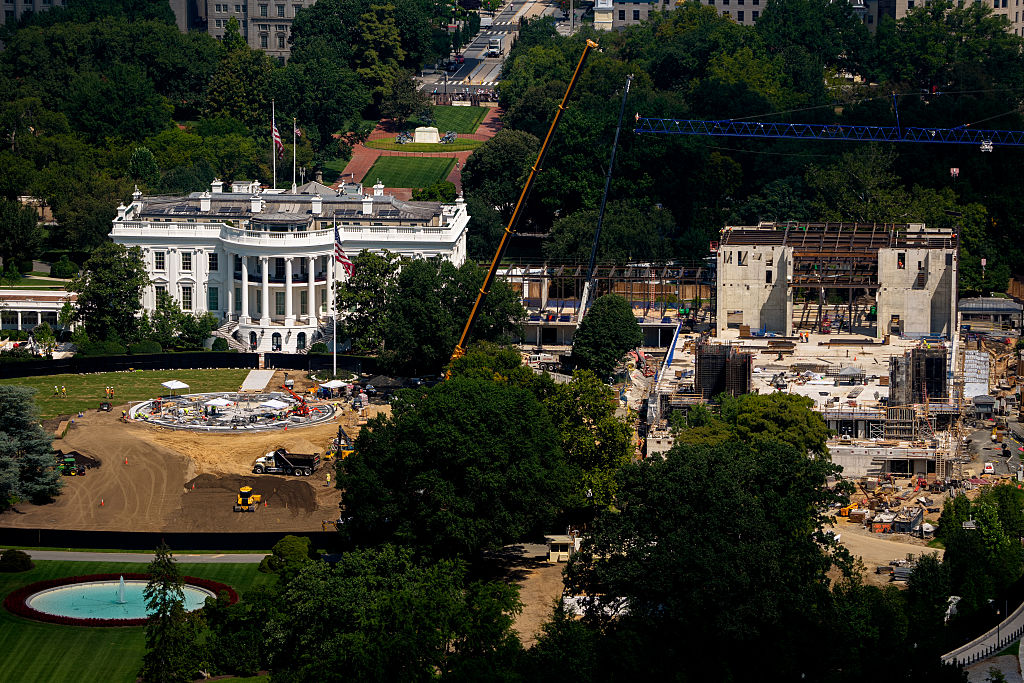
President Donald Trump’s $400 million, 90,000 sq ft White House ballroom is a step closer to becoming reality.
The Supreme Court on Monday allowed Trump to move forward with construction of the ballroom, which had been partially blocked by lower courts. Divided 5-4, the Supreme Court granted an emergency request filed by the Trump Administration earlier in August, staying the lower court rulings.
The legal challenge to the construction, brought by the National Trust for Historic Preservation, argued that Trump did not have the authority to build the ballroom without congressional approval.
The Supreme Court ruled on procedural grounds that the trust likely does not have legal standing to sue. The court did not rule on the legality of the construction.
“Today, we do not pass upon the legality of the government’s East Wing project. We conclude only that, based on the submissions before us, the government is likely to prevail in showing that the Trust lacks ... standing to challenge the project in federal court,” the court said in its ruling.
The decision comes after Chief Justice John Roberts issued a temporary stay on the lower court injunction on Aug. 21, allowing above-ground construction to proceed while the full court deliberated.
Roberts ultimately was the only conservative justice to dissent, arguing that the project was “likely unlawful.”
“The ballroom is a building or structure being erected on federal park grounds—President’s Park—in the District of Columbia. Yet Congress has not passed any law resembling ‘express authority’ for the Executive’s construction of it,” Roberts wrote.
Trump celebrated the legal victory in a Monday post on Truth Social.
“I am pleased to report that the United States Supreme Court has just ruled in favor of the Ballroom/Military Complex being built without any further contingency, doubt, or threat,” Trump wrote. “We are living in the Golden Age of America, and this Building will be one of the Greatest ever constructed in Washington, D.C.”
The President said the ballroom will be completed in the summer of 2028.
The project is part of Trump’s broader effort to leave a permanent legacy on the U.S. capital. Since signing an executive order last March to “beautify” Washington, the Administration has completed a renovation of the Reflecting Pool, pursued an overhaul of the Kennedy Center, and announced plans to erect a 76m arch. Trump also began renovating the “horrible” front of the White House in July.
The trust filed the lawsuit in December on behalf of one of its members, Alison Hoagland, an architectural historian and preservationist who lives in Washington. Hoagland said in a declaration that she would “suffer both professional and personal injuries, including to my aesthetic, cultural and historical interests, if a ballroom of the proposed form and scale were constructed.” She argued that “an adjacent structure overshadowing the White House, exceeding it in height and massing, would diminish the primacy of the White House.”
The Supreme Court’s majority said the trust likely lacked standing as the court had not previously recognized legal standing “in circumstances like these.”
“To the contrary, we have repeatedly held that mere offense, disagreement, or distaste does not qualify as a concrete and particularized injury,” the court said.
Roberts, in his dissent, wrote that a “historic preservationist such as Hoagland can be aesthetically injured in a concrete, particularized way by the transformation of a historic building that she frequently enjoys.”
The trust also argued that the government needed the “express authority of Congress” to build on federal land in Washington, D.C.
The Justice Department argued that the White House had authority for the construction under other federal statutes. It also argued that the project was necessary for national security reasons, citing an alleged assassination attempt on Trump during the White House Correspondents’ Association dinner in April, as well as other alleged attacks and threats against the President.
“This case involves an extraordinary and unlawful injunction that will halt the ongoing construction of the integrated military complex, including a totally secure ballroom space, at the East Wing of the White House, which is vitally required by national security,” DOJ lawyers argued. The Administration said in its emergency request that construction was 65% complete.
The Supreme Court majority concluded that halting construction at this stage would likely cause “irreparable harm” to the government.
In late March, U.S. District Judge Richard Leon in Washington, D.C., issued a preliminary injunction in favor of the trust, blocking above-ground construction of the ballroom while litigation proceeded. The underground portion of the project, which involved construction of military and medical infrastructure, was allowed to continue, along with above-ground work deemed “strictly necessary” to ensure security.
On Aug. 7, the U.S. Court of Appeals for the District of Columbia Circuit upheld the preliminary injunction, concluding that the Administration could not construct the ballroom during litigation without obtaining congressional approval.
“Each President is a temporary tenant, not the owner, of the White House,” the D.C. Circuit majority said in its ruling.
The trust’s president and CEO Brent Leggs said in a statement on Monday that the organization was “deeply disappointed in the Supreme Court’s ruling.” He noted that “the majority did not weigh in on whether the ballroom project was in fact legal.”
“This is not the final decision on the merits of our case and does not resolve our fundamental argument—that each President is a temporary steward of the People’s House and does not have the unilateral authority to demolish and redesign it without the approval of Congress,” Leggs said.
Construction began last October with the demolition of the East Wing of the White House. Built in 1902 during Theodore Roosevelt’s presidency and expanded in 1942, the East Wing had housed the offices of the first lady and the White House movie theater.
The new ballroom, substantially bigger than the demolished 12,000 sq ft East Wing, is expected to accommodate as many as 999 guests and include missile-resistant columns, drone-resistant ceilings, and ballistic- and blast-proof glass. It also includes an underground complex containing bomb shelters, medical facilities, and other security features.
The Administration has estimated that the project will cost $400 million, up from an initial estimate of $200 million. It has said that the ballroom is funded entirely through private donations, although it said taxpayer funds would pay for security and military components of the project.
The Washington Post reported in June that an internal contractor estimate projected a total cost of $600 million, with just over half coming from taxpayer-funded accounts. Democratic lawmakers have also pointed to Office of Management and Budget documents that showed more than $350 million in Secret Service funding reserved for “White House Security Measures,” which the lawmakers alleged were connected to the ballroom project.
There was initially little congressional appetite to authorize the project. But after the April shooting, some congressional Republicans rallied behind the project. Three Republican Senators introduced legislation to authorize $400 million in federal funding for the overall project. Senate Republicans later proposed a separate $1 billion appropriation for broader Secret Service needs, which included security features associated with the project, although the provision was ultimately removed from the legislation before it passed Congress.
Even so, some lawmakers have continued to oppose the construction project. Seven Republicans joined Democrats in June in an unsuccessful bid to bar federal or private funding for the ballroom without congressional authorization.
The Administration said in court filings that a 250-person crew has been working 20 hours a day, seven days a week.
“The Project, despite the baseless lawsuit brought by the so-called National Trust for Historic Preservation of the United States, which is not in any way affiliated with the United States Government, is under budget and ahead of schedule,” Trump wrote on Monday.