

If you’ve been driving with the same factory rearview mirror for years, you’re missing out on one of the easiest upgrades you can make to your car. A mirror dash cam replaces your standard mirror with a smart, all-in-one device that records your drive, improves your rear visibility, and keeps you safer on the road, without adding extra clutter to your dashboard.
In this guide, we’ll break down what a mirror dash cam actually does, how it compares to a regular dash cam, and which model stands out as the best mirror dash cam for 2026. Whether you’re a daily commuter tired of squinting through headlight glare, a truck owner who can never see past the tailgate, or an off-roader who needs to know what’s in front of the bumper before it becomes a problem, this guide should help you figure out exactly what to look for.
What Is a Mirror Dash Cam?
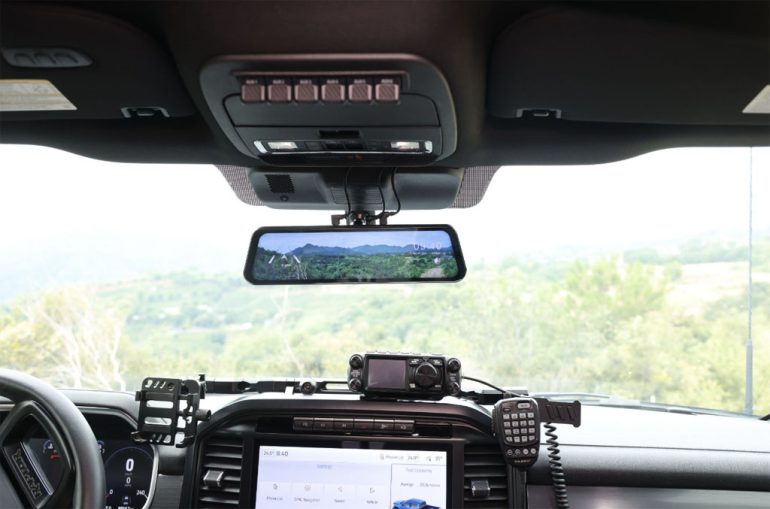
A mirror dash cam isn’t just a camera taped to your windshield. It’s a direct replacement for your factory rearview mirror, mounting over or in place of your existing mirror, and it ends up doing the job of several separate gadgets at once. Instead of a plain reflection, you get a digital rearview mirror that shows a live, wide-angle feed, which means an obstructed rear view from a loaded trunk, tall passengers, or tinted glass stops being an issue.
The same device can also record driving footage through its connected cameras, while some models provide additional views for reversing and parking. Depending on the model, built-in features such as GPS can also record information such as vehicle speed, location, and driving routes.
Add a genuinely high-definition camera system that holds up in both daylight and darkness, and you can see why people describe these devices as multifunctional rather than “just another dash cam.” Instead of running four separate gadgets bolted around your car, a mirror dash cam like the WOLFBOX lineup folds all of that into a single device sitting right where your mirror already lives, which is really the whole appeal.
What Is the Best Mirror Dash Cam for 2026?
The WOLFBOX G900TriPro Bumper Version is one of the strongest mirror dash cams available in 2026, especially for drivers who want complete coverage around their vehicle rather than just a front-facing recording. What makes it worth calling out is that its strengths are backed by actual hardware, not just marketing language.
Up front, it uses a 4K camera built into the mirror with a Sony STARVIS 2 IMX678 sensor, which captures sharp, detailed footage at 30fps and holds up well once the light starts to fade. The rear camera runs a 2.5K feed off an OmniVision OS04J10 sensor (1/1.88″) with PureCel Plus technology, and the difference shows up most at night, where older rear units tend to wash out but this one keeps details visible. Then there’s the feature that actually sets this version apart: a 1080p external bumper camera, waterproof and mounted at the front of the vehicle, built specifically to eliminate the blind zone directly in front of the car that most dash cams, and most drivers, simply can’t see. That’s especially valuable for trucks, SUVs, and anything used off-road, where curbs, rocks, and low obstacles are easy to miss until it’s too late.
All three feeds land on a 12-inch IPS touchscreen with split-screen live view, so you can actually monitor everything at once instead of digging through menus while driving. It connects over 5.8GHz Wi-Fi with app control, so pulling footage to your phone doesn’t mean removing the SD card every time, and the built-in GPS keeps a running log of route, speed, and location for every trip. On top of that you get voice control, smart collision detection, and 24/7 parking monitoring, so the car keeps watching even after you’ve walked away from it, and it supportsup to 512GB SD card, which is enough room for extended 4K, 2.5K, and 1080p recording running across all three channels at the same time.
For anyone asking what the best mirror dash cam for 2026 actually is, this is a fairly direct answer: a triple-camera system that turns your mirror into a digital mirror, a backup camera, a GPS unit, and an HD dash cam, all in one device instead of four.Installation is also more approachable than most drivers expect. The mirror unit clips over your existing mirror, the rear camera cable runs along the headliner to the back window, and the bumper camera gets routed to the front of the vehicle, which is admittedly the longer run but worth it for the visibility it buys you. Owners who’ve mounted it on trucks and off-road builds have mentioned that the cable lengths are generous enough for larger vehicles, and that most of the setup doesn’t call for any specialized tools, just some patience and a clean cable route.
Mirror Dash Cam vs. Regular Dash Cam: What’s the Difference?
This is one of the most common questions drivers have before buying, so it’s worth answering plainly. A regular, wedge-style dash cam mounts to the windshield, usually tucked near a top corner, and all it really does is record. It doesn’t replace or improve your actual rearview mirror, the screen is small if it has one at all, and it’s mainly meant for reviewing footage later rather than helping you see anything in the moment. Most of these run single or dual-channel, meaning front and maybe a rear camera on a separate cable, and because they sit on the glass itself, they end up being a small but permanent visual obstruction.
A mirror dash cam, like the G900TriPro, works differently because it isn’t adding anything new to your windshield, it’s replacing something that was already there. It functions as a live digital rearview mirror, which matters the moment your rear window view gets blocked by cargo, passengers, or a taller vehicle behind you. The touchscreen is large enough for real-time viewing while you drive, not just footage review after the fact, and it can run three channels at once (front, rear, and bumper) for a kind of coverage a single wedge camera can’t match. Rather than being a dedicated recorder sitting off to the side, it becomes the dash cam, the backup camera, the GPS unit, and the mirror, all at the same time.
Put simply, a regular dash cam only records what happened. A mirror dash cam records and actively improves how you see the road while you’re driving it, which is a big part of why more people are switching over in 2026.
Who Should Choose a Mirror Dash Cam?
A mirror-style setup like the G900TriPro tends to make the most sense for a specific set of drivers. If you’re in a truck, SUV, or off-road vehicle where the front bumper area is a genuine blind spot, or your rear window view is regularly blocked by cargo, headrests, or tinted glass, this kind of setup solves a problem you’re probably already dealing with. It’s also a natural fit if you want live GPS tracking and speed logging running quietly in the background of every drive, or you’d simply rather have one clean device doing the job instead of a dash cam, a backup camera, and a GPS unit all competing for space on your dashboard. And if stronger night-vision performance, front and rear, is something you’ve been missing from whatever you’re using now, this is the category built to fix that.
Final Thoughts
A mirror dash cam isn’t just a dash cam with a bigger screen anymore, it’s a genuine upgrade to your factory rearview mirror. The WOLFBOX G900TriPro Bumper Version makes that case well: a 4K front camera, a 2.5K rear camera, and a dedicated 1080p bumper camera work together with GPS, Wi-Fi, and a 12-inch touchscreen to give you a digital mirror, a backup camera, a GPS unit, and an HD dash cam in one device. If you’ve been weighing a mirror dash cam against a regular dash cam for 2026, the added coverage and the sheer amount of functionality packed into one unit make the mirror-style setup the more complete choice.