

Photo by Валерий Линк from Pexels
Passing a road test proves you can operate a vehicle. It does not prove you can handle every situation on the road. Those are different things, and the gap between them shows up in the data. The essential skills every new driver should learn extend beyond the test itself. According to the Centers for Disease Control and Prevention, drivers ages 16 to 19 have a fatal crash rate almost three times higher than drivers 20 and older, per mile driven.
Inexperience is a major reason. New drivers are more likely to miss developing hazards and make critical errors when something unexpected happens. The answer is deliberate practice on specific skills, not just accumulating seat time.
Many new drivers focus too closely on the car directly ahead. That is a dangerous habit to carry into independent driving.
Trained drivers scan roughly 12 to 15 seconds ahead, or about one-fifth to one-quarter mile at highway speed. The point is to see problems developing while there is still time to adjust speed or position rather than brake hard.
Mirror checks should happen frequently—often every several seconds, depending on traffic and road conditions. That helps maintain a running picture of traffic behind and beside you, so a lane change does not start with a surprise.
Gauge Magazine’s guide to defensive driving techniques provides additional advice on recognizing hazards and maintaining space around a vehicle.
Parents often teach the mechanics well but may not cover all the situational judgment addressed by formal programs. Structured instruction can fill that gap with graduated exposure to conditions a learner might otherwise avoid.
State requirements vary considerably. A Nebraska drivers education guide lays out the permit requirements, supervised-hour minimums, and provisional licensing stages that apply there, which differ from neighboring states in both hour counts and restriction periods.
Knowing those requirements upfront matters. A missed hour requirement can delay a license, and incomplete or improperly documented driving logs may not satisfy a state’s requirements.
Following distance is one of the most commonly misjudged variables for new drivers. The three-second rule is a useful starting point in good conditions, measured by picking a fixed object and counting after the car ahead passes it.
Conditions change that number:
Space to the sides matters too. Sitting in another vehicle’s blind spot can reduce your available escape routes.
Most new drivers have never experienced a skid. That means their first one may happen at speed, in traffic, with no practiced response.
In a rear-wheel skid, look and steer toward where you want the vehicle to go while easing off the accelerator. Avoid abrupt braking or overcorrecting. In a front-wheel skid, ease off the accelerator and reduce unnecessary steering input until the front tires regain traction.
Anti-lock brakes change the technique for emergency stops. The correct input is firm, continuous pressure. The pedal may pulse and make noise. That is the system working, not a malfunction, and repeatedly releasing the brake can reduce its effectiveness.
Emergency-handling exercises should be practiced through a qualified driver-training program or another controlled environment specifically approved for that purpose.

Photo by Andrea Piacquadio from Pexels
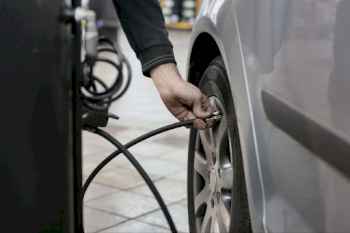
Knowing how a car behaves requires knowing its condition. A few checks a new driver should be able to do without help include:
Gauge Magazine’s guide explaining how to measure tire tread offers additional methods for checking tire condition.
Understanding what stability and traction control actually do also helps. These systems can help manage a loss of traction, but they cannot overcome excessive speed or the limits of available grip.
Skills can fail under load. A new driver who handles a quiet road well can become overwhelmed at a busy interchange because attention is finite.
Reducing that load is a skill in itself. Set navigation before moving. Adjust mirrors and climate controls before shifting into drive. Keep the phone out of reach rather than relying on willpower.
Passengers add load too, which is why many graduated licensing systems restrict them during the early licensing stages. Those restrictions are intended to reduce distractions while new drivers gain experience.
Competence behind the wheel accumulates in specific conditions, not just through general driving time. A driver comfortable in daylight on familiar roads may not yet be prepared for rain, snow, night driving, or highway merging.
Seek experience in those conditions deliberately, with a qualified instructor or supervising driver, before encountering them alone. That is what turns a licensed driver into a capable one.
The post Essential Skills Every New Driver Should Learn appeared first on Gauge Magazine.