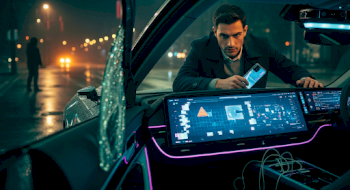

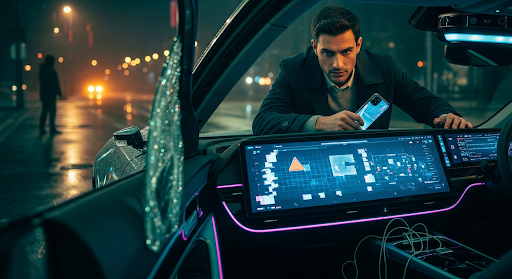
A crash involving a driver-assist or self-driving vehicle may leave behind important digital evidence, including alerts, system data, and available camera footage. Image generated by Gemini.
A highway collision is stressful enough when two conventional vehicles are involved. But a crash with a self-driving vehicle can present a different kind of problem—one in which important evidence may exist in software records, cameras, radar sensors, event data, and company-controlled systems.
Some digital records may be overwritten, changed during repairs, or retained only for a limited period. Access can also depend on the vehicle, manufacturer, operator, insurance policy, and applicable law. Taking prompt action can protect both your physical health and a future insurance or legal claim. Here is what drivers should know about preserving evidence and navigating the developing liability questions surrounding automated driving collisions.
There is considerable confusion about what “self-driving” actually means, and marketing terminology does not always make the distinction clear. Many vehicles described casually as self-driving use Level 2 advanced driver-assistance systems. Under the classification used by the National Highway Traffic Safety Administration, Level 2 means the system can assist with both steering and acceleration or braking while the human driver remains fully engaged and attentive.
Higher-level automated driving systems are different. A Level 4 vehicle can perform the driving task without a human driver, but only within its defined operating area and conditions. Responsibility after a crash may involve the vehicle owner, human driver, fleet operator, automated-driving-system developer, manufacturer, or more than one party. The answer depends on how the vehicle was operating, the available evidence, and the applicable law.
A conventional collision may be investigated through photographs, police reports, physical damage, witness statements, and vehicle inspections. A crash involving advanced vehicle technology can generate additional evidence, including Event Data Recorder information, dashboard alerts, ADAS status data, available camera footage, telematics, and navigation or dispatch records.
Not every vehicle records or preserves all of this information, and an EDR should not be assumed to contain complete sensor or camera data. Even so, digital records can become important when determining whether a system was engaged, whether warnings appeared, and how the vehicle responded. As one analysis explains, cloud-stored vehicle data has become critical in some modern accident claims. Obtaining company-controlled records may require a formal preservation request, subpoena, court order, or another legally authorized process.
| Crash Type | Usual Evidence | Possible Technology-Specific Evidence | Why It Matters |
|---|---|---|---|
| Standard Car Crash | Photos, witness statements, and police report | EDR or dashcam data when available | Can help document the impact and driver behavior |
| Driver-Assist Vehicle Accident | Photos, statements, and police report | Dashboard alerts, ADAS status, EDR data, and available camera clips | May show whether assistance was active, warnings appeared, or braking occurred |
| Highly Automated Vehicle Crash | Photos, statements, and police report | Sensor logs, route data, remote-assistance records, dispatch data, and software logs | May help identify how the automated system and its operator responded |
Check yourself and your passengers for injuries right away. If it is safe and legally appropriate to do so, move the vehicle out of active traffic lanes. Request police and medical help when someone may be injured or the collision creates an immediate danger. Do not delay emergency care to collect photographs or other evidence.
An official report can document the people and vehicles involved, statements given at the scene, apparent injuries, road conditions, and an officer’s observations. It does not necessarily make the final determination of civil fault, but it can preserve important information.
Human inattention remains a serious road-safety concern as automated features expand. NHTSA reports that 3,208 people were killed in car crashes involving distracted drivers in 2024. Because Level 2 systems still require the driver to remain fully engaged, observations about driver behavior may become relevant.
From a safe location, photograph the positions of the vehicles, visible damage, license plates, traffic controls, weather, road conditions, debris, and skid or tire marks. Photograph your own dashboard warnings and screen messages before they disappear, provided doing so does not interfere with emergency responders or put anyone in danger.
If another vehicle’s displays are visible from a lawful public position, a photograph may preserve useful information. Do not enter, reach inside, touch, restart, or manipulate another person’s vehicle. Do not interfere with police, towing personnel, or emergency care to obtain an image.
Some prompts disappear after a vehicle is restarted or powered down, although this does not mean all underlying data has been erased. NHTSA crash reports involving automated systems can include narratives and system-status information, but public reports may contain redactions and do not necessarily provide every internal record. Independent photographs can therefore add useful context.
Gather the human driver’s license and insurance information when a driver is present. Determine whether the vehicle is privately owned, rented, commercially operated, or part of an automated ride service. For a robotaxi or app-based trip, save screenshots showing the ride, vehicle identification, route, pickup information, and service provider.
You can ask whether a driver-assistance mode was engaged, but do not argue about fault or treat the answer as conclusive. A driver may say the car was driving itself, but the actual automation level and system status still need to be verified.
For Level 2 systems, the person behind the wheel remains responsible for supervising the driving task. Different rules may apply to a Level 4 robotaxi operating without a driver. International approaches are also changing; for example, BYD recently promised to assume responsibility for certain crashes involving specified automated-driving technology in China. That policy does not establish liability rules in the United States.
If a serious injury or disputed technology issue is involved, ask how onboard data will be preserved before substantial repairs, software resets, salvaging, or disposal occurs. Do not perform a factory reset or delete vehicle-app information. Save your own dashcam files promptly in at least two locations.
Necessary towing, emergency work, and safety-related handling should not be delayed. Simply powering down a vehicle does not automatically erase every record, and keeping a damaged vehicle energized may create its own risks. The appropriate preservation process depends on the vehicle and should be handled by qualified personnel.
Potentially relevant records may include EDR information, available onboard video, ADAS or automated-driving-system status, sensor fault codes, telematics, dispatch records, remote-assistance communications, and software-version information. A formal preservation request may be needed when another driver, fleet operator, software developer, or automaker controls the records.
Early legal guidance can matter when several parties control different evidence, especially if you’re hit by a car crash involving automated technology in Wisconsin, where comparative-fault and product-defect questions may affect the claim.
Report the crash to your insurance carrier within the time required by your policy, but stick to facts you actually know. Do not speculate about whether the other vehicle’s technology failed, and do not accept blame based only on an assumption about which systems were active.
Keep copies of insurer correspondence, claim numbers, photographs, estimates, medical records, and notes from telephone conversations. Before giving a recorded statement, understand who is requesting it and what cooperation your own policy requires. An opposing insurer does not represent your interests.
Insurance issues can become complicated after a serious collision. The Insurance Information Institute reports that 15.4 percent of motorists were uninsured in 2023. The National Safety Council estimated that the average economic cost of a fatal car crash was approximately $2.05 million per death in 2024, while the average economic cost of a disabling injury was $174,000. These are national estimates of economic impact, not formulas for valuing an individual insurance or legal claim.
Gauge Magazine’s guide explaining what to do immediately after a car accident provides additional guidance on safety, medical care, insurance notification, and scene documentation.
Restarting or altering a vehicle before photographing visible dashboard warnings can remove useful context. Deleting ride history from a smartphone app can also eliminate information connecting a passenger or vehicle to a particular robotaxi trip.
Avoid stating that a system “worked fine” or definitely failed before the relevant records have been reviewed. For a serious or disputed crash, ask about preserving available vehicle data before authorizing repairs that could alter evidence. Do not delay safety-related towing or necessary medical care simply to preserve a vehicle in place.
Be careful with social-media posts. Photographs, speculation, location data, and comments about injuries may later be compared with insurance statements and medical records.
The driver who receives a ticket is not necessarily the only potentially responsible party in a civil claim. Depending on the facts, a vehicle manufacturer, component supplier, automated-driving-system developer, fleet operator, maintenance provider, or human driver may face questions about responsibility.
A private industry overview reports 2,081 automated-vehicle crashes between 2021 and 2025 and states that the autonomous vehicle was found solely at fault in just 4% of 2,052 incidents involving another road user for which the publisher reviewed narratives. That percentage is the publisher’s analysis, not an official NHTSA fault determination.
NHTSA specifically warns that its automated-driving crash reports have important limitations. Reporting requirements differ between automated driving systems and Level 2 assistance, reports may be incomplete or updated, and the database does not by itself establish fault or provide valid crash-rate comparisons without information about miles traveled and operating conditions.
The stakes extend beyond individual claims. The Insurance Institute for Highway Safety reports that 7,080 pedestrian fatalities occurred in 2024, accounting for 18% of motor-vehicle crash deaths. That broader safety concern helps explain the attention given to pedestrian detection and automatic emergency braking.
Save every piece of documentation related to the collision and your medical care. Organize hospital records, pharmacy receipts, therapy bills, towing invoices, storage charges, repair estimates, and insurer communications in one physical or digital folder.
Track missed work and keep dated notes about symptoms and limitations. Record the facts without exaggeration, and report new or worsening medical symptoms to an appropriate healthcare professional rather than relying only on a personal diary.
A broader safety report estimated that fatal and serious traffic crashes in 2023 resulted in $1.9 trillion in societal harm, including approximately $460 billion in economic costs. Those national figures do not determine an individual claim’s value, but they illustrate the wider financial effects of serious crashes.
Obtain the police report when it becomes available and ask the appropriate agency how to request 911 recordings or dispatch records. Ask the repair facility to photograph damaged cameras, radar units, lidar equipment, wiring, control modules, and sensor mounting points before repairs begin. Save backup copies of your own dashcam footage on separate devices or storage services.
Keep manufacturer communications, recall notices, and software-update information associated with the exact vehicle and system involved. In 2026, Waymo filed a voluntary software recall after identifying a condition in which affected vehicles could slow but continue into standing water on higher-speed roads. The recall demonstrates why software versions and manufacturer notices can matter, but it does not prove that the same defect caused an unrelated collision.
If the collision may involve braking or sensor performance, Gauge Magazine’s guide to advanced braking system malfunctions provides additional automotive context. Gauge Magazine also explains the factors that can help build a strong car accident claim.
Safety always comes first after a roadway collision. Once everyone is out of immediate danger, documenting physical evidence and identifying possible digital records become important. Do not assume fault is obvious simply because a human driver was—or was not—behind the wheel.
Some driver-assist and automated-vehicle crashes involve company-controlled or cloud-based records that an individual driver cannot access directly. Retention periods and access procedures vary, which makes prompt preservation requests important in serious or disputed cases.
Secure the records available to you, ask who owns or controls the remaining data, and avoid making technical conclusions before the evidence has been reviewed. Early, careful documentation provides a stronger foundation than assumptions about what the vehicle or its software must have done.
The post 5 Steps to Take After a Crash With a Self-Driving Vehicle appeared first on Gauge Magazine.