
Warning: This post contains spoilers for Verity.
Under the studio lights of Hot Ones, across the table from host Sean Evans, Verity Crawford (Anne Hathaway) looks every inch the bestselling novelist with the enviable life. We have seen a sliver of this interview before, playing on a laptop while someone else watched. Now it fills the frame, and for once nothing stands between Verity and the audience: no laptop screen, no manuscript page. The footage comes from before: before the car wreck that left her silent, before a writer moved into her house to take over her work, before the night her husband and that writer carried her body down to the lake. The interview is the film’s final image, and Verity gets the closing line, a remark about certainty. Then cut to black.
Verity’s return to its title character at its very end is a bold way to close a story that declines to say whether she was a sociopathic monster or the ultimate tragedy. It is also, for director Michael Showalter and author Colleen Hoover, the entire idea. Showalter’s Verity adapts Hoover’s 2018 novel, a self-published thriller that became one of the biggest word-of-mouth hits in contemporary publishing. In the book, Lowen, a broke writer grieving her mother, is hired to finish Verity’s series, which the latter can no longer write herself; a car accident has seemingly left her unable to speak or even comprehend what’s going on around her. In Verity’s office, Lowen finds So Be It, an autobiographical manuscript Verity wrote before her accident, in which she confesses to resenting her twin children, Harper and Crew, and to letting Harper drown in the lake behind the house. She also finds Jeremy, Verity’s husband, grieving and attentive, and growing closer to her by the day.
The film keeps the shape of Hoover’s ending, including its refusal to definitively explain what really happened inside that house. What it changes is who speaks last. “There’s something about this story that’s very big,” Showalter tells TIME. “Crazy things happen. It’s scary, it’s sexy, it’s surprising. I wanted to preserve those moments that are like, whoa, that just happened.” Hoover, a producer on the film, had a simpler test. “I was just hoping that readers would walk away with the same feeling they felt when they read the book,” she says.
The film opens not on Lowen but on Verity, mid-interview, with Gayle King marveling at one of the best-selling authors on the planet and Verity calling her life “all a miracle.” Some could say, King replies, “it’s a miracle built on villains,” a line that hangs over everything that follows.
On a Manhattan sidewalk outside Grand Central, Lowen Ashleigh (Dakota Johnson), headphones on, is spattered with a stranger’s blood when a car strikes a cyclist nearby. The man who walks her to a coffee-shop bathroom and hands her a clean white shirt is Jeremy Crawford (Josh Hartnett), who seems steadier than she is. “I’ve seen worse, unfortunately,” he says. When she asks what happened to him, he tells her he pulled his eight-year-old daughter’s body from a lake last spring. She answers with her own loss: Her mother died last week of cancer.
Minutes later she encounters him again in a meeting with Hachette Book Group, where Verity’s editor asks whether she would finish Verity’s series. Jeremy privately tells Lowen the offer is a lowball; she should ask for $500,000. She does, and gets it.
Lowen heads north to the Crawfords’ home in Vermont, where Verity kept her papers and Jeremy offers her a room. The house, all angles and low ceilings, sits with the lake at its back. There she meets Crew (Brady Wagner), the surviving twin, small and watchful, and Verity herself, propped upright, eyes open but vacant.
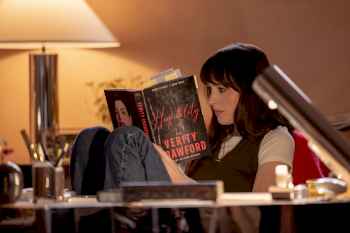
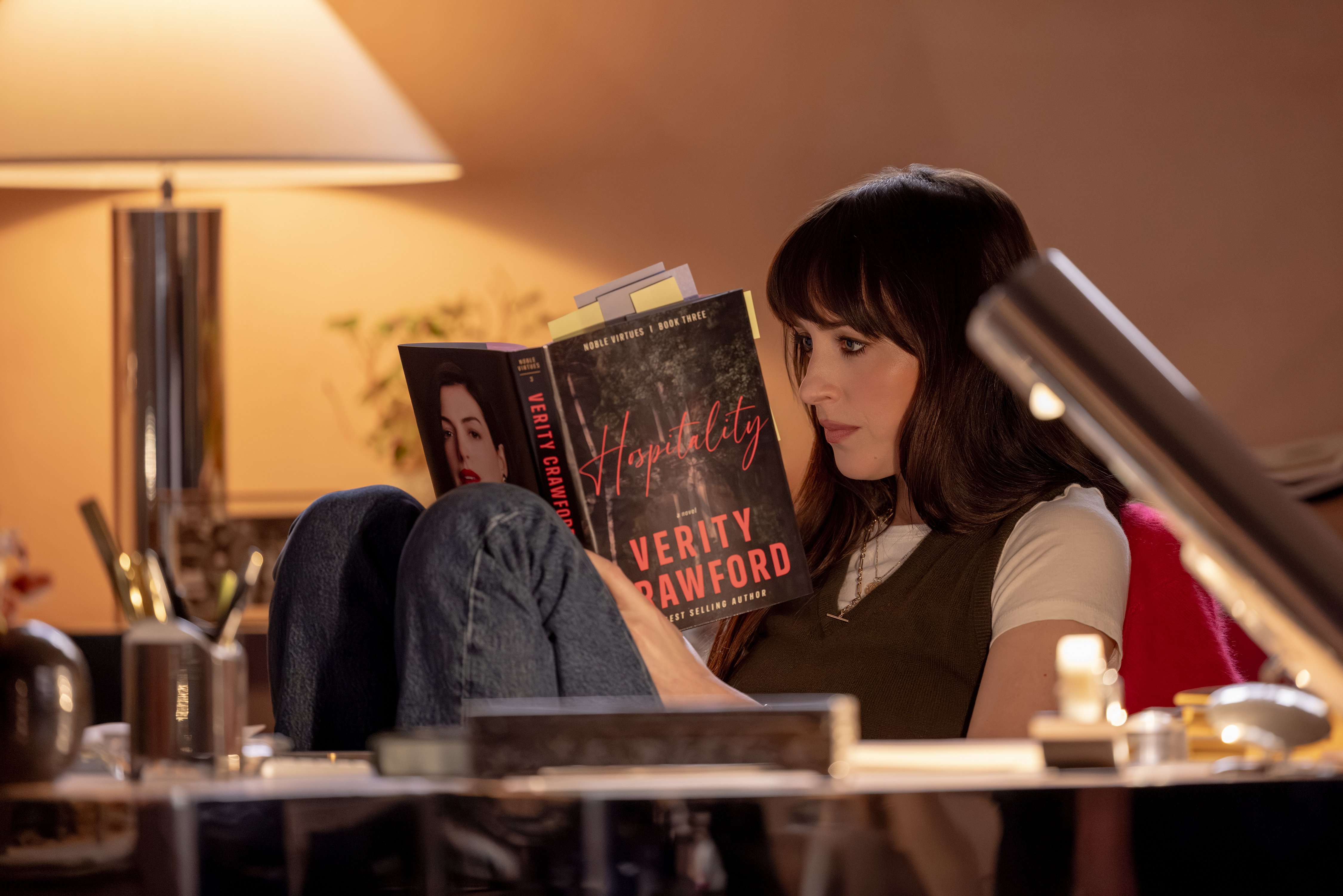
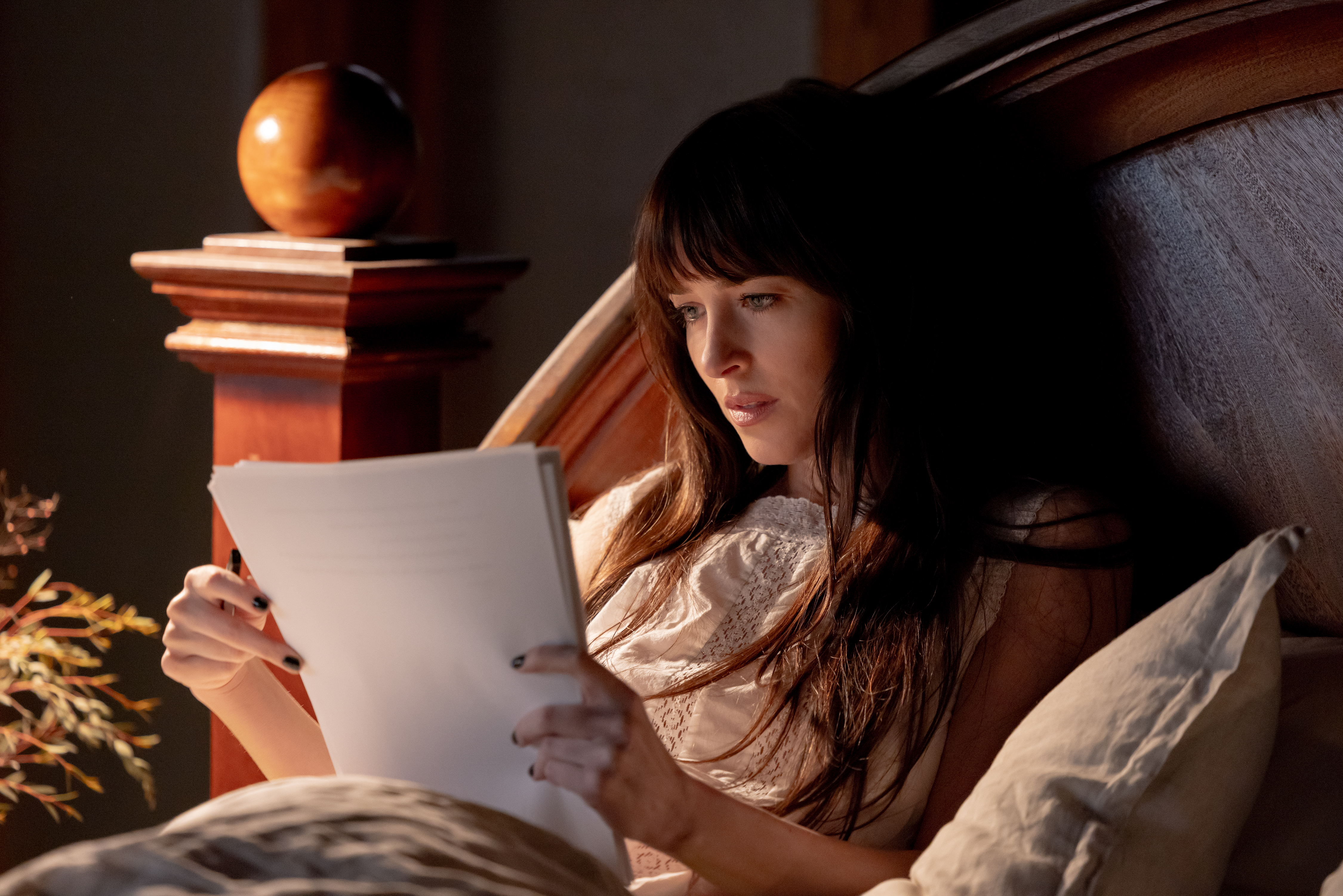
Lowen finds the manuscript early, saved on a USB flash drive hidden in a cigarette pack in Verity’s desk. It reads as nothing the publisher asked for: an autobiography of the marriage, opening on the night Verity, in a red dress, first caught Jeremy’s eye. From there, the film alternates between Lowen’s days in the house and the chapters of So Be It, and the way it stages those chapters is its most daring swing.
As Lowen reads, the manuscript takes over the screen: Verity narrates her confession and occasionally turns to address her reader directly, as if she can feel Lowen turning the pages. The author’s note ends on a dare. “Here you are. Human. Curious,” she writes. “Carry on. But know one thing: there is no light where we’re going.” The device breaks the fourth wall of a story that is, underneath the murder plot, really about what reading can do to a person.
Hoover allows that the device gave her pause; it “could either go really well or really badly.” But seeing it on screen settled the question, and she loved it. For Showalter, the reading itself became the film’s real subject. “It’s a relationship. It’s intimate. It’s all-encompassing,” he says. “It’s a love affair.”
The manuscript’s logic is stark. Verity never wanted to share Jeremy with anyone, and once the twins arrive, she finds one far easier to bear than the other. “Crew was fairly quiet, but Harper cried constantly,” she writes. “It was like she was trying to punish me, telling me I was a bad mother.”
Her first attempt to kill Harper comes while the twins are still infants, when she presses a pillow over the baby, believing suffocation could be mistaken for SIDS. But she’s interrupted when Jeremy wakes and finds her, though he doesn’t see what she’s attempting to do. Her second try comes years later. Harper and Crew are painting at the dining table when Jeremy, about to leave for Boston, suggests Verity take them out in the canoe—and she does. Harper sits in the front, Crew in the middle. “None of us were wearing life vests, and I shifted all my weight, and the boat tipped over,” Verity writes. She saves Crew and lets Harper drown. A mother exaggerating ordinary resentment into a monster’s confession is exactly what the letter, when it eventually arrives, will claim Verity was doing.
Readers of the novel will notice the family is smaller. Hoover’s version has three children, two of whom die; the film makes Harper and Crew twins and leaves only one death at its center. The change predates Showalter’s involvement, but he says it “streamlined” the story and lets the film “focus on the one child and the mystery surrounding that.”
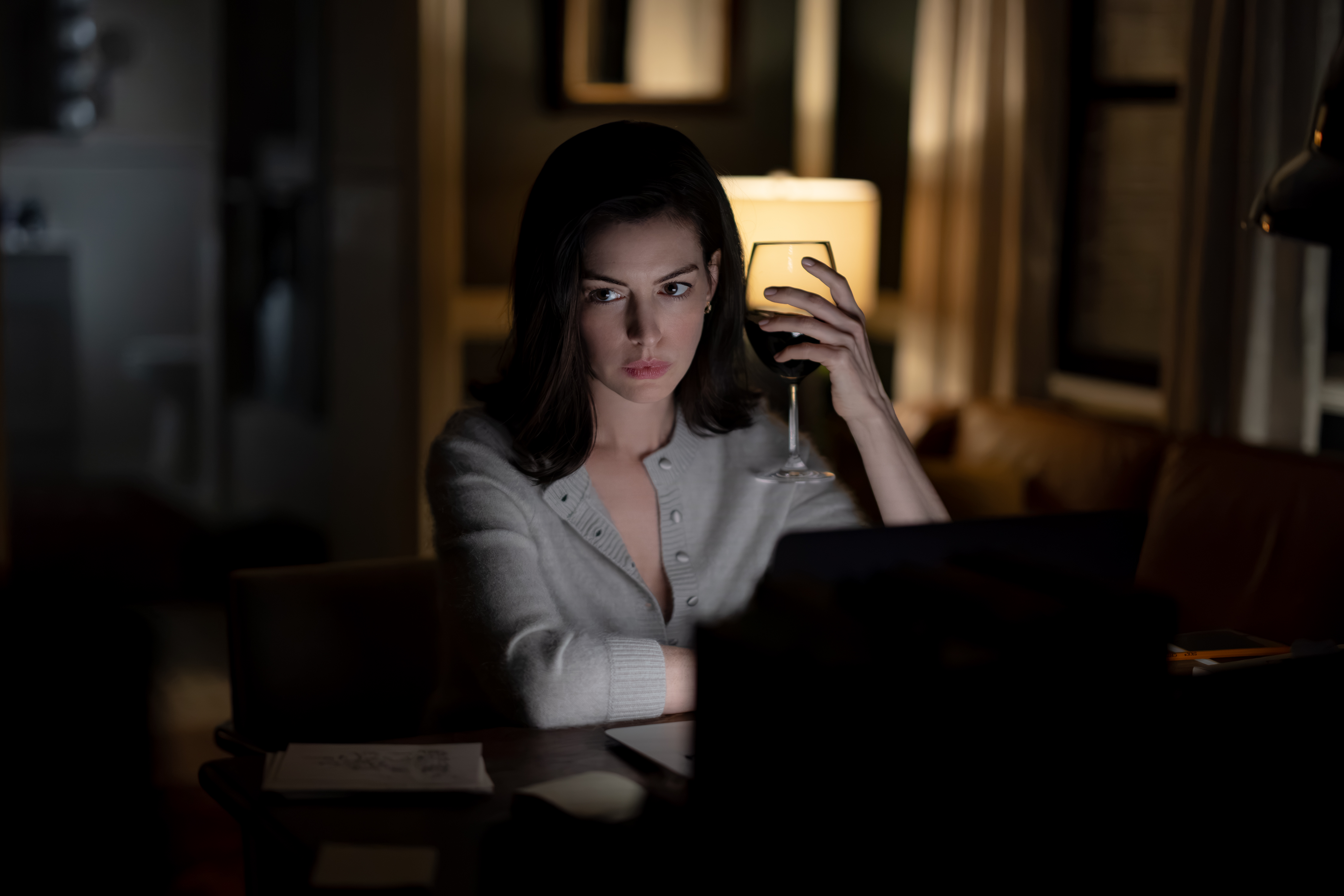
The more Lowen reads the manuscript, the further she steps into Verity’s life. Between chapters, she watches Verity’s Hot Ones appearance on her laptop. When Jeremy takes her out for a belated birthday dinner, he points her to his wife’s closet to find something special to wear. Lowen chooses a red dress that echoes the one Verity wore the night the couple met. Over wine and Wiener schnitzel at what Jeremy bills as the best Bavarian restaurant in rural Vermont, he confesses he lied earlier: Verity never read Lowen’s book. He did. “Because the thing is, your writing matters to me, Lowen,” he says. Back at the house, they kiss, until Lowen thinks she sees Verity standing in the dark hall behind him. Jeremy tells her his wife can’t walk. Despite Lowen’s unnerving vision, that night they become lovers. In the film’s most delirious sequence, the dread follows Lowen into sleep: She kisses Jeremy in a dream, then pulls back to find Verity beneath her, blood on her lip.
With the dress, the husband, and the dream, Showalter is signaling exactly which tradition he’s drawing from. “Hitchcock does so much in his films with doppelgängers,” he says, citing Vertigo and All About Eve, as well as Brian De Palma’s Body Double, as touchstones for stories about people taking on another person’s identity. “[Lowen] covets the success. She covets the relationship. She covets all of it,” Showalter says. “She’s sort of slowly becoming Verity.”
The house’s last secret comes from Crew. “Mommy said I shouldn’t talk to you if you ask any questions about her,” he tells Lowen, and when she asks whether his mother is pretending she can’t talk, he bites down on a knife. Lowen goes to Verity. “You have this perfect life,” she tells her. “You have everything that anyone could ever want. That I want. And you don’t deserve it. So I’m gonna take it from you. All of it. Your house. Your career. Your husband.” It is the closest the film comes to a confession from Lowen. It’s up to our interpretation whether the words wash over Verity, meaningless, or she hears each and every one.The manuscript ends where Verity’s public story began, with the car. In its final chapter, she recounts the police interviews after Harper’s death and Jeremy’s grief, which she finds tiresome. “He’s become such a drag now that Harper’s dead,” she writes. “I almost wish I hadn’t killed her. If that’s the case, so be it. I’ll just drive my car into a tree.” Lowen reads those lines knowing how the story turned out: there was a tree, a wreck, and a woman upstairs who hasn’t spoken since.
The turn comes on a stormy night, when Jeremy realizes Lowen planted a camera in Verity’s room to try to catch her in a lie. Confronted, Lowen stops explaining and starts accusing. “Your wife is not who you think she is,” she tells him, handing him a printout of the manuscript. Jeremy finishes reading it looking like a man seeing his wife for the first time. He storms into Verity’s room. “You murdered our daughter, Verity,” he shouts. His wife does the one act that ends the argument over her condition for good: she moves. She has, in fact, been faking her incapacitation the entire time, while hatching a plan of her own.
Jeremy’s hands go to Verity’s throat, and Lowen, watching, stops him, not to save Verity but to save him. “Think about Crew,” she says. “He won’t have a mother or a father if you do this.” She tells him to “make it look like an accident” by covering Verity’s nose and mouth until she stops breathing. “Don’t leave any marks.” So Jeremy smothers his wife in her bed while Lowen stands a few feet away, and Showalter’s camera holds a few feet closer than that, leaving the audience nearer to the killing than Lowen, who called for it. The couple carry the body to the water and let it go, arranging a fiction for whoever finds her: Verity woke from her long absence and walked into the lake that took her daughter. “It was done,” Lowen says in voiceover. “It could not be undone. We were free from Verity.”
For Showalter, Lowen’s suggestion is the crucial moment. Until then, he says, “we are all Lowen going into this haunted house with these larger-than-life characters.” The instant she proposes making it look like an accident, “all of a sudden, it’s like the rug has been pulled out from under us.” He considers it the story’s engine. “The minute you think you’re on solid ground, you’re not.”
Staging Verity’s death in the lake is the film’s own invention, and it works two ways at once. In the novel, the couple make it look as though she choked on her own vomit. Here, her death mirrors Harper’s: another drowning, another death made to look like an accident. And it gives Lowen a physical role in the cover-up; she is no longer advising a murder but helping to hide one. When the police come, Lowen lies as smoothly as she writes. One officer asks whether she was working with Verity on the newest Noble Virtues novel. “Perhaps,” Lowen says, and when he admits he’s a fan, she adds, “It’ll be the best one yet.”
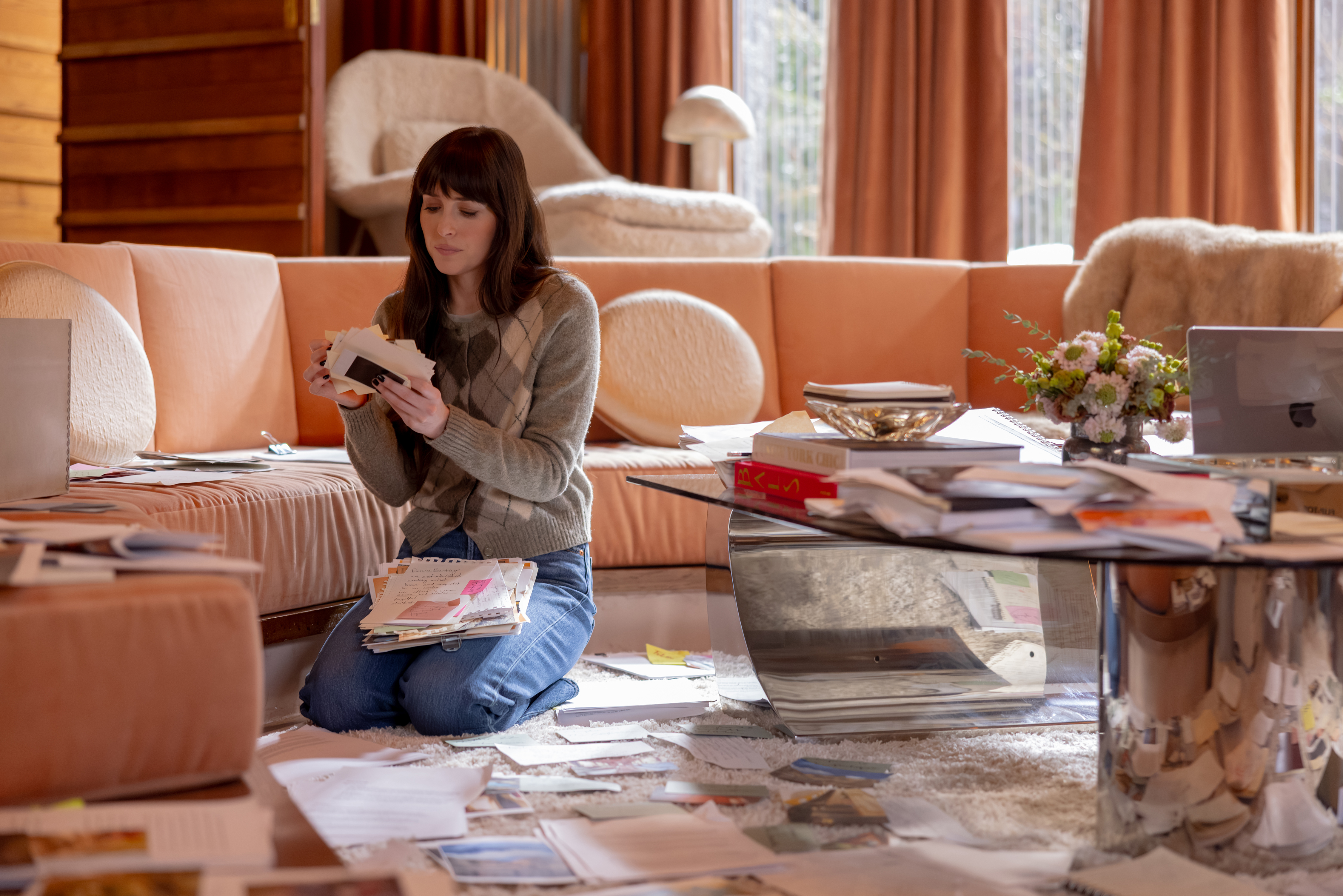
Seven months later, Lowen is pregnant, and the Crawford house is emptying into a moving truck; she, Jeremy, and Crew are bound for Southport, North Carolina. She hands Jeremy an advance copy of Diligence, the latest book in Verity’s series, which Lowen wrote. Crew has retrieved his pictures from a secret hiding place he won’t reveal. Lowen finds it anyway: a loose floorboard, with several handwritten pages beneath it.
Verity’s letter, written to Jeremy after the crash during the months she spent feigning her condition, insists that So Be It was never a confession but a writing exercise. It came, she writes, from a dinner with her editor, Amanda, who called it “antagonistic journaling”: keep a journal of your life, except flip your inner dialogue to the opposite of what you were thinking, the opposite of who you are. Living inside a villain’s head proved “exhilarating,” the secret behind her “realistic, terrifying characters” and the reason her books sold. After Harper’s death, with her mind in “such a dark space,” she leaned on it harder, pushing the pages to be “more jarring, more disturbing.” Jeremy, finding the file open on her computer, mistook the villain for his wife. “It was just an exercise. It wasn’t real,” she writes. “After all those years of marriage, how could you, even for one second, believe any of that manuscript to be true? I mean, seriously, Jeremy. Do you know me at all?”
The letter then describes what he did about it. Every memory of their family, she writes, was “erased with every new word of the manuscript that you had read.” She remembers his face, “complete and utter misery,” and then very little: “I felt dizzy, and everything became a blur, and I realized that you believed it.” By her account, Jeremy drugged her. He put her behind the wheel of their car, aimed it at the trees, and sent it off, so that the wreck would look like Verity had done what her manuscript promised. She came to as it was happening. “I looked out the windshield; all I saw were trees, and in that moment I knew what you were doing,” Verity writes. “You were going to kill me and make my death look like an accident. I had unknowingly written my own death into the last two sentences of my manuscript.” Those are the last two sentences Lowen read, and the ones that gave the manuscript its title.
If the letter is true, Jeremy staged his wife’s death from her own ending, and the phrase Verity uses for it, “make my death look like an accident,” is the one the audience heard an hour earlier from Lowen, in the bedroom. It also explains the months of silence. “Inconveniently, I was still alive, so I made a plan,” Verity writes. Denying the manuscript would never work, and if Jeremy learned she had recovered, “you can turn me in to the police or finish the job yourself.” So she played the invalid and waited for a chance to take Crew and go. Crew, she writes, was the only one who knew she was still there. Which means Jeremy already knew the pages existed when Lowen handed him the printout, and his shock, like his wife's silence, was an act.
The letter is the most argued-over object in Hoover’s novel, and the one that puts its title to the test. “That was my whole goal with the book, and also the title,” she says. The word verity, after all, means truth. She hadn’t outlined the ending, but once the letter occurred to her, “I got so excited and probably didn’t sleep for three days writing that scene.”
After reading the letter, Lowen chooses not to show it to Jeremy; Hoover sees the silence as practical. “What’s done is done,” she says. Nor, in her view, does Lowen want to believe the letter at all, though Hoover wonders how anyone could move forward, carrying Jeremy’s child, without some fear. But she points to the same consolation the character reaches for: whatever the truth, Jeremy was protecting his children. “Like, oh, he’s going to be the best dad ever,” Hoover says. “He would kill his wife for his kids, which doesn’t really constitute dad of the year.”
Hoover’s readers have spent the better part of a decade splitting into camps over which document to trust: Team Manuscript holds that Verity’s manuscript is a confession to take at face value, while Team Letter claims Verity became the victim of her own craft. The film leaves the question fully open: which version of Verity was real?
As a reader of her own book, Hoover leaned toward Team Manuscript in the past. The movie has since complicated that view. “While the movie was being made, I still wanted to be confused,” she says. She got her wish and then some. “I had to go back and reread the book for some annotations recently, and now I feel bad for Verity in a way that I never felt after writing the book—and I think that’s because of the movie.” Showalter, she says, “opened up this possibility for so many different perspectives to be the truth,” and each return to the story has landed her somewhere new. “After writing it, I thought one way. Watching the movie, I thought one way. But then reading the book again, after having all of that, really made me start questioning again.”
Showalter’s thinking on the film shifted, too. He explored multiple endings before landing on the one that made the cut. In many, Lowen ends the film “way more at peace with everything,” her doppelgänger arc complete, having “fully become sort of the dark phoenix rising a little bit.” He stands by the final cut. “We ultimately decided not to go that far, but to leave it in that very ambiguous place,” he says.
The novel ends inside Lowen’s head, as she weighs which Verity to believe, and the film gives her that moment too, in voiceover that begins during her last sweep of the house and carries into the car ride. “Her manuscript, her letter, her husband. I have no idea what to believe,” she says. “The only thing I know for certain is that Verity was a master at manipulating the truth. The only question that remains is which truth was she manipulating.” Then the film takes the ending away from her.
As the car disappears down the road with Jeremy, Lowen, and Crew, sun dappling through the trees, Showalter cuts back to the Hot Ones interview, the clip Lowen watched on her laptop inside the Crawfords’ house. This time no screen frames it.
Evans asks which of the nine moral themes behind Verity’s book series was the most fun to corrupt. “Truth,” Verity says. “I wanted to see how far you could push it, how certain I could make the audience before showing them that maybe certainty wasn’t the wisest choice.” She’s describing her novels, but she is also describing the movie that just ended, which spent its runtime making its audience certain about her, then handed them a letter threatening to change everything. And she is speaking past every character in the film, straight to the theater, the way her manuscript spoke past Lowen to us. The clip that entered the film as Lowen’s homework exits as Verity’s final address.
For Showalter, the cut is less a twist than a refusal. “We’re not going to let you walk out of here knowing for sure what was real and what was false,” he says. “It was giving her the last word.”
Hoover shares that instinct, and she counts not two Veritys in Hathaway’s performance but really three: the Verity of the manuscript, as Lowen imagines her; the bedridden Verity; and the public Verity from the interviews. “You walk out thinking, which one is the real Verity?” Hoover says. “I love that they decided not to answer that question, and that you leave with that uncertainty.”
Lowen leaves the Crawfords’ home with nearly everything she coveted in the film’s first act: Verity’s husband, Verity’s surviving child, a baby on the way, and a higher-profile writing career attached to Verity’s name. But she will never know whether the man beside her in the car is a grieving father or the villain of Verity’s letter, or whether the woman they carried to the lake wrote a confession or a character. Certainty is the one possession Lowen has to leave behind.
Lowen won’t be the only one left wondering. Readers have argued over Verity since 2018; now anyone with a ticket can join in. Somewhere in the days and weeks ahead, in a lobby or a group chat, one viewer will swear the manuscript was real and another will swear by the letter. Verity, who wrote both, took the answer with her into the lake. That is the ending’s last trade: the living inherit the doubt, and the dead, as ever, hold the truth.