
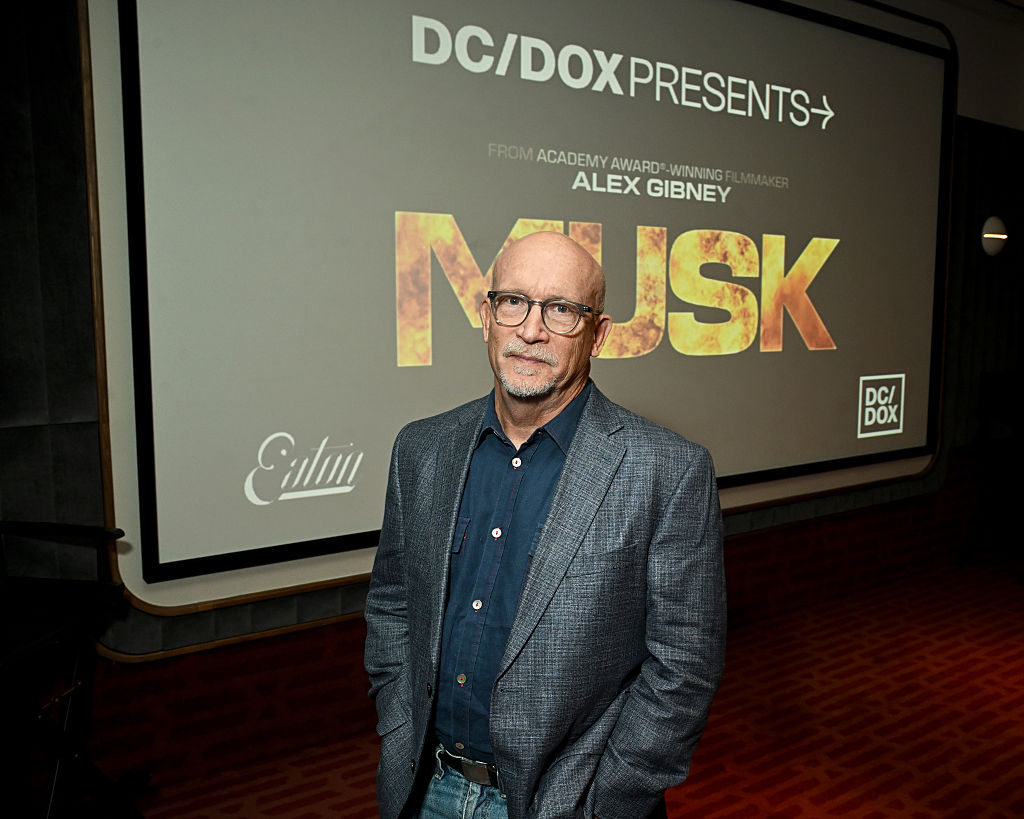
Elon Musk has called the documentarian Alex Gibney many names on X in the last few months: “crackpot,” “douchebag to his core,” “an idiot,” and someone for whom “dogsh*t is worth more respect.” That’s because Gibney made a four-hour documentary about him, “Musk,” which arrives in U.S. theaters October 9.
Gibney has chronicled tech leaders including Elizabeth Holmes and Steve Jobs. But this film has generated perhaps more news and controversy ahead of its release than any of his previous documentaries, in large part because of how strongly Musk and other tech companies have reacted to it.
Musk is waging a war of words over the documentary online, and his lawyer threatened Gibney with a defamation lawsuit. In late September, the Hollywood Reporter wrote that YouTube, Meta, TikTok, and X all declined to run the movie’s trailer on their platforms due to its “political content.” Universal Pictures, which controls the movie’s worldwide distribution rights, also delayed its rollout over political sensitivities before saying that it stood by the film. (A representative for Gibney wrote to TIME on Oct. 5 that worldwide distribution had been "worked out" following an Oct. 2 call with Universal, but did not elaborate further.)
On Sept. 30, Gibney sat down with TIME in Washington, D.C. to discuss why the movie is so critical of Musk, and Gibney’s ongoing fight to distribute it widely. Here are excerpts from the conversation, which has been condensed for clarity.
TIME: Is this movie a hit piece, as Elon Musk says?
Gibney: It's certainly critical, but I think the criticism is earned. This is a rigorous and meticulous investigation of somebody, and it ends up being critical.
I saw the film yesterday and found it incredibly dread-inducing. It literally ends with the destruction of the planet into a fireball.
Yes. That's right.
How are your dread levels these days?
They're really high. Look at all of these tech leaders in Washington, talking about the future of AI. The takeaway seems to be, “We'll just take care of it.”
Having been on that ride with Elon Musk, I don't want him to take care of it. He seems so comfortable with risk that he'd just as soon leave the planet. I posit at the end of the film, it's as if he's betting on whether or not AI will lead us to a moment of extraordinary abundance or basically the end of life on Earth. Who makes that kind of a bet?
Musk just landed a new gig: co-leading Project Meridian, a new Pentagon initiative aimed at shaping the future of warfare.
That's like putting the Joker in charge of the Manhattan Project. This is not a serious person at this moment, but he's being handed enormous power.
You’ve made several docs about Silicon Valley figures, including Steve Jobs and Elizabeth Holmes. In which ways is Musk simply channeling Silicon Valley mythmaking, and in which ways is he distinct?
I think it’s both, but I would draw some distinctions. Steve Jobs, after NeXT [the startup he ran between his Apple stints], surrounded himself with a small group of people who could tell him no, and he would listen to them. And that's what made Apple great. He had a fanatical attention to detail when it came to making products. Elon did just the opposite. He surrounded himself with people who only tell him yes.
I do think, in the “fake it till you make it” sense, that he's straight out of the Silicon Valley mold and similar to Elizabeth Holmes in that way. The obvious difference between him and Elizabeth Holmes is you can drive a Tesla, and the Edison [Theranos’s blood-testing machine] never worked. It’s not worth what its valuation is, but there’s a real car.
Many in Silicon Valley would tell you that failure and mythmaking are part of the pathway to success. Thomas Edison lied about the lightbulb for years, and then he made it work and changed the world. While Musk has plenty of failures, he’s built so many actual things: rockets, cars, satellites.
Yeah, these are real companies with very impressive technology. Seeing those reusable rockets come down—it's really impressive.
But there’s an interesting angle to that SpaceX story, too. Elon has always positioned it that if SpaceX hadn't succeeded on the fourth rocket launch, he would have been broke and everything would have been over.
Lori Garver [former NASA administrator] tells a very different story. The federal government had decided to use him as a test case, and they were going to keep working with him whether that fourth launch went up or not. We're supposed to invest in the lone entrepreneur who gets by without any government help or assistance. Turns out, it's just the opposite. The government has always been his friend—it made SpaceX, it made Tesla profitable at critical moments.
Over your career, you've incurred the wrath of other powerful figures who you’ve made documentaries about: the Church of Scientology, Bibi Netanyahu. What is it like, comparatively, incurring the wrath of Elon Musk?
He threatened to sue over a movie that he hadn't even seen, which made it very much like the Church of Scientology.
That was just part of the playbook. I had just seen him threaten to sue Ro Khanna for citing all sorts of evidence about USAID. So, to some extent, Elon Musk is playing the role I expected him to play.
But I'd be a fool not to be concerned about Elon Musk, both because he's the richest man in the world and also because he has the ear of a president who has turned the Department of Justice into an instrument of revenge.
Have any odd things happened to you, like being tailed or anything like that?
There was somebody, actually, in Camden, Maine. I thought somebody from behind me was following me, and the person in the passenger seat had an iPhone up, photographing me. But what did Hunter Thompson used to say? “Just because I'm paranoid doesn't mean I don't have enemies.” [Thompson was famously paranoid, but the line is actually from Joseph Heller’s Catch-22.]
Many people on X are currently dismissing you as a hack and the movie as a hatchet job. Do you get discouraged over the fact that Musk has a bigger platform than you, and that you won’t be able to change most people’s minds?
I don't get discouraged over the fact that Elon has a microphone, because I think Twitter has become this kind of dumpster fire which houses a collection of cult followers for him, as well as some critics, in order to boost engagement.
But what I do worry about—and I saw it in the initial refusal of Google, Meta, TikTok, and X to run our ads for the trailer—is a kind of unspoken consolidation of power that doesn't want to allow criticism, particularly over the accretion of power and money. That is becoming more and more and more of a worry.
Thankfully, to some extent, there is a cyclical nature to this, because I remember when I did a film called The Trials of Henry Kissinger, no cable network would show it in this country until we put it out in theaters. It played for months at Film Forum, and then started playing around the country. And then there was such public demand for it that finally the network put it on.
Theaters, in this moment, are proving to be a pretty good outlet for critical voices that the streamers and the social media platforms won't allow.
Which of those social media platforms has backed down from blocking the trailer?
YouTube and Meta—both on Instagram and Facebook—are now allowing ads. TikTok is not, and X has said that they would allow them, but we haven't seen any evidence of it.
What does this whole kerfuffle tell us about the status of free speech?
It's being curtailed. I mean, the free-speech absolutist Elon Musk is doing his damnedest to limit speech.
One of the most controversial parts of the film is when Ashley St. Clair, Musk’s ex, says that before the 2024 presidential election, Musk texted her about feeling optimistic about Trump winning because of Musk’s “10,000 lasers in space.” What does that text mean, and what do you hope comes of it being in the movie?
It was there to raise questions. We did not assert that Elon Musk had changed votes in 2024. All we did was show Elon Musk's text to Ashley, where he talks about 10,000 lasers in space. Is that Mini-Me talking? Is he lying to his lover? Or is he boasting about something that he did relating to the fact that he knew before everybody else what the outcome of the election was going to be? That seemed worth putting in.
And it pays off a little bit later in the film, when we begin to wonder what happened to all of the data that DOGE had access to, and did it end up in Elon's hands? And is he going to use it for the 2026 elections? We don't know.
Why should the public care about all of the data that Musk may have had access to through DOGE?
As Geoffrey Hinton, the godfather of AI, says: if you were to train an AI on all the data of every American citizen, you'd have some powerful tools. Either to figure out how or where to devote resources during the election, or develop rhetorical strategies to appeal to people. We know how good Facebook and Instagram are at getting right to what we want, right? So, it's just disquieting on its face.
I think the idea is that, particularly with what Elon Musk is doing with AI: what does AI want more than anything else? Data. And that is a vast amount of data to feed to an AI system.