


Russian authorities told the World Health Organization (WHO) on Tuesday that a laboratory worker who died last week had not been found to have plague, and that no cases had been detected among people who came into contact with her.
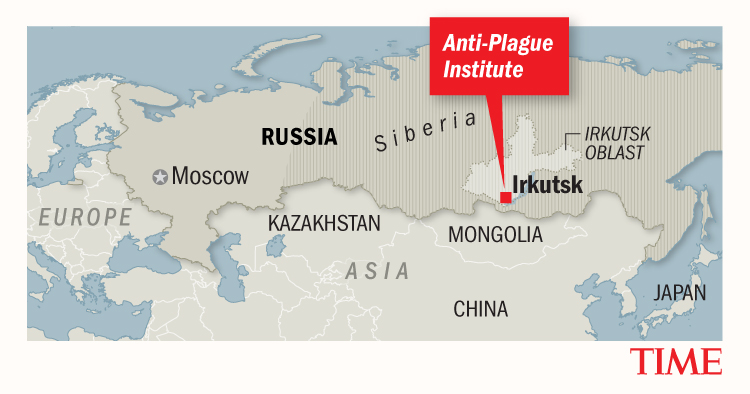
The statement comes amid speculation about the death of the 28-year-old worker, identified by local media as Darya Shipilova, who was employed at the Irkutsk Research Anti-Plague Institute of Siberia. Local reports said dozens of her contacts had been placed in quarantine.
One local outlet reported that she may have been exposed to plague when a test tube broke, but Russian authorities say they found no evidence of a laboratory accident. They told the WHO her illness “first looked like a typical acute respiratory viral infection.”
The WHO said on Tuesday it has asked Russia which pneumonia-causing pathogen led to the woman’s death. At a press briefing in Geneva on Tuesday, WHO spokesperson Christian Lindmeier said “no pathogens of dangerous infectious diseases were detected among any of the contacts."
Lindmeier said that the WHO’s initial risk assessment, based on the information available to the U.N. agency, “estimates the risk to be moderate to low for Irkutsk, a low risk for the Russian Federation as a whole, and very low for the WHO European region.”
Igor Kobzev, the regional governor of Irkutsk, said Monday the staffer had died from “pneumonia of undetermined” origin. Acknowledging there have been “different interpretations of the events” in the media, he said extensive laboratory tests had determined “no microorganisms related to the girl's professional activities were found in her biological samples.” He also said no new employees from the institute had sought medical attention in the past few days.
Rospotrebnadzor, the government body responsible for public health, similarly told state media the institute had not found signs of any accidents involving the handling of pathogens in the lab.
Maxim Modin, the mayor of the Shelekhovsky district in the Irkutsk region, said “comprehensive anti-epidemic measures are being implemented” in the area in response to the incident and that anyone who had contact with the deceased patient is being tested daily. Dozens of people who had been in contact with the lab worker have now been quarantined and are under observation by medical professionals.
Local media also reported last week that the inpatient department at the Shelekhov hospital where the lab worker died has been closed due to a suspected “particularly dangerous infection,” with local residents informed they will be unable to visit family at the facility. This has not been confirmed by public officials.
Kremlin spokesperson Dmitry Peskov, in remarks carried by Russian state media outlet TASS, told reporters Rospotrebnadzor should be followed for official updates, “rather than listening to various rumors and speculations.”
TIME has reached out to the Russian Health Ministry, the Irkutsk Research Anti-Plague Institute of Siberia, and Rospotrebnadzor for further comment.
Amid growing online speculation, some social media users have likened the reports coming out of Russia to those that circulated in the early days of the COVID outbreak in early 2020.
But Dr. Simon Clarke, associate professor in cellular microbiology at the University of Reading, stressed in a statement that it is “important to remember that pneumonic plague is a very different” disease.
“It is caused by bacteria, Yersinia pestis, famous for causing the Black Death, that remains with us today mostly in animals across parts of Asia, Africa and the Americas,” he said. "Pneumonic plague is particularly serious because it means the infection has reached the lungs and is nearly always fatal if not treated promptly. Unlike the bubonic plague which enters the body via infected flea bites, pneumonic plague can spread between people through respiratory droplets during close contact.”
However, unlike many viral respiratory diseases, he said, “plague is caused by bacteria and is generally treatable with antibiotics, if identified quickly.”
Remarking on the unverified reports that a lab worker was exposed to plague via a broken test tube, Clarke again urged caution. “It is not unheard of for pathogens to escape from labs, but an awful lot must have gone wrong for a lab worker to be infected by a broken test tube,” he said.
Jennifer Nuzzo, director of the Pandemic Center at the Brown University School of Public Health, agrees. "When someone is working with a dangerous pathogen in a lab, there are certain protocols that would be in place for the very realistic scenario that an accident could happen," she says. "One would expect that that person would have been treated with antibiotics immediately after the exposure to prevent the person from becoming ill and certainly to prevent the person from dying. If this is plague, I don't understand why that didn't happen."
She finds it notable that this rather standard biosafety procedure does not appear to feature in reports from the Russian authorities. "For a variety of reasons, the situation in Siberia doesn’t strike me as a plague outbreak," she says. It might be another pathogen, from which we have fewer protections. "For that reason, I'm not calling it a plague. I'm calling it a pneumonia of unknown etiology," she says.
It might also turn out to be a case where the authorities overreacted to something more common—but even that would not be a reason to stop surveilling the situation. "Absent information, all of this makes me think we should be looking harder and asking more questions, and we should be getting more answers," Nuzzo says. "They should have a full sequence by now," she says, meaning the pathogen should be identified.
U.S. Secretary of State Marco Rubio on Tuesday called for Russian authorities to release more details about the lab worker's death.
“I think it's incumbent upon Russia to obviously share more information with the world. That's what they should do, that's what we hope they will do,” Rubio told reporters during a press briefing in Iceland.
He added that the U.S. is watching the situation “very closely, hour by hour” and has “measures” available to help Russia, if needed.
A spokesperson for the Department of Health and Human Services said: “The Centers for Disease Control and Prevention (CDC) is monitoring the situation closely with the State Department and our other interagency partners. The safety and security of U.S. citizens is our highest priority.”
Rubio previously said that while he doesn’t think the situation is cause for alarm, he does consider it to be “cause for focus.”
Relaying what the U.S. is aware of at this stage, he said it “seems there was a worker at the lab that was infected” and “there’s concern that could have spread, at least internally, so you’ve seen them do quarantines.”
He continued: “There’s very limited travel between the U.S and Russia, obviously, but like anything else, something like that gets out and it could quickly spread.”
President Donald Trump on Monday also emphasized a strong U.S. interest in the matter and pledged to “help [Russia] as much as we can.”
As the situation in Siberia continues to unfold, here’s what to know about the plague:
The bacterium Yersinia pestis has a long, dark history with the human race; it was this pathogen, spread by flea bites, that killed more than 25 million Europeans during the Black Death of the 14th century. There are three different forms, all caused by the same bacterium but affecting different tissues: bubonic, which can cause dark swellings in the groin and armpits; septicemic plague, in which the pathogen enters the bloodstream; and pneumonic plague, which attacks the lungs. The pathogen can be spread by the bites of infected fleas, by contact with the bodily fluids of infected people, or by breathing in airborne particles that contain it.
Pneumonic plague occurs when the pathogen infects the lungs. This can happen when the bacterium spreads to the lungs of someone with another form, or after someone breathes in particles containing the pathogen. It’s the only form that spreads easily between humans.
The symptoms include fever, weakness, rapidly progressing pneumonia, and cough. Pneumonic plague has a very short incubation period—as short as one day. If untreated, this form is almost always fatal. Even with treatment, about 30% of infected people die.
When given early, antibiotics work well against all forms of plague. When a case is suspected, government guidance suggests acting quickly to treat with oral or intravenous antibiotics rather than waiting for a precise identification from a lab result.
Natural reservoirs of the bacterium exist on all inhabited continents except Oceania, according to the World Health Organization. In the U.S., cases are concentrated in the West; visitors to Yosemite National Park, for instance, are warned against feeding ground squirrels and chipmunks, creatures that can carry fleas containing Yersinia pestis. Every year, a handful of people in the American West, usually campers and hikers who have come into contact with rodents, test positive for plague.
A recent paper records a lethal case of pneumonic plague in Arizona that occurred in 2025. The patient in that case is thought to have acquired the bacterium from professional exposure to two cats with respiratory symptoms that may have been pneumonic plague.
Globally, plague is most common in Democratic Republic of Congo and Madagascar, according to the WHO.
Yes. In fact, there are often annual outbreaks in Madagascar, from September to April, and some of these outbreaks have been of the particularly dangerous pneumonic form, which can spread through the air.
That’s why public-health monitoring to prevent initial cases from spreading is an important way to guard against wider spread. In its general guidelines for managing plague, the WHO calls pneumonic plague “of particular concern because of the high risk of triggering epidemics.” Any cases of plague, especially pneumonic form, are important to contain quickly, WHO says.