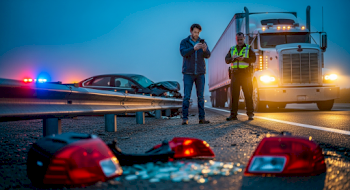

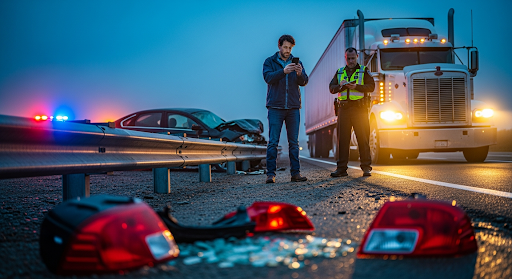
 Image generated by Gemini
A highway collision with a big rig can create immediate risks from moving traffic, damaged vehicles, leaking fluids, and unstable cargo. National Safety Council analysis of NHTSA data shows that the number of large trucks involved in fatal crashes increased 30% over the 10 years ending in 2024.
Here is the part that should get every driver’s attention: 70% of the people killed in large-truck crashes during 2024 were occupants of other vehicles, not the trucks. Knowing how to respond after a semi strikes your vehicle can help protect you from secondary crashes and preserve important information once the immediate danger has passed.
The moments immediately after a collision can remain extremely dangerous because highway traffic may continue moving around disabled vehicles. Secondary impacts happen when approaching drivers do not recognize the obstruction or cannot move away from it in time.
Over 5,200 people died in truck-related crashes in 2024. Your first priority is reaching the safest available location. If your vehicle still operates and moving it is permitted and safe, pull as far out of the travel lane as possible and activate the hazard lights.
If the vehicle is disabled in a live lane, call 911 immediately, keep your seat belt fastened, activate the hazard lights, and follow the dispatcher’s instructions. Whether it is safer to remain inside or exit depends on traffic, visibility, fire, smoke, leaking fuel, and the vehicle’s position. Do not step into moving traffic simply because there appears to be a temporary gap.
| Situation | Action | Primary Risk | Safety Priority |
|---|---|---|---|
| Vehicle operable with no apparent serious injury | Move out of the travel lane when it is safe and legally permitted | A secondary collision involving approaching traffic | Clear the live lane and call 911 from a protected location |
| Vehicle disabled in a live lane | Call 911, activate hazards, stay buckled, and follow the dispatcher’s instructions | Remaining in the vehicle or exiting into high-speed traffic | Assess the specific danger before attempting to exit |
| Vehicle disabled with fire, smoke, or leaking fuel | Exit by the safest available side if possible and move well away from the vehicle and traffic | Fire, hazardous materials, passing traffic, or unstable cargo | Reach a protected location without entering a live lane |
Call 911 as soon as you can do so safely. Large trucks need considerably more room to stop than passenger vehicles. The Federal Motor Carrier Safety Administration warns that large trucks and buses can require up to the length of two football fields to stop under some conditions.
Tell the dispatcher the direction of travel, nearest exit or mile marker, number of vehicles involved, whether traffic lanes are blocked, and whether you see fire, smoke, leaking fluids, damaged cargo, or anyone who appears injured.
Police-reporting requirements vary by state and by the severity of the collision, but a crash involving a commercial truck, injury, major damage, or a blocked highway should be reported immediately. Responding officers can document vehicle and driver information, identify witnesses, manage traffic, and record observable conditions. Their report can become important, but it does not by itself make the final determination of civil fault.
Some injuries may not be obvious at the scene. Tell emergency personnel about pain, dizziness, confusion, numbness, breathing problems, or any other symptoms. Accept emergency care when responders recommend it, and seek prompt medical evaluation if symptoms appear or worsen after leaving the scene.
Skid marks, debris patterns, and vehicle positions can change once emergency responders, tow trucks, and cleanup crews begin clearing the highway. Photographs may help investigators understand the scene, but they should be taken only from a safe location and never by walking into an active traffic lane.
Skid marks alone do not prove that a truck driver followed too closely or caused the collision. Investigators may consider them alongside vehicle data, roadway measurements, photographs, witness statements, damage patterns, and other evidence. Gauge Magazine’s guide to documenting an 18-wheeler crash explains why safety must come before collecting photographs.
If conditions are safe, try to capture:
Save original photographs and dashcam footage without editing them. Do not approach unstable cargo, enter the truck, climb onto the trailer, or touch debris in the roadway.
A trucking company or its insurer may begin investigating quickly after a serious crash. The broader financial stakes surrounding roadway crashes are substantial. A national report cited by ATSSA estimated that fatal and serious crashes during 2023 caused $1.85 trillion in societal harm, including approximately $460 billion in economic costs and $1.4 trillion in quality-of-life costs.
Give responding officers accurate, objective information about what you observed. Do not guess about speed, distance, injuries, or fault. If a trucking-company representative or insurer requests a detailed or recorded statement, you can ask for time to understand the request and obtain legal advice before responding.
Do not sign a release, settlement agreement, medical authorization, vehicle-disposal document, or other unfamiliar paperwork at the scene. A recorded statement may later be compared with medical records, photographs, electronic vehicle data, and witness accounts, so accuracy matters.
A commercial-truck claim can be more complicated than a routine property-damage case. Depending on the circumstances, relevant evidence may include driver logs, electronic logging-device records, engine-control data, inspection reports, maintenance files, cargo records, dashcam footage, and company communications.
According to the National Safety Council, 120,724 large trucks were involved in injury-producing crashes during 2024. That does not mean every truck collision requires a lawsuit, but serious injuries, disputed fault, multiple potentially responsible businesses, or inadequate insurance coverage can justify consulting an attorney familiar with commercial-vehicle cases.
If you’ve been hit by an 18 wheeler, the physical and financial consequences can be difficult to manage. A personal injury attorney familiar with commercial-transport regulations, driver records, vehicle data, and corporate liability can evaluate which evidence should be preserved and which parties may be involved. Gauge Magazine’s overview of evidence used in serious truck-accident cases provides a closer look at the records that may matter.
Many personal injury firms offer contingency-fee arrangements, but the percentage, responsibility for case expenses, and payment terms vary. Read the written fee agreement carefully before hiring anyone. No lawyer can guarantee a particular settlement or result.
Surviving the initial impact is only the first concern. The decisions made in the minutes and hours afterward can affect personal safety, medical care, evidence preservation, and any insurance or legal claim that follows.
Call 911, follow the dispatcher’s directions, move out of traffic when it is safe and permitted, and put medical needs ahead of photographs. Document what you safely can, preserve original records, and avoid signing releases or giving detailed recorded statements before you understand their purpose.
This article provides general safety and legal information, not medical or legal advice. The correct response and applicable legal requirements depend on the crash circumstances and the law where it occurred.
The post 5 Steps to Handle a Highway Collision With a Big Rig appeared first on Gauge Magazine.