
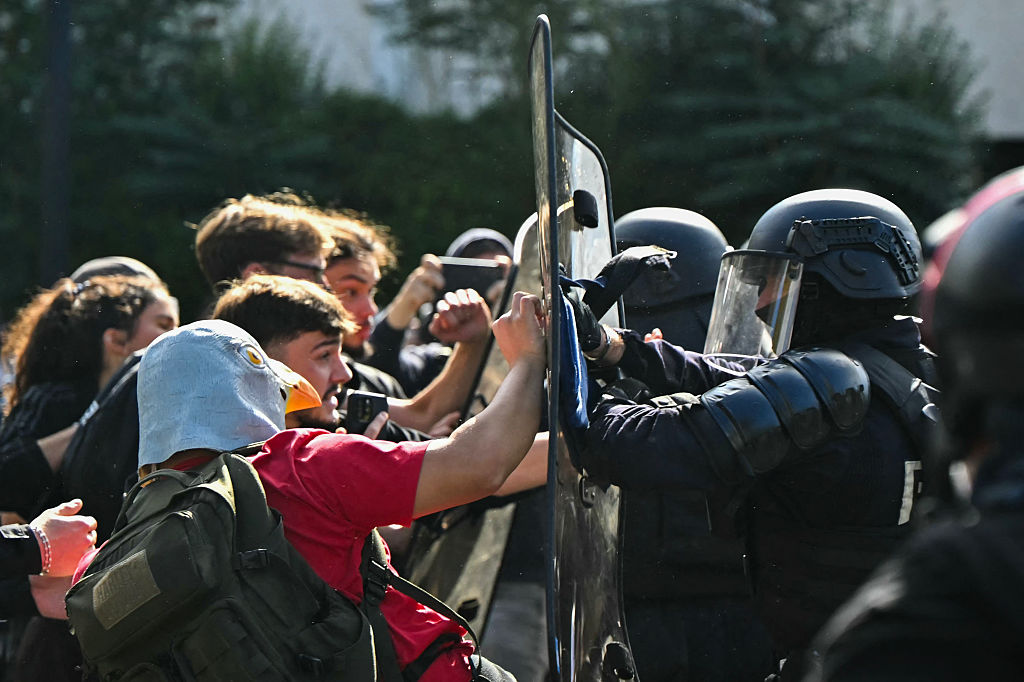
Hundreds of thousands of people took to the streets around France on Tuesday, marking the biggest day of protests yet in the escalating unrest over conditions in the country’s school system that has spread and erupted into violence in recent days.
The student demonstrations, which began two weeks ago in the suburbs of Paris, have forced high schools across France to close and resulted in thousands of arrests and hundreds of injuries.
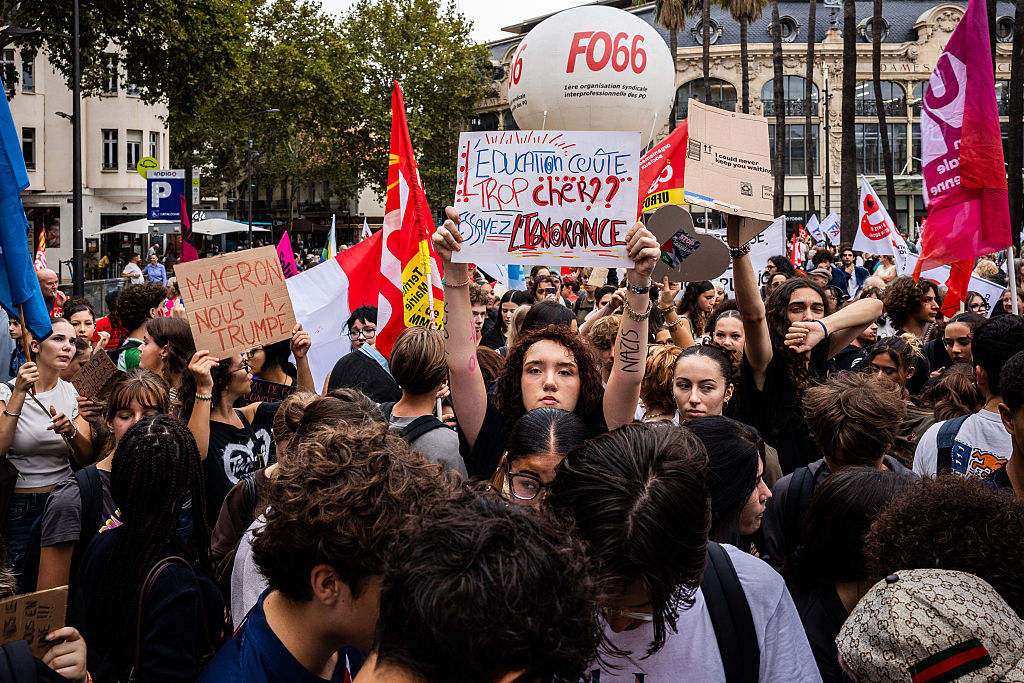
Over 250,000 demonstrators gathered in more than a dozen French cities on Tuesday, including around 56,000 in Paris alone, according to the Interior Ministry. Student unions, parents, teachers, and university students joined in the protests.
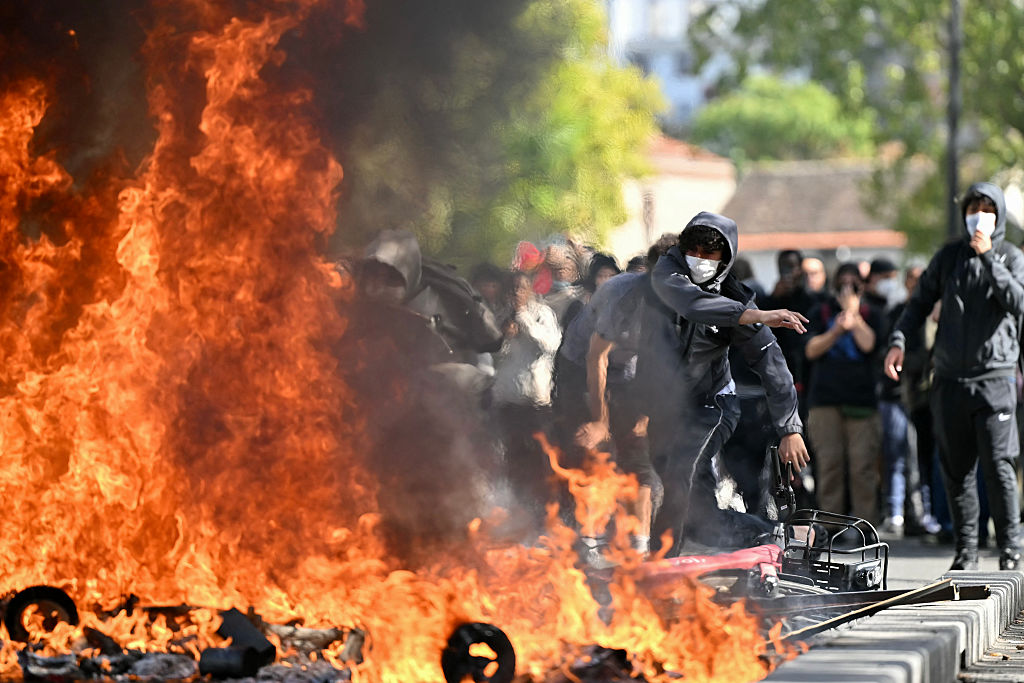
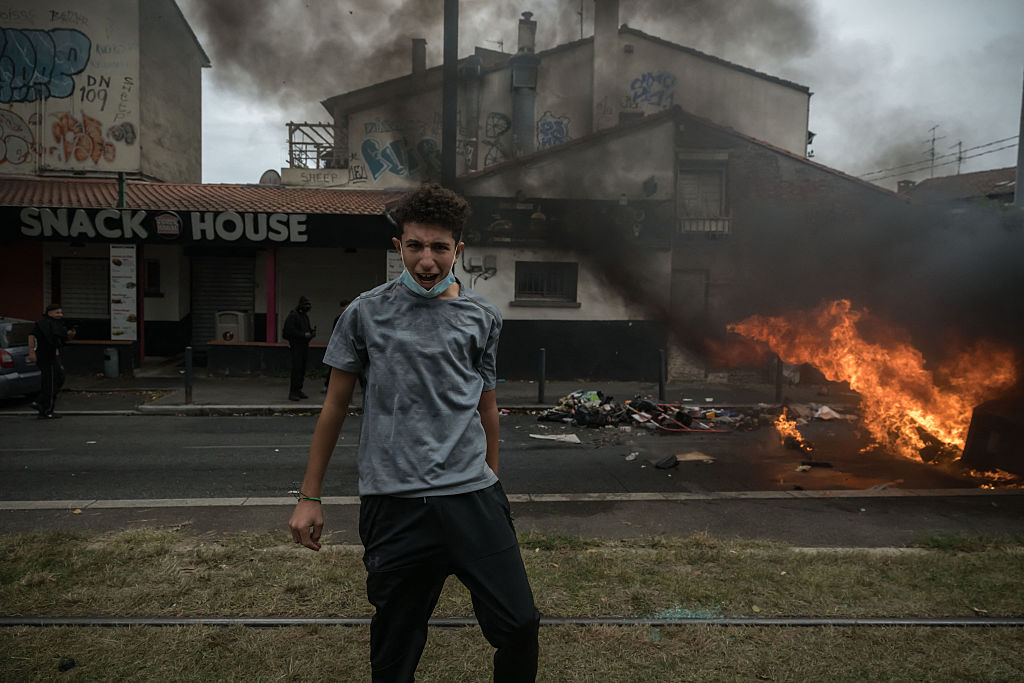
Most of the demonstrations were peaceful, but some broke into conflagrations and clashes between protesters and law enforcement. In Strasbourg, Lyon, Rennes, and Paris, demonstrators set fires and hurled projectiles, and police officers deployed tear gas into crowds. Firefighters were deployed in some locations to extinguish blazes started amid the unrest.
The national day of protests comes a day after a 15-year-old’s hand was blown off during a clash between high school students and riot police in Northern France on Monday morning, according to François-Xavier Lauch, the prefect of Pas-de-Calais.
The regional newspaper La Voix du Nord reported that the boy lost his hand and part of his lower arm after picking up a stun grenade thrown by police amid a demonstration in the town of Lens. Lauch told news outlets that roughly 200 protesters had been hurling objects at police, but declined to comment on the specific circumstances of the boy’s injury.
In total, 215 students and 85 school staff members have been injured amid the demonstrations since they started in late September, according to French Prime Minister Sébastien Lecornu. A spokesperson for the national police told RTL radio over on Saturday that more than 600 police officers have also suffered injuries.
Over 6,000 people have been arrested since the protests began roughly two weeks ago, France’s Justice Ministry said on Tuesday.
Of those who have been detained, the ministry reported on Monday that 87% have been minors and more than 1,800 are being prosecuted. Nearly 2,000 protesters were detained on Thursday alone, the French interior ministry announced last week.
Read More: Why French Protesters Are More Successful Than American Demonstrators
French officials have met with students and school administrators over the past few days and announced that they will take steps aimed at hearing and addressing students’ concerns.
But the protests show no signs of abating. Here’s what you should know as they stretch into their third weeks.
The protests have been driven by anger over a variety of issues impacting French high schools.
A main complaint among demonstrators is the shortage of teachers and support staff in the country’s schools.
The education ministry found that during the 2024-2025 school year, nearly 10% of teaching hours went untaught in public secondary schools. About 7.5% of those lost hours were due to a failure to find substitutes.
"Today our school is paralyzed due to a lack of resources, teachers, and not enough desks,” one student told the French outlet Agence France Presse (AFP). “We don't have nurses or supervisors, and all they do for us is take away our phones.”
Complaints about insufficient resources and funding and poor infrastructure in schools have also been raised in the student protests.
"We are 35 per class, we don’t have enough chairs in classrooms,” a 15-year-old student told Reuters in the Paris suburb of Pantin as demonstrators clashed with police deploying tear gas in an effort to quell the protest.
“There are 35 of us per classroom. With 35 degrees Celsius [95 degrees Fahrenheit] in summer, it’s unbearable. There aren’t enough toilets, and there are water leaks in some rooms,” a 17-year-old said while speaking to AFP at a protest in Strasbourg in the northeast of France. “The building is falling apart, the cafeteria is too small. There’s zero budget, zero resources, not enough supervisors.”
Read More: What Is the Youth-Led ‘Cockroach Movement’ Staging Mass Protests in India?
Another student also raised concerns about a lack of resources to address high summer temperatures when talking to The Guardian.
“We’re also protesting about the conditions in the heatwave,” the 19-year-old said. “Young people just want to study and learn in decent conditions. The French state seems surprised about worsening school results, but they’re doing nothing to remedy that.”
A series of deadly heatwaves hit Europe over the summer, with Western Europe experiencing its hottest summer ever. In France, nearly 8,000 people died over the course of the summer as a result of the high temperatures.
Student protesters have also expressed grievances with the country’s online university application system, Parcoursup, which they have described as a source of stress and mistrust in the education system.
The particular complaints being raised by demonstrators have varied somewhat across different parts of the country, however.
Education Minister Édouard Geffray characterized this as a complicating factor in addressing the roots of the unrest. "One of the difficulties of this movement is that there are no national demands. It all started with local demands,” the Education Minister said Friday morning.
The protests began with students at Lycée Saint-Exupéry in Créteil outside Paris mobilizing to protest teacher shortages and a lack of adequate resources in late September.
In the days that followed, protests spread throughout the Île-de-France region, which includes Paris and its surrounding metropolitan areas, as students attempted to set up blockades at dozens of schools.
The demonstrations have escalated still further in the past week, spreading outside of Paris’ surrounding area and into regions around the country. Tracking from Reuters also showed that protests have sprouted across western France in Rennes, Nantes, Quimper, and Brest; around the southern part of the country in Bordeaux, Toulouse, Toulon, Marseilles and Grenoble; as far east as Strasbourg; and as far north as Lille.
Last Monday, 180 schools were disrupted by the expanded demonstrations, according to the interior ministry. By the week’s end, that number had risen to over 500.
Read More: What to Know About the ‘Gen Z’ Protests Roiling Countries Across the Globe
Thursday marked the largest escalation of protests in the lead-up to Tuesday’s national day of demonstrations. Fires were started at at least two French schools that day. Several teachers were accidentally splashed with gasoline at Marseille's Victor Hugo high school. At Saint-Exupery high school, also in Marseilles, hundreds of students set ablaze a fire truck that had arrived to put out a previous fire from the morning. Firefighters were forced by students to exit their vehicle before it was burned. In protests around the country, confrontations broke out between students and police, who fired projectiles in attempts to control crowds of demonstrators.
The following day, roughly 900 demonstrations took place around France, according to police.
And in a message last week, two student unions, the Student Union and the High School Trade Union, jointly called for continued protests this week.
“Students and high school students, while the authorities seek to drive us out of our places of study through budget cuts, the closure of places, dilapidated buildings, selection, or repression, let's not let them: let's block and retake the universities and high schools!” the unions wrote in a press release.
On Tuesday, Geffray said that once classes resume around France, the government will establish “high school time” across the country’s secondary schools, which will consist of setting aside one half-day “first with the staff, then with the students, for an in-depth, open, and democratic debate, everywhere.”
“We cannot resume the path of classes as if nothing had happened,” he said.
Lecornu hailed these planned periods of “internal democracy” in French high schools as a way that “disagreements can be expressed within a legal, declared, and democratic framework.”
“After fifteen days of mobilization, the demands are numerous and vary from one high school to the next. They must be assessed objectively, school by school,” he said in a post on X, adding that “substitutes, the state of the buildings, guidance, organization of school time, high school democracy: all topics must be put on the table.”
The Prime Minister at the same time condemned the violence of the protests and defended the police response, pushing back on what he called “false reports” about the actions of law enforcement. “The situation is serious enough without needing a political class that fans the flames and stokes the violence,” he wrote.
As the protests intensified last week, Lecornu called a crisis meeting on Thursday and canceled ministers’ travel plans to work on quelling the demonstrations. Days later, he introduced five initiatives to address students’ demands, including “ensuring classes are held, improving facilities in partnership with the regional councils responsible for them, better organizing school days, making Parcoursup more transparent, and giving follow-through to the voices of high school students.” He added that a timeline and a funding plan for the initiatives would be given before the end of the month.
Geffray meanwhile met with education unions, student organizations, and parent associations on Friday morning in an attempt to temper the protests through dialogue. The same day, he announced a platform students can use to submit proposals for education reform, which he said will be evaluated and used for a “national report.”
High school student organizations, however, called for continued demonstrations following their meetings with Geffray, citing a lack of “concrete measures” from the French government to address their complaints.
Dialogue between students and education administrators remained ongoing on Monday, as Geffray continued to meet with students At Villaroy high school in Guyancourt outside of Paris.
French President Emmanuel Macron has been less vocal in responding to the protests roiling his country.
"I hear and understand the anxieties and anger that our youth may have,” Macron said on Wednesday while speaking in Madrid. “However, none of these debates, none of these fears legitimizes violence.”
Nearly a week since his comment, Macron has remained relatively silent on the ongoing demonstrations. On Tuesday, the President posted a video aboard a French naval vessel, where he witnessed the first firing of new ballistic missiles from a nuclear-powered submarine.