As Israeli voters prepare for elections on Oct. 27, Prime Minister Benjamin Netanyahu has tried to defend and distance himself from one of his government’s most controversial policies: allowing Qatar to funnel nearly $2 billion into the Hamas-controlled Gaza Strip for more than a decade. Previously undisclosed documents obtained by TIME, including letters from senior Israeli security officials to Qatari leaders, reveal that Israel encouraged and played a direct role in a payment program that was more extensive than Netanyahu has publicly acknowledged.
Beginning in 2012, Netanyahu’s government helped to facilitate Qatari payments to Gaza that had begun after Hamas seized control in 2007. By 2018, Qatar had sent roughly $1.1 billion into the Strip, according to an analysis provided to Israeli ministers, the Israeli daily Haaretz reported, with the funding designated for humanitarian assistance, fuel, and government salaries. That year, after Israeli officials castigated Qatar for allegedly financing Hamas, the Qataris began demanding formal documentation of an arrangement the two governments had agreed was meant to provide relief to citizens of the beleaguered enclave.
The extent of Israel’s cooperation with the payments was reflected in a 2020 letter from Yossi Cohen, then director of the Mossad, Israel’s intelligence agency, to Qatar’s Emir Tamim bin Hamad Al Thani. “It is indeed a great opportunity to express our gratitude and appreciation for the humanitarian aid efforts that the State of Qatar has provided the last few years to the Gaza Strip,” Cohen wrote. “Undoubtedly, these humanitarian efforts have played a crucial role in improving the humanitarian situation within the Gaza Strip, and ensuring stability and safety in the region.”
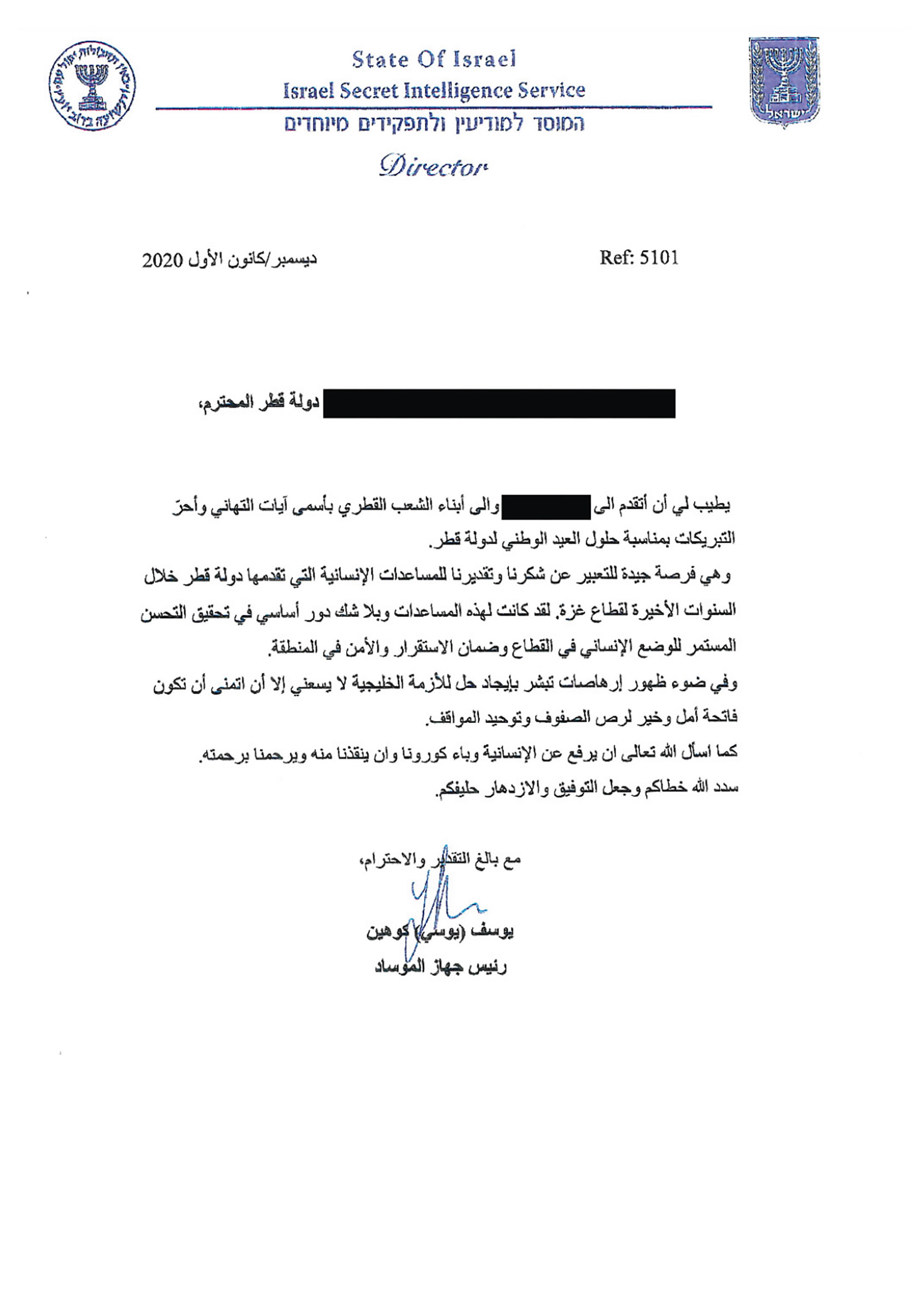
The payment arrangement had the support of successive Israeli governments, the Palestinians, the Trump and Biden Administrations, the United Nations, and European powers, according to officials who served in both the Trump and Biden Administrations. The flow of money from Qatar into Gaza has taken on new significance since October 7, 2023, when Hamas terrorists stormed southern Israel, murdered some 1,200 people, and took 251 more hostage. The worst security failure in the country’s history raised troubling questions about whether the financial lifeline helped to sustain Hamas’s grip on power and, in turn, enabled it to carry out the assault.
Since then, Qatar has been frustrated by allegations leveled by Israeli political leaders that its payments to Gaza had helped finance the deadliest massacre of Jews since the Holocaust. “All of Qatar’s financial assistance in Gaza has been directed to Palestinian citizens through mechanisms coordinated with the Israeli authorities and international partners. Under previous aid mechanisms, all financial assistance, as well as goods such as food, medicine and fuel, passed through Israel before entering Gaza,” a spokesperson for Qatar’s International Media Office tells TIME. “Nothing was delivered directly by Qatar; we provided the aid, while delivery was carried out by the United Nations’ organizations in coordination with the Israeli authorities. If any funding reached Hamas, as alleged by individuals and groups with political agendas against Qatar, the responsibility lies with Israel, which oversaw the delivery and created the mechanism.”
Critics have long argued that Netanyahu sought to sustain Hamas rule in Gaza to keep the Palestinians divided between the Islamist terror group and the Fatah-led Palestinian Authority in the West Bank, foreclosing the prospect of a unified Palestinian leadership capable of negotiating a two-state solution. Netanyahu’s wager, according to these critics, was that the aid would give Hamas something to lose and would therefore help contain the group while Israel pursued normalization with the Arab world without resolving the Palestinian question. Instead, as Israel moved closer to a historic agreement with Saudi Arabia, Hamas launched an assault that upended the region, plunging it into war.
The Prime Minister’s office declined to comment for this story.
The documents now give Israelis a fuller accounting of a policy that preceded the catastrophe, as they prepare to render a verdict on the man who presided over both. “It was a policy failure on our part born of good intentions that multiple prime ministers kept going,” says one former Israeli defense official. “But Netanyahu was unquestionably at the center of it. He was the one who championed and accelerated the program, his government was in charge of the way it was run, and now we know as a society that we can never afford to make a mistake like that again.”
Ehud Olmert was still prime minister when Qatar began sending money to Gaza in 2007, after Hamas won control of the coastal enclave. At the outset, the Israeli government was not directly involved in the transfers. That changed under Netanyahu. By 2012, his government had approved a system that gave Israel a direct role in facilitating Qatari assistance: delivering food and medical supplies, determining which Palestinian families qualified for financial aid and disbursing the funds, and enabling Qatari financing to expand Gaza’s electricity supply, according to Israeli and Arab officials, as well as official documents obtained by TIME.
At first, the arrangement was informal. Qatar supplied the money with Israel’s approval, even as Israeli officials publicly criticized Doha for financing Hamas, according to sources familiar with the negotiations. The contradiction aggravated the Qataris, a senior official in the first Trump Administration tells TIME: Israeli officials would denounce the payments in public, then privately ask Doha to renew them.
Qatar, a gas-rich monarchy in the Persian Gulf, is accustomed to walking a fine line. It plays host to both the U.S. Central Command and to senior Hamas officials. The country set up a Hamas political office in Doha at the request of the U.S. in 2011. In contrast to other Gulf monarchies, especially Saudi Arabia, Qatar sees no threat in the Muslim Brotherhood, the political movement that spawned Hamas. After Oct. 7, Qatar's government emerged as the go-between in negotiations among Israel, Hamas and Washington, where Biden Administration officials privately praised the Qataris as honest brokers.
By 2018, Qatar sought written documentation of the Israeli government’s role in the aid agreement. It was subsequently formalized through a trilateral mechanism involving Qatar, Israel, and the United Nations, designed to administer the aid with international and Israeli oversight. On October 2, 2018, Israel and Qatar, together with the United Nations, signed an agreement to finance fuel deliveries into Gaza.
A spokesperson for the United Nations declined to comment for this story but referred TIME to statements the body’s special coordinator for Middle East peace, Tor Wennesland, made in 2021 acknowledging the arrangement. “These efforts are vital to improving the dire socioeconomic and humanitarian situation in Gaza,” he said at a UN Security Council briefing.
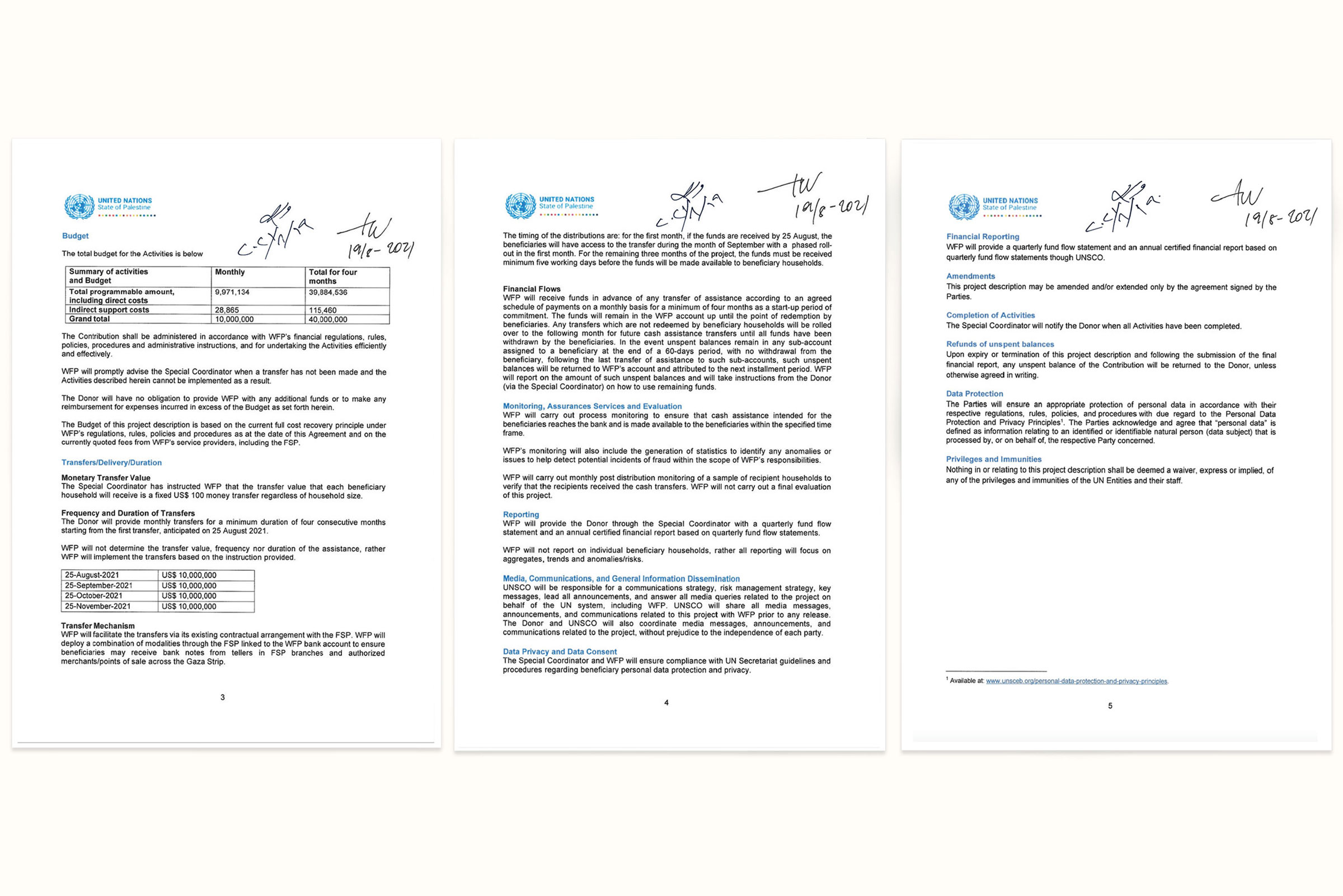
In August 2021, Qatar signed another agreement committing $40 million to a cash assistance program that would give nearly 100,000 Palestinian households $100 per month for four months. The arrangements were subsequently extended. American officials were brought into the discussions as well. According to a diplomat briefed on the process, who asked for anonymity to divulge details because they were not authorized to comment publicly, Qatar wanted Washington to understand precisely how the system worked, fearing that Israeli officials might later accuse Doha of financing Hamas without acknowledging Israel’s own role. “The Israelis kept insisting on doing it this way, so that they can control what goes in and out,” the official told TIME, rather than establish “something more regular and something which goes directly to the people.”
Under the system, according to U.S. and Israeli officials, Qatar paid for fuel and electricity purchased from Israel to increase the number of hours Gaza received power, a structure coordinated with Israeli security services. It transferred money through the United Nations for projects in the Strip. And it provided monthly $100 payments to some of Gaza’s poorest families. According to diplomats familiar with the system, Israel vetted the recipients and oversaw the distribution mechanism, with funds transferred through the World Food Programme and eligible families notified by text message before collecting their assistance at designated locations. “If the money ever got in the wrong hands, it was because of the Israelis,” the diplomat said, “because they were the ones overseeing the whole thing.”
Netanyahu’s government was so committed to the policy that when Palestinian Authority President Mahmoud Abbas cut payments to government workers in Gaza in 2018, Israeli security officials shuttled Qatari cash into the Strip in suitcases, U.S. and Israeli media reported at the time. Naftali Bennett, then Netanyahu’s education minister, publicly opposed the transfers, denouncing them as “protection money.” Netanyahu briefly suspended the payments in January 2019 amid renewed violence along the Gaza border, using the prospect of their resumption as leverage to pressure Hamas to stop firing rockets.
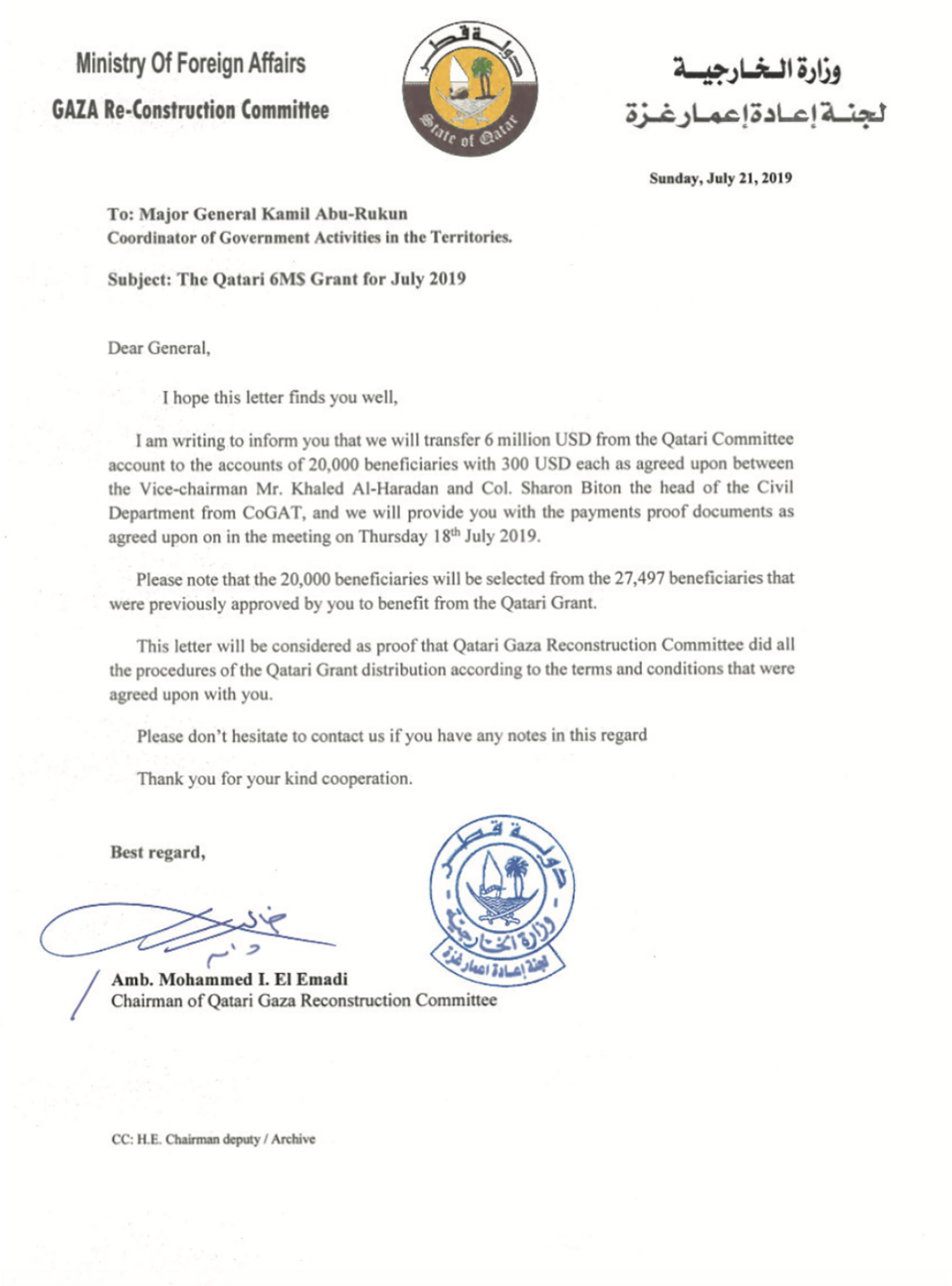
But while critics on the Israeli right railed against the deal, Netanyahu’s deputies worked behind the scenes to preserve it, according to correspondence obtained by TIME. In July 2019, according to one letter, Qatar notified the Netanyahu government that it was transferring $6 million to 20,000 beneficiaries in Gaza, with each receiving $300. It is unknown how many of those beneficiaries, chosen by Israel, were connected to Hamas or had family members who belonged to the group. Over the last two decades, Hamas has been deeply embedded in Gaza, operating not only as an armed militant organization but also as a political movement and governing authority, employing civil servants responsible for the territory’s public services and infrastructure.
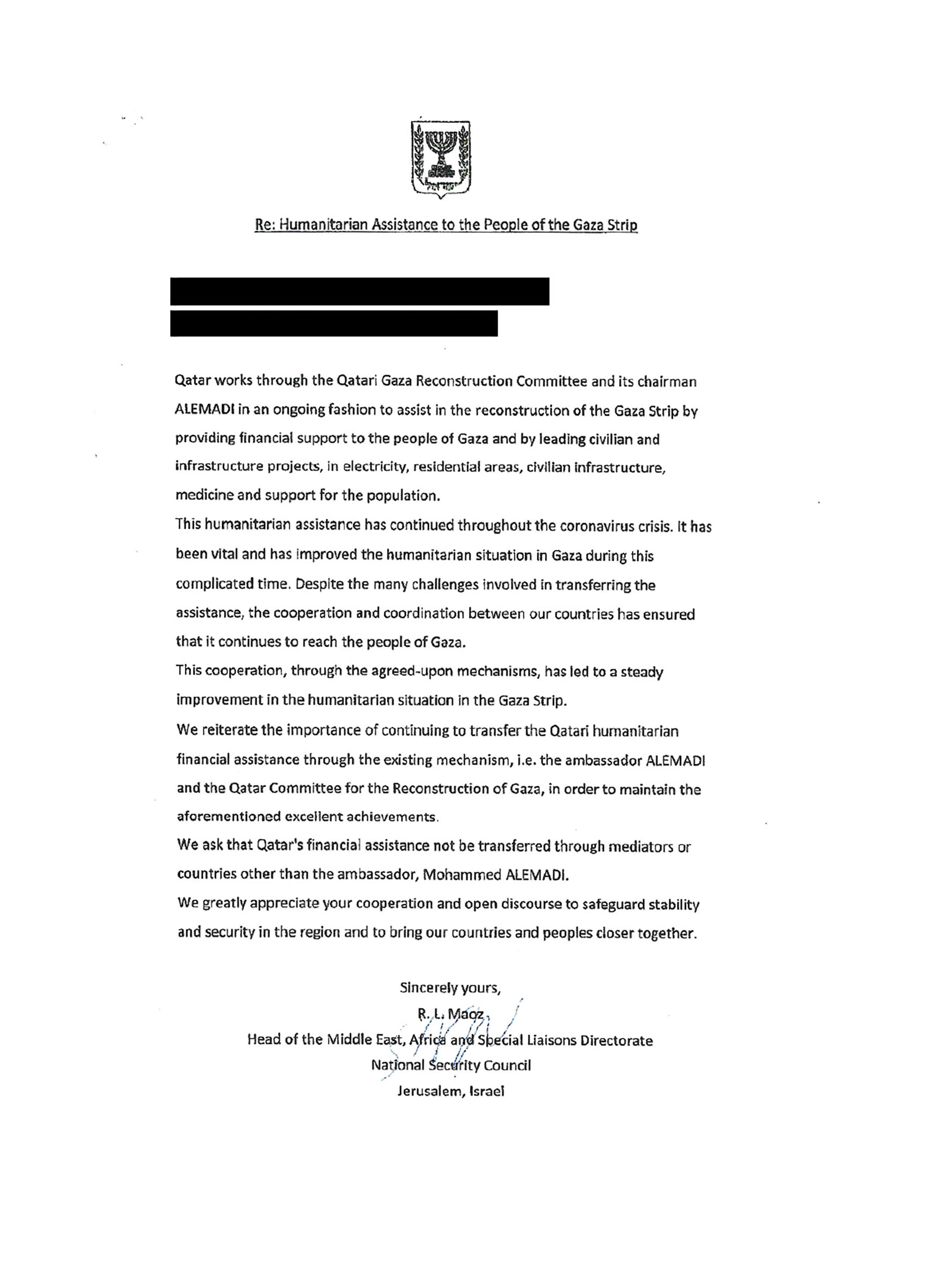
In 2020, as the coronavirus pandemic swept through Gaza, R. L. Maoz, a member of Netanyahu’s National Security Council, urged Qatari officials to maintain the payments despite the Israeli government’s public criticism. “We reiterate the importance of continuing to transfer the Qatari humanitarian financial assistance through the existing mechanism,” Maoz wrote. “We ask that Qatar’s financial assistance not be transferred through mediators or countries other than the ambassador, Mohammed Al-Emadi,” he added, referring to the chairman of the Qatari Committee for the Reconstruction of Gaza. “We greatly appreciate your cooperation and open discourse to safeguard stability and security in the region and to bring our countries and peoples closer together.”
The program survived Netanyahu’s departure from power. His successor, Bennett, had been among its fiercest critics, raising the prospect that the arrangement might finally end. At that point, Qatar prepared to halt the program, a former Biden official tells TIME. Instead, after taking office in 2021, Bennett ended only the delivery of cash-filled suitcases, not the broader flow of Qatari assistance to Gaza, the Associated Press reported. According to people familiar with discussions about the policy, Bennett’s prior objections were a message intended for his domestic political constituency. “There’s no issue,” an Israeli representative told a Biden envoy, according to an official present. “We want to continue with it as is.”
To some of the officials involved, the compact contained a fundamental flaw: both the Israeli government and Hamas retained control over aid intended for ordinary Gazans. “Bibi and Hamas hold the tap, essentially,” one of the officials told me. Hamas could restrict the system to exert pressure internally, the official said, while Netanyahu could restrict it to pressure Hamas. “We knew this was not something that was beneficial for the long term. We need to have something that’s sustainable, that empowers the civilians.”
By 2023, with tensions mounting between Israel and Hamas, Qatari officials pressed for a different model, one that would deliver assistance to Gazans without making civilians dependent on either Hamas or the Israeli government. But Netanyahu’s government wanted the existing framework kept intact, according to multiple sources who spoke to TIME, including an Israeli official and an international diplomat.
Two weeks before October 7, Mossad director David Barnea traveled to Doha and asked Qatar to renew the funding, the New York Times reported in 2023. The Qatari officials agreed but warned Barnea that it would be the last renewal. With tensions rising between Israel’s far-right ministers and Hamas, the arrangement had run its course, Qatar believed. Barnea asked for two more months. The rationale, according to the officials familiar with the conversation, was that continuing assistance to Gaza’s civilians gave Hamas something to lose and therefore gave Israel a measure of leverage over the group. After two months, the parties could reassess Hamas’s behavior and devise a more durable mechanism for delivering aid.
They never got the chance. With the brutal Oct. 7 attack on southern Israel, the Qatari aid arrangement that successive Israeli governments had spent years helping to build, modify, and preserve was over.
Ever since, Netanyahu has faced accusations that he deliberately strengthened Hamas to keep the Palestinians divided—between Hamas in Gaza, and the secular Fatah party that under Abbas governs the West Bank—and forestall a peace agreement. Critics point to remarks Netanyahu allegedly made at a 2019 Likud Party meeting. “Anyone who wants to thwart the establishment of a Palestinian state has to support bolstering Hamas and transferring money to Hamas,” he said, according to a report in the Jerusalem Post. “This is part of our strategy—to isolate the Palestinians in Gaza.”
In a 2024 interview with TIME, Netanyahu denied making the statement, insisting that the payments were meant to prevent a humanitarian catastrophe. “The reason that successive governments agreed to that is that we wanted to make sure that Gaza has a functioning civilian administration to avoid humanitarian collapse,” he said. Without the money to maintain sewage systems, water supplies, and schools, he argued, the territory could have descended into chaos and disease. Netanyahu claims that Iran supplied Hamas with weapons through separate channels, including suspected smuggling routes across Egypt’s Sinai Peninsula.
Netanyahu’s dealings with Qatar have also become a source of controversy in Israel. Netanyahu has been under intense scrutiny in recent weeks over the so-called Qatargate scandal, in which former and current aides to the Israeli premier allegedly received payments to conduct a public relations campaign to cast Qatar in a favorable light for more than a year after the Oct. 7 onslaught.
Now, as international diplomats contemplate Gaza’s reconstruction, they face a version of the same dilemma: how to provide essential assistance without strengthening Hamas or another militant organization. Trump Administration officials, led by envoys Jared Kushner and Steve Witkoff, are working with Qatar and other Arab governments on a framework that would restore basic services while eliminating Gaza’s dependence on Islamist armed factions. “We want to ensure that the civilians are reliant on themselves and not on anyone else,” an international diplomat tells TIME. “So it’s providing actual opportunities for civilians to make money and be sustainable.”
The question confronting Israel and its international partners is not simply whether money should flow into Gaza, but also who controls it—and whether the next arrangement will avoid the failures of the last.