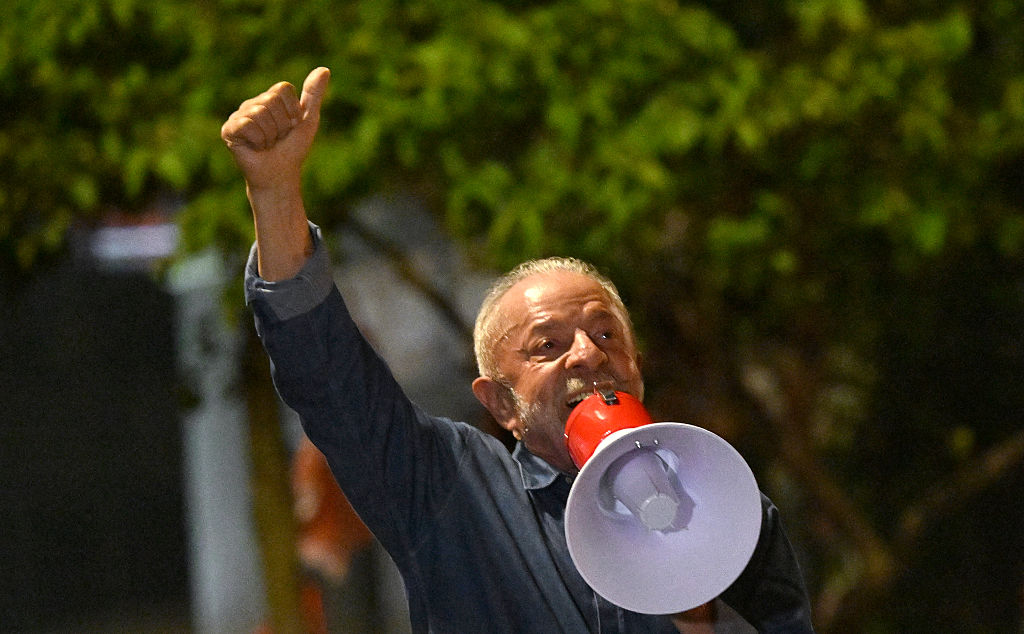
On Oct. 25, Brazil’s president, Luiz Inácio Lula da Silva, won an unprecedented fourth term, defeating the far-right senator Flávio Bolsonaro with 51.79 % of the vote, a margin of nearly 4.4 million votes. For the 80-year-old Lula, who had trailed his opponent by 2.2 million votes in the first round of elections just three weeks earlier, the victory was a remarkable comeback.
Brazil is the largest country and economy in Latin America, and the contest had become a test of whether the region’s rightward shift could be stopped. Lula’s victory interrupted that drift and dealt a setback to President Donald Trump’s ambition to build a hemisphere of governments aligned with his politics. Yet interpreting the result as a triumph for the left would be a mistake.
Consider the first round of the elections in Brazil: more than 33 million Brazilians did not vote in the first round, an abstention rate of 21.08 %, the highest for a presidential election first round since 1998. Millions more cast blank or invalid ballots. Voting is optional for Brazilians aged 16 and 17 and for those 70 or older, but the scale of abstention points to a broader problem of political alienation. The high rejection rates for both candidates suggest that, for many voters, the election was not about electing a president but to ensure his opponent is not elected.
Flávio, whose father and former president Jair Bolsonaro is serving 27 years in prison for crimes against democracy, won the first round, with 2 million more votes than Lula, and his Liberal Party’s formidable showing in Congress in early October shocked the liberal world. He ran as his father’s proxy. He promised to pardon his father and his accomplices and to carry forward his political legacy.
It seemed puzzling that Lula needed such a dramatic comeback to win re-election when unemployment in Brazil stood at 5.3 %, near a historic low. The International Monetary Fund projected that Brazil would become the world’s eighth-largest economy in 2027. Poverty in the country had fallen substantially during Lula’s third term, while real wages rose and food insecurity declined. Violent deaths had fallen to their lowest level in over a decade. Deforestation of the Amazon had fallen to its lowest level since records began in 1988. Incumbents have been re-elected in Brazil with far less to show for their time in office.
The children of Lula’s social policies came of age in a rapidly changing world, and in a country where formal employment, labor unions, and traditional social protections have struggled to serve an increasingly informal workforce. Some turned toward market-oriented politics. Others found a sense of belonging in conservatism, part of a broader rightward turn among young men around the world.
Brazil’s left governed for much of their formative years. Lula’s successor, Dilma Rousseff, was impeached in 2016 amid a bitter political crisis and corruption scandals that implicated political figures across party lines. For many Brazilians, the political establishment became synonymous with impunity and self-preservation. They saw Lula’s Workers’ Party as the establishment. And while Lula’s earlier corruption convictions had been annulled, the allegations continued to shadow him.
Meanwhile, lethal violence had become a defining feature of everyday life. Brazil had urbanized rapidly without addressing deep inequality or reforming a public-security system inherited from the military dictatorship. Overcrowded prisons became recruiting grounds for criminal factions.
In Rio de Janeiro, militias made up largely of serving and former police officers and other security personnel initially claimed to protect residents from drug traffickers. They evolved into criminal enterprises that extorted communities, struck deals with drug factions, and infiltrated local governments. Yet responsibility for confronting them remained fragmented. State governments control most policing, leaving the federal government with limited direct authority over local law enforcement.
Flávio understood how to exploit voters’ distrust and frustration. His promises of tougher security resonated with Brazilians desperate for protection. His campaign drew comparisons to the hardline model of President Nayib Bukele of El Salvador. Yet Bolsonaro Jr. also faced questions about his own associations with criminal figures in Rio, undermining his claim to offer a solution to the country’s security crisis. During the campaign, new revelations about his ties to Daniel Vorcaro, the disgraced banker and owner of Banco Master at the center of a vast financial scandal, added to those doubts, even as he denies wrongdoing.
Flávio's brother, Eduardo, had lobbied the Trump Administration to punish Brazil over the prosecution of their father. Washington imposed tariffs on Brazilian exports, explicitly linking the measures to the prosecution of Jair Bolsonaro. The tariffs threatened Brazilian businesses and proved deeply unpopular, leaving Flávio defending a political alliance whose costs would be borne by Brazil.
Lula’s campaign had expected these vulnerabilities to suffice. When Flávio entered the presidential race in Dec. 2025, early polls placed Lula comfortably ahead. His first-round defeat jolted the progressive camp out of its complacency. Lula’s campaign returned to the streets of São Paulo and Rio de Janeiro and intensified its presence on social media, seeking to mobilize the voters who had stayed home in the first round. Lula’s people reorganized their digital outreach to speak more directly to younger Brazilians and informal workers.
Lula, who had initially seemed detached from younger voters’ digital habits, embraced viral content and selfies. His coalition expanded beyond the traditional left, drawing in moderates and voters who feared another Bolsonaro presidency. His campaign also challenged what it described as algorithmic bias on platforms such as Instagram, securing an electoral court ruling requiring equal treatment of candidates’ content.
The most potent opening for the Lula campaign came from Washington. Trump praised Flávio’s first-round performance as a “very, very big victory,” helping Lula recast the runoff as a contest over national sovereignty. The tariffs had already alienated Brazilian exporters and moderate voters.
In televised debates and rallies, Lula accused the Bolsonaro family of serving American interests and warned that Flávio would surrender control of Brazil’s natural resources to foreign interests. He also attacked his rival’s support for sweeping cuts inspired by President Javier Milei of Argentina. For voters outside the left, defending national sovereignty offered a reason to support Lula despite their reservations about his government.
On São Paulo’s Paulista Avenue, Brazil’s main stage for political protests, a protester wore a Trump mask and carried a Flávio puppet. The image captured the choice Lula wanted the voters to see. This was no longer simply a referendum on his record. It was also a choice about whether Brazil would let an American president shape its politics.
Lula’s campaign turned a contest he had been losing into a choice between an imperfect incumbent and a candidate whose victory threatened democratic institutions and national autonomy. Abstention fell from 21.08 % in the first round to 19.22 % in the runoff. On election day, severe weather and heavy rainfall in southern Brazil kept some voters from reaching the polling booths. Transportation disruptions also hampered voting in cities including Salvador and São Paulo. A last-minute Supreme Court ruling extended voting hours by two hours, allowing more voters in working-class strongholds to cast their ballots.
Lula’s victory is both a reprieve and a warning. It shows that a broad democratic coalition, mobilizing in the streets and online, can defeat a far-right candidate even amid a regional shift to the right and pressure from Washington. But the victory has not resolved Brazil’s divisions. Lula must govern a country where about half of those who cast valid ballots chose his opponent. He has won four years. He has not won back the country.
Flávio has challenged the result and demanded that the runoff be annulled. His party holds a powerful position in Congress, where conservative and center-right forces can obstruct Lula’s agenda. The election has given Brazilian democracy breathing room, but the battle for Brazil’s democracy has only begun. What Lula does with his mandate will determine whether he can make it count.