The roof is the most expensive part of a house that most owners never look at. One spring storm can turn it into a five-figure decision with a deadline.
Texas homeowners face that decision more often than most. This guide breaks down what a new roof costs, how insurance changes the number you actually pay, and how to build a budget so the bill does not arrive as a surprise.
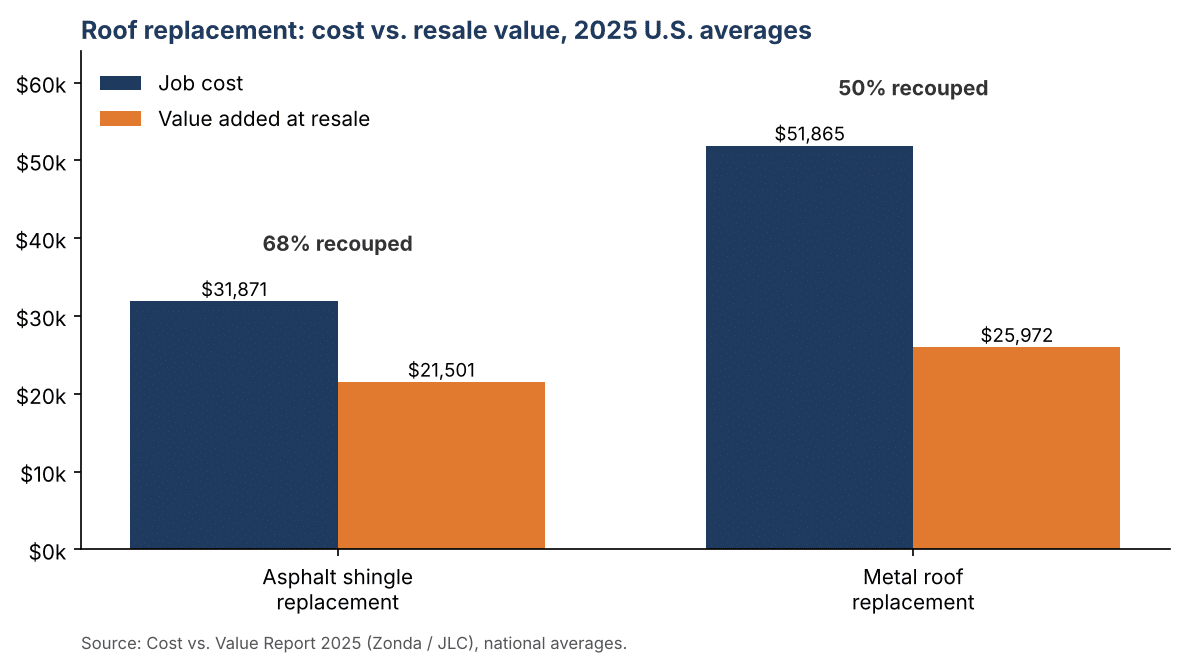
Roof prices vary widely, so start with an independent national benchmark before you collect local quotes. The Cost vs. Value Report 2025 tracks the average price of common remodeling jobs and how much of that spend comes back when the home sells.
Show Image Source: Cost vs. Value Report 2025, national averages.
| Roof type | Average job cost | Value added at resale | Cost recouped |
| Asphalt shingle replacement | $31,871 | $21,501 | 68% |
| Metal roof replacement | $51,865 | $25,972 | 50% |
Local prices can sit well below those national averages. An Austin contractor, LOA Roofing & Construction, estimates on its website that replacing a 3,000-square-foot roof in Austin typically costs $10,500 to $12,000, depending on materials and labor. The same company puts minor repairs at roughly $150 to $1,500 and major repairs at $1,500 to $7,000 or more.
A national survey and a local quote measure different things, so treat the national figure as a ceiling check and your written bids as the real number.
Five variables decide most of your quote, so compare bids line by line rather than by total alone.
Lifespan matters because a cheaper roof that needs replacing sooner can cost more over time. These are the typical ranges LOA lists for common systems on its Austin page:
| Material | Typical lifespan (per LOA) | Best suited to |
| Asphalt shingles | 15 to 30 years | Most homes on a budget |
| Metal | Up to 50 years or more | Long-term owners, hail-prone areas |
| Clay tile | Over 50 years | Spanish and Mediterranean styles |
| TPO membrane | 20 to 30 years | Flat or low-slope roofs |
| EPDM rubber | Up to 30 years | Low-slope and commercial roofs |
Own a business property too? This guide to climate-ready workplaces covers storm preparation for buildings and staff.
Your policy type can shift your out-of-pocket cost by thousands of dollars. The Texas Department of Insurance explains the difference with a $10,000 roof claim on a $200,000 home with a 2% deductible, which works out to $4,000.
Show Image Source: Texas Department of Insurance example.
In that example, a 20-year-old roof covered on an actual cash value basis pays $0, because the depreciated value equals the deductible. Actual cash value policies cost less in premiums, but they also pay less when you file.
Deductibles add a second layer. TDI notes that the deductible for wind and hail damage is often higher than for other kinds of damage. According to United Policyholders, as reported by WFAA, a 2% deductible has become the dominant standard for wind and hail coverage across most of Texas.
Two steps can lower your long-term cost:
Hail is the main reason Texas roofs fail early. The Insurance Information Institute reports that Texas logged 902 major hail events in 2025, defined as hailstones one inch or larger. That was out of 5,432 across the whole country and more than double the next state, Kansas, at 375.
A dedicated roof fund turns that risk into a planned expense. Here is a simple way to size one using the TDI example above:
| Budget item | How to estimate it | Example |
| Wind and hail deductible | Your deductible % × insured home value | 2% × $200,000 = $4,000 |
| Depreciation gap (ACV policies) | Replacement cost minus actual cash value | $10,000 − $7,000 = $3,000 at 10 years |
| Decking contingency | Per-sheet price in your bid × likely sheets | Ask each bidder to quote it |
| Upgrades | Gutters, vents, resistant shingles | Optional, priced separately |
If your policy pays replacement cost, the deductible alone is your core target. If it pays actual cash value, add the depreciation gap and revisit the fund as the roof ages.
A fair quote starts with a contractor you have checked yourself, since Texas has no statewide roofing licence. The Roofing Contractors Association of Texas notes that a 2025 bill to create one cleared a House committee but ran out of time before a floor vote.
The Texas Department of Insurance recommends these checks before you sign:
For reference, here is how one established local firm measures up against that list. LOA Roofing & Construction, an Austin roofing company based on West Ben White Boulevard, holds an A+ rating and has been accredited since October 29, 2018, according to its Better Business Bureau profile. The BBB listing also shows payment options including credit cards, checks and financing.
LOA’s Austin page displays a 5.0-star Google rating across more than 1,000 reviews. The company says it offers free, no-obligation inspections, including drone inspections when the owner cannot be home, and a lifetime workmanship warranty. Compare those terms against every written bid you collect, not just the price.
Planning other outdoor upgrades too? See what makes a poolside area comfortable, or this roundup of commercial skylight companies for business buildings.
A new roof in Texas costs more than the number on the quote once you factor in deductibles, depreciation and hidden decking repairs. Start with independent price benchmarks, read your policy before a storm hits, and build a roof fund sized to your deductible. Vet contractors with the state’s own checklist, and the replacement becomes a planned expense, not a shock. For more money guides, browse the Finance section.
The post What a New Roof Really Costs in Texas: A 2026 Budget Guide appeared first on The Next Hint.