Anyone who spends weekends around lifted trucks, tow rigs and show cars understands how much mass an eighteen-wheeler carries. When a loaded semi meets a passenger car, the crumpled metal is only the visible part of the problem. The evidence, the insurance questions and the legal clocks all start moving at once. Drivers who share Valley freeways with freight traffic have good reason to think this through before it happens. This checklist, written in late 2026, walks through what generally matters in the first hours, in the order you are likely to need it.

Under most circumstances, it is worth learning your options early, because a semi crash rarely involves just two drivers. A trucking claim can bring in the driver, the motor carrier that dispatched the load, and a paper trail governed by the Federal Motor Carrier Safety Administration (FMCSA) under Title 49 of the Code of Federal Regulations. That is a different world from a collision between two private motorists, and it moves faster than most people expect.
Valley Accident Law is a personal injury firm in Scottsdale, Arizona, founded by attorney Charles Paglialunga, who has represented injured people since 1994. The firm takes cases anywhere in Arizona, though most of its clients are in the Phoenix metro area. Truck claims sit alongside car, motorcycle, rideshare and pedestrian cases in its practice.
Readers who want to see what truck accident representation in Scottsdale involves can read the Valley Accident Law attorneys page, which describes the firm’s own approach. Reading is not the same as hiring anyone, and no attorney-client relationship exists until a person and a firm agree to one.
Call 911 first, then protect yourself and the evidence in whatever order your condition allows. Take photographs only from a safe location; do not enter an active traffic lane to document the scene. Gauge’s five-step guide to handling a highway collision with a big rig also covers immediate scene safety. A short list of actions at the scene can matter a great deal weeks later:
Details about the truck matter more than people expect. The carrier name and USDOT number identify who may be responsible, and anyone can look up a carrier’s registration by USDOT number on the FMCSA SAFER Company Snapshot. A tractor and its trailer can also belong to different companies, so photographing both helps later.
Adrenaline can hide injuries, so be checked by a medical professional the same day, even if you walked away feeling fine. Beyond that, treat the scene the way a show judge treats a paint inspection: look closely, and record what you safely can before conditions change.
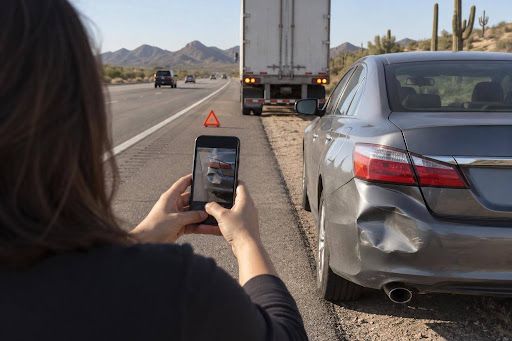
Start with the medical evaluation, then switch to preserving what you know. Write down your memory of the crash while it is fresh: the weather, the traffic, what the truck was doing before impact and anything the driver said. Save your photos in more than one place, and leave the car unrepaired until its condition has been documented.
Report the crash to your own insurer with the basic facts. Be more careful with the trucking company’s insurer, because adjusters take statements for a living and early wording can stick. For-hire carriers operating in interstate or foreign commerce with a vehicle rated at 10,001 pounds or more and carrying nonhazardous property generally must maintain at least $750,000 in financial responsibility under 49 CFR 387.9. This minimum applies to that carrier category; it does not determine the value of a particular claim. Sticking to what you saw, and not speculating about causes, is generally the safer course.
Stay quiet on social media for now, since posts and photos can be read as statements about the crash or your health. Tell your medical providers about every symptom as it develops, so your records reflect what you are actually experiencing.
Finally, start a folder for medical paperwork, repair estimates, missed work, rental costs and every message from an insurer. Claims are built from documents, and the folder you start on day one is the one you will be glad to have later.
Federal rules set minimum retention periods for certain records, so some evidence may have a limited routine retention schedule while a claim is still taking shape. Carriers must keep drivers’ records of duty status and supporting documents for at least six months from receipt under 49 CFR 395.8(k). That six-month minimum is not a rule that all evidence must be discarded at six months. Those logs matter because 49 CFR 395.3 lets property-carrying drivers drive 11 hours after 10 consecutive hours off duty, inside a 14-hour window that does not pause, with a 30-minute break after 8 hours of driving.
Because some carrier records have limited retention periods, Valley Accident Law says it sends preservation letters to the carrier within days of being retained, and an attorney handling a trucking claim may consider moving quickly. A preservation letter is simply a written request that the carrier keep specific evidence, such as duty status logs, dispatch records, maintenance files and electronic logging device data, instead of discarding it on its normal schedule. Preservation matters because once a record is overwritten or discarded, it may no longer be available.
Fault is decided by evidence, and in Arizona it is rarely all or nothing. Under A.R.S. 12-2505, a claimant’s damages may be reduced in proportion to their causal share of fault. The statute provides an exception for a claimant who intentionally, willfully or wantonly caused or contributed to the injury or wrongful death. Insurance companies and attorneys often negotiate that percentage, which is exactly why early statements and good documentation matter.
In a trucking case, fault can be spread across more than the person behind the wheel. Questions about dispatch schedules, load securement or maintenance may point toward the carrier, which is another reason the records above matter.
No article can say what a particular claim is worth: every case turns on its own facts, injuries and proof.
Most personal injury claims must generally be filed within two years under A.R.S. 12-542. That sounds like plenty of time until you factor in medical treatment, records requests and negotiations, all of which eat calendar days. Waiting also makes evidence harder to gather, since witnesses relocate and memories fade.
Different rules apply if a government body is involved, for example a city-owned vehicle or a public employee. A claim against a city, county, the state, a public school or a public employee generally needs a written notice of claim within 180 days that states a specific dollar amount under A.R.S. 12-821.01, with any lawsuit generally filed within one year under A.R.S. 12-821. Missing those shorter windows can end a claim before it starts, so any government connection is worth raising immediately.
A big rig crash scrambles the first hours, but the sequence is simple enough to remember: get help, document what you safely can, look after your health, and treat the records clock as real. Whatever you drive, from a restored classic to a daily commuter, the same checklist applies. Preparing now costs nothing, and it makes a stressful day more manageable. Details always depend on the specific facts, so this overview is a starting map for car and truck people, not legal advice.
The post What to Do in the First Hours After a Semi Truck Hits Your Car appeared first on Gauge Magazine.