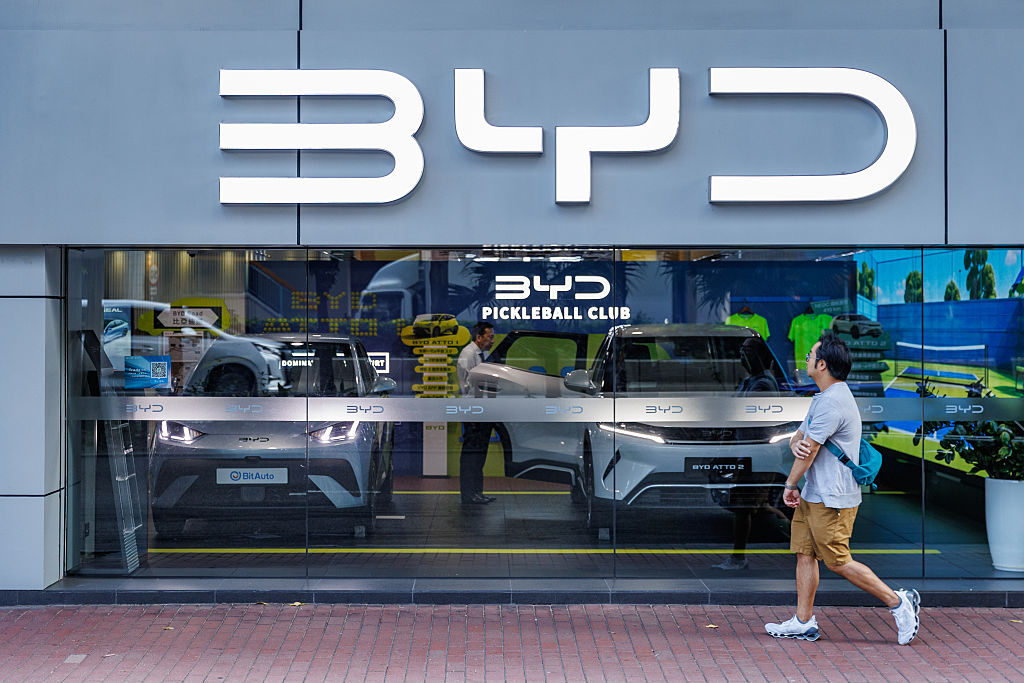
Last summer, while on an assignment in Ethiopia, I found myself daydreaming while trapped in Addis Ababa’s rush hour traffic. Staring out from my gridlocked taxi, I was struck by something remarkable: on all four sides were vehicles produced by Chinese manufacturer BYD.
Except it wasn’t really that remarkable. For years now, BYDs have been a regular feature of my travels to even the most far-flung places, plying streets from Yerevan to Yangon and beyond. Last year, the firm, whose initials stand for “Build Your Dreams,” became the world’s top purveyor of EVs, selling 4.6 million vehicles across 120 countries and regions, while accruing revenue of $111 billion. It was perhaps more surprising I wasn’t sitting in a BYD myself.
“If you look at a lot of markets, we say, ‘there's been a boom in EVs,’” says Ilaria Mazzocco, a senior fellow at the Center for Strategic and International Studies. “Actually, it's just BYD. They're single-handedly creating markets in some countries, which is remarkable.”
Now the Shenzhen-based firm aims to overtake Toyota as the number one automaker by 2030—a feat that, at current sales figures, would require more than doubling its output. As China’s auto market cools amid a broader consumer slowdown, it’s an ambition that increasingly depends on swelling BYD's foreign business, which has already surpassed its domestic revenue.
Indeed, BYD’s runaway success overseas has contributed to a broader rethink of global trade policy, spurring barriers such as 27% tariffs in the E.U., 35% in Brazil, 40% in Turkey, and 100% in the U.S. On Oct. 12, the E.U. announced a 350,000-a-year quota would be imposed on hybrid EV imports from China in a move that is expected to halve their market share. The U.S. has gone further than tariffs and quotas, with the Pentagon in June labeling BYD as a “Chinese military company.”
Analysts say Europe’s restrictions on Chinese plug-in hybrid vehicles may become a template for protecting other industries exposed to what’s been dubbed “China shock 2.0,” from chemicals and medical equipment to wind turbines that critics say are heavily subsidized. As such, BYD has become an unwilling lightning rod for a fundamental rebalancing of global trade.
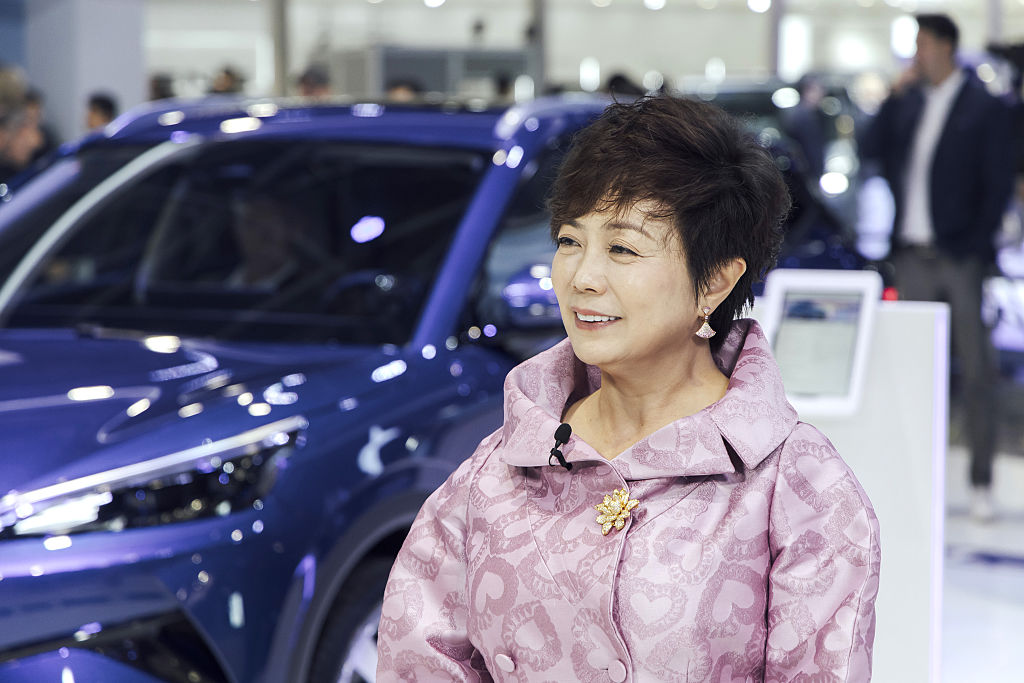
TIME spoke with Stella Li, BYD vice-president and CEO for the Americas, Europe, the Middle East, and Africa, about the geopolitical headwinds to her firm’s ambitions. The following has been edited for clarity and length.
TIME: The U.S. recently listed BYD as a Chinese military company. What’s your response?
Li: We are working closely with them to check what's the reason, because we are a privately owned, publicly traded company. They say BYD is close to [the Ministry of Industry and Information Technology,] which is the industry authority to give approval of cars. Well, all car companies for sure always need to go to them, including Tesla. Every U.S. company needs to go there. So this reason isn’t very strong. The second they say that BYD has a manufacturing plant within an army industrial park. But different companies, including several American companies, are also there. It’s ridiculous.
Will that designation affect your existing American business, such as batteries, buses, and everything else?
No, we’re working on the legal basis to get out of [the designation].
BYD leads the world in EVs and aims to be its top auto firm by 2030. What's the biggest obstacle to making that happen?
The big challenge now is geopolitical. Every day, you wake up with headlines saying, ‘the U.K. is going to put a 45% tariff,’ and ‘the European Union is going to put another tariff.’ It’s all this scary news.
In Europe, policymakers talk about stopping BYD to protect their legacy automakers. Do you think that those tactics have merit or are they driven by political concerns?
This is mainly triggered by political concerns. Because thinking about BYD or [other foreign] manufacturing in the region, we will hire local people. Then what's the difference? Sometimes when the revolution comes, people need a little time to digest. For us, we are a global company. We need to also make ourselves very strong [by hiring] local people.
One argument is that the whole of China's car industry was built on joint ventures, with Volkswagen and Audi and all these companies forced to partner with local firms to do business in China, which helped build up the domestic auto industry. Does it not make sense to reciprocate with joint ventures overseas?
It's a very different moment now, because when all those foreign companies came to China, the whole auto industry was weak. But China did open up for all the foreign brands to make tons of money over the past 20 years. They banked the profit from China. So now if we do a joint venture, can we make the same profit that they did in China? No, it's impossible. So it's a different moment because now the whole society, industry, has grown to be more open, to be a really consumer-driven, competitive market.
But without BYD, the Chinese auto industry would still be weak, because in these joint ventures the Chinese engineers had zero influence or knowledge with the car. Everything was decided by the foreign country. But when we started in the car industry, people went, ‘how can they do this?’ Then they also started to learn.
China remains the world's biggest auto market but is slowing and getting more competitive. Does that mean you are shifting your focus overseas?
We need to focus on the domestic market, where we're going to get stronger. It is just like altitude training—training with extreme conditions! So we need to retain our number one position in China.
There are some concerns in Europe and elsewhere about data transfers from BYD vehicles and China. What restrictions or safeguards are you implementing to address those worries?
We are maybe 10 times more careful than other companies. Because everybody is watching us to see any mistake we make. We already use tech firms from overseas. Even our data center, our Cloud, uses Google.
BYD is a leader in battery technology, especially pioneering flash charging. How far are we from having solid state batteries in cars for that next leap of performance?
BYD is in the leading position to develop a solid-state battery, but this kind of technology still needs some maturity for mass production. The industry wants to push for 2030, but I think now they need to postpone the schedule a little bit. But BYD will be the first one to make this happen.
You talk about BYD as being a pure technology company and your electronics arm already assembles a lot of the world’s smartphones and iPads. Now you're moving into humanoid robots, data centers, and other things. What's the next great leap you’re preparing for?
For cars, autonomous driving is already the big challenge. And second is about the ecosystem. For example, flash charging; all the charging capability we do is also a huge business. And then the third is robots. And then battery storage and the server and all the components among the server. So all this industry add-on together we already have a very strong position.
Considering the breadth of BYD’s operations, do you see any competitors?
We did not see the competitor who moves to a totally different scope [like us]. If we talk about cars, a lot of companies only have hybrid cars. BYD also has electric buses, we have battery storage. So BYD has multiple core industries. We have a whole ecosystem here.
BYD is developing its own semiconductors but still relies heavily on Nvidia. Do you have a timeline for when your own chips will be deployed in most of your vehicles?
Our chips will take some share, but never 100%. Nvidia will always be our partner.
Have you considered alternatives by a Chinese chipmaker, such as Huawei?
We don't use Huawei chipset. Because we need to sell globally.