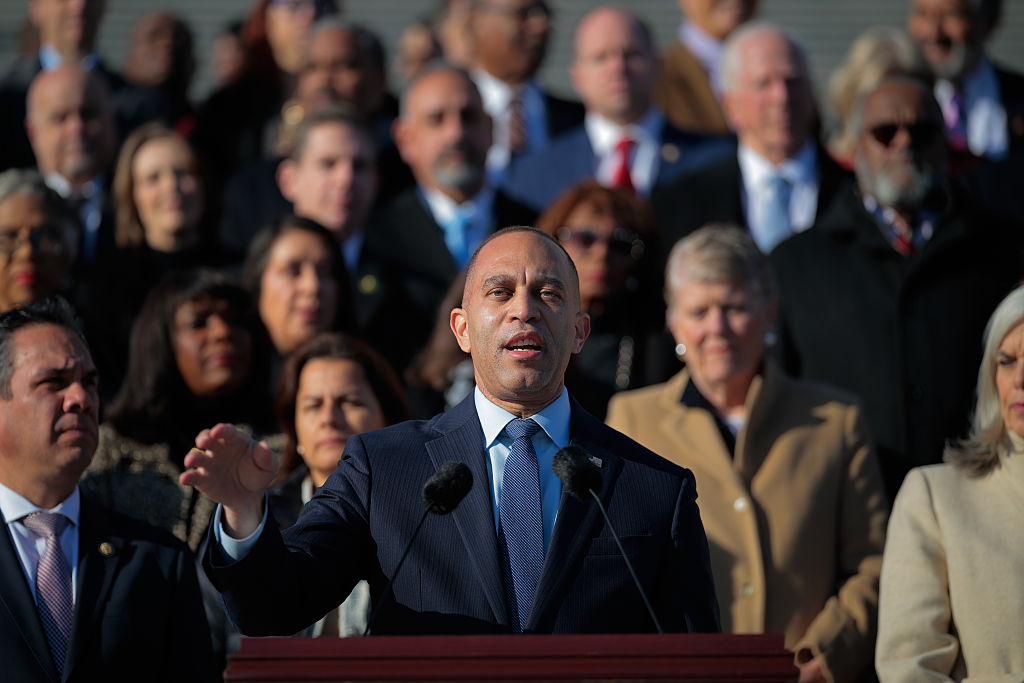
In 1870, Joseph Rainey of South Carolina became the first Black person to serve in the U.S. House. This week, current and newly elected House Democrats are poised to meet to select Rep. Hakeem Jeffries as the chamber’s first Black Speaker.
It is a moment fraught with meaning and hurdles for both the New York Democrat and the larger Black community, multiple Black leaders tell TIME. They spoke of the symbolic significance of Jeffries taking on a role that puts him second in the presidential line of succession as well as the challenge of turning a breakthrough in Black representation into policies that actually improve voters’ lives.
“When Martin Luther King Jr. said, ‘I have a dream,’ he's saying it's deeply rooted in the American dream, and that's the tradition that Congressman Jeffries taps into,” says Rev. Frederick Haynes, a pastor at a Black megachurch who was just elected to a U.S. House seat in Dallas.
As Speaker, Jeffries will set the legislative priorities for the House and play a central role in negotiations over federal spending and policy. He will also help lead his party’s opposition against a Trump administration that has spent much of the past two years dismantling institutions intended to protect Americans’ civil rights, as well as a President who earlier this year shared a video portraying Barack and Michelle Obama as apes.
Democrats are set to have their biggest majority since the opening years of Obama’s presidency. The moment carries echoes of 2008, when Obama’s election broke a racial barrier while raising expectations that Democrats would deliver economic relief and lasting change.
For Rep. Jim Clyburn, a South Carolina Democrat and one of the most influential Black lawmakers in the country, Jeffries’ task is to advance the party’s agenda while maintaining the trust of his caucus. In an interview with TIME, he says the advice he’s given Jeffries is private, but describes the tenor of much of it in a single sentence: “Conduct yourself in such a way that you'll ensure that you won't be the last.”
Jeffries has been teed up for this job ever since 2022, when House Democrats, then in the minority, selected him to replace Nancy Pelosi as their next leader. Long before this month’s midterm elections, he had already won the support of the Congressional Black Caucus as well as key progressive members such as Alexandria Ocasio-Cortez and Greg Casar, the chair of the Congressional Progressive Caucus.
Yet some progressives remain skeptical of his selection, arguing that he is the wrong leader for the moment. Since Election Day, several incoming progressive members have said they remain uncommitted to backing Jeffries as Speaker, and some liberal groups have called for someone else to lead the chamber.
Clyburn, who has been a mentor to Jeffries for years, suggests the Speaker role can often feel thankless, as so much of it involves managing different party factions and personalities without bruising egos.
“You're operating behind a glass door,” he says. “Everybody thereby can see through.”
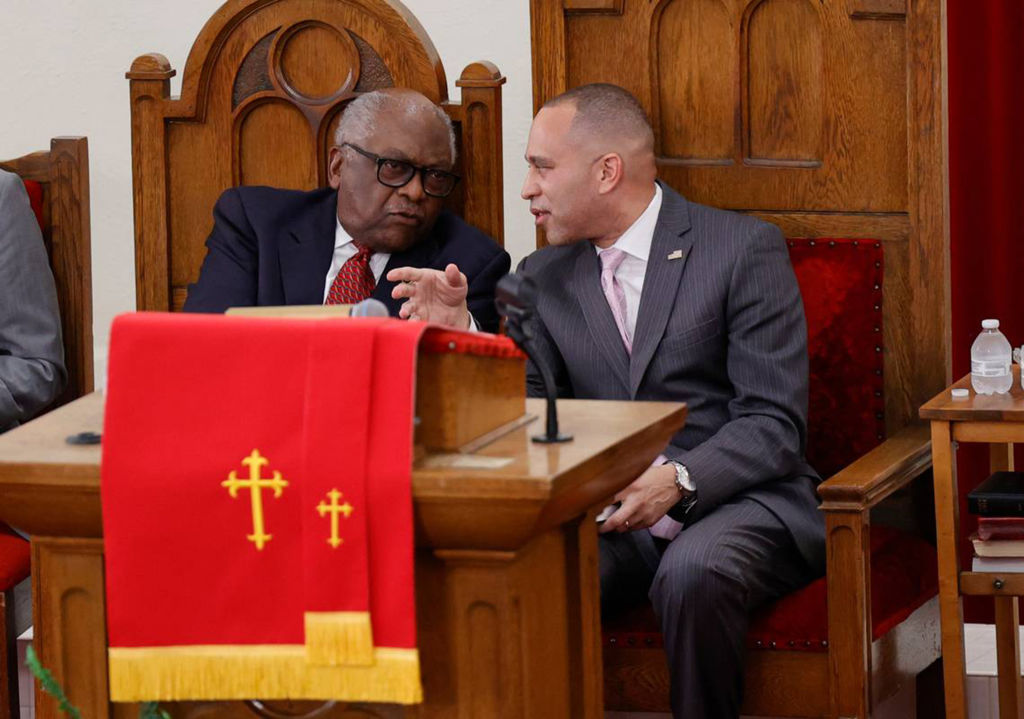
In an open letter to his colleagues released earlier this month after historic wins in the midterm, Jeffries wrote that he intended to draw upon “the insights and perspectives of every single part of the Caucus in the days and weeks ahead.”
But he also made clear that the expectations for him and his party are to do more than deliver messaging bills or score political points. “House Democrats must deliver dramatic change,” he wrote.
Haynes recalled first meeting Jeffries years ago and coming away impressed. It was at Cornerstone Baptist Church in Brooklyn, which Haynes regularly visited as a guest preacher. Cornerstone was an essential organizing hub for the Civil Rights Movement and had a close relationship with Dr. Martin Luther King Jr. Jeffries attended the church while growing up in the Crown Heights neighborhood.
“There are some people when you meet them and they're young, you know they have the ‘it’ factor,” Haynes says of Jeffries. “You know that they are hungry for knowledge. They are determined to make a difference.”
Haynes is now one of several religious leaders poised to join Congress in January. Others include incoming Senators Adam Hamilton of Kansas, a lead pastor at a megachurch, and James Talarico of Texas, who is a seminarian. Haynes suggests Jeffries’ ascendance is also part of that trend, as he sees an opportunity for Jeffries to bring forth the best of the Black church tradition front and center.
“Congressman Jeffries will have an opportunity to bring the moral tradition of the Black community that has believed in democracy, even when we've been victimized by a practice of democracy that was more fascist than democratic,” he says. “You cannot appreciate what it means to be black in this country without knowing that our community has always believed in democracy.”
Perhaps no one understands the challenges Jeffries is about to face better than Carl Heastie, who is the first Black Speaker of the New York Assembly, a role he’s held since 2015. Heastie has known Jeffries for decades, and worked with him when Jeffries was a member of the State Assembly from 2007 to 2012.
Heastie says that being a speaker means balancing the roles of leader and legislator. It requires listening first to your constituents, but also to your colleagues, who are counting on you to manage both the chamber and your party’s caucus. It also means allowing his real-life experiences as a Black person to shape his decisions as both a lawmaker and speaker when appropriate, he says.
He highlighted Jeffries’ work helping secure a 2010 state law involving how New York counted incarcerated people for state and local redistricting. It's a practice that disproportionately impacts the state’s Black population. The law required that incarcerated people by counted in their home communities. In the State Assembly, Jeffries led a passionate debate on why counting people where they are incarcerated, also known as prison gerrymandering, not only violates the rights of incarcerated people but also disenfranchises communities without a prison.
“Hakeem to me was always one of the finer debaters on the floor,” Heastie says. “When he debated or spoke on the bill, everybody would stop what they were doing to make sure that you listened to him.”
Heastie describes Jeffries’ expected promotion as more than just a moment of pride for his friend and former colleague. It suggests that, despite “terrible times and terrible dispositions,” the American dream remains very much alive.
“That a Black person from Brooklyn can become the first Black Speaker in the history of this nation,” Heastie says. “I'm just so proud of him, and I can't wait.”