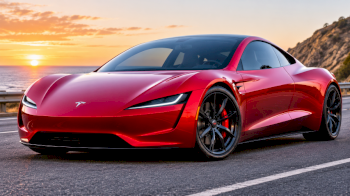
Elon Musk has unveiled a new vehicle to the world: the Tesla Roadster. A prototype had been anticipated since 2017, but the version revealed now looks entirely different, featuring a futuristic design with nods to the Cybertruck and a presentation that felt more like a stunt show.
The car drove up a ramp, performed an aerial flip, and landed. It then leaped from a standstill, soaring over five cars lined up in a row. Though it lacks wings or propellers, the maneuver looked like true flight. Yet, neither the price nor an exact release date has been announced – only a target year of 2028. Furthermore, it turns out that the most spectacular version of the vehicle is not permitted for use on public roads.
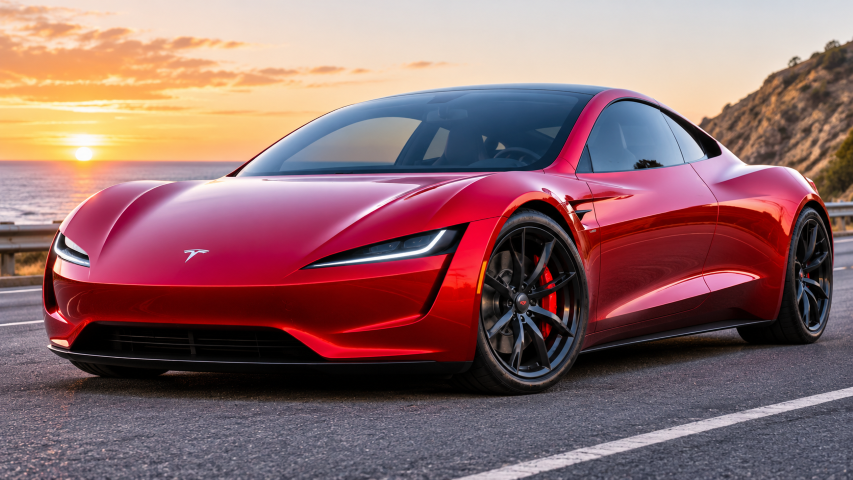
Following the presentation, Tesla shared details about three trim levels on the social media platform X. They differ significantly in their intended purpose, ranging from a car suitable for public roads to a version that would not be permitted on them.
Performance (“Road-legal”) – Under 1.6 seconds. Base model, two-seater, target range of over 300 miles.
Thrust (“Track-focused”) – Under 0.9 seconds. Additional thrust, limited production run
Rocket (“Flight-capable”) – Under 0.59 seconds. Single-seater, speeds exceeding 230 mph, invitation-only.
The flagship “Rocket” version was the one showcased on stage. During the presentation, the car did indeed clock 0.81 seconds. However, it is unlikely that this specific configuration will ever reach the market; the figure serves more as a demonstration of the technology’s capabilities. Consequently, this most spectacular variant is better described as an expensive toy for private tracks rather than one of the electric vehicles to buy for comfortable daily commutes.
For the typical buyer, the “Performance” model remains the primary option. An acceleration time of under 1.6 seconds is exceptionally fast for a production vehicle, and its stated range is comparable to that of many contemporary electric cars.
As for the interior, it is best to wait for the production version. Low-slung sports cars are often cramped and can be uncomfortable for taller drivers. Only once the production models are released will it become clear how the Roadster fares in this regard.
Elon Musk described the vehicle’s capabilities with his characteristic flair. According to Mr.Musk, the Roadster can fly like a rocket, perform barrel rolls, and execute incredible gymnastic stunts. He was quick to note that this is not necessarily a car optimized for safety. In other words, the stunts were designed for spectacle rather than for the convenience of everyday driving.
On a stage in Waco, Texas, a multi-level ramp was constructed. The Roadster ascended it, held in place by immense downforce, the aerodynamic force that presses a vehicle against the surface, preventing it from losing traction. As it descended from the peak, the car executed a “kickflip” – a rotation around its longitudinal axis, much like a skateboard trick – before landing smoothly on the stage.
In a separate demonstration, Tesla showed the Roadster using its thrusters to clear a line of five Tesla vehicles. The stunt was a prototype demonstration, not proof of a production vehicle’s capabilities.
The vehicle does not fly in the conventional sense. Stunts are performed using “cold gas” thrusters, essentially nozzles that expel air at high pressure. The principle is the same as that of an inflated balloon that has been released: as air rushes out in one direction, the balloon moves in the opposite direction.
Tesla engineers described a prototype compressed-air storage system with approximately 600 liters of capacity to support the thrusters. The number of tanks and mass of stored air have not been substantiated in the reviewed manufacturer information. Since no combustion takes place, the gas is referred to as “cold.”
Following the event, Tesla resumed accepting pre-orders for the Roadster. First, you must put down a $5,000 refundable deposit, followed by an additional $45,000 payment within 10 days; otherwise, the order will be canceled. This brings the total to $50,000 – the exact amount Tesla charged for a Roadster pre-order back in 2017.
Meanwhile, the company has not announced a final price for the vehicle, nor has it provided a specific launch date. Musk has only pointed to 2028. Those who pre-ordered the original Roadster have been waiting since 2017, so any stated timelines should be viewed with caution.
If the car actually reaches mass production, the Roadster could become a rare collector’s item, especially the limited-edition “Thrust” and “Rocket” versions. Its market value will depend on more than just technology; even unsuccessful cars from the 1980s have, over time, seen their value rise significantly. For now, the main question is something else: will Tesla manage to release the Roadster in 2028?
The post The New Tesla Roadster: Is It Worth Rushing to Pre-Order? appeared first on Gauge Magazine.