
When an Amazon delivery van blows through a red light at 40 miles per hour, you can end up with a totaled car, a fractured spine, and a mountain of medical bills before the week ends. Dallas roads carry hundreds of Amazon vehicles daily, and that kind of volume means crashes are inevitable. Most injured people’s first real question isn’t about fault. It’s about money. What you can actually recover, and from whom, depends on the nature of your injuries, who bears legal responsibility, and how fast evidence gets locked down after the collision.
Compensation in these cases splits into two main categories: economic damages and non-economic damages. Knowing both is the first step toward a realistic sense of what your claim might be worth. Talking to an Amazon truck accident lawyer early gives you a sharper read on which damages apply to your situation, since many injured people leave money on the table by not knowing what they’re entitled to claim. Texas law generally does not impose a single across-the-board cap on compensatory damages in ordinary personal injury claims, although exceptions and other legal limits can apply. The amount recoverable depends on the evidence, applicable law, liability, and available insurance coverage.
Economic damages cover every financial loss you can document with receipts, bills, and records. These are the most straightforward damages to calculate, though that doesn’t mean insurance adjusters hand them over without a fight.
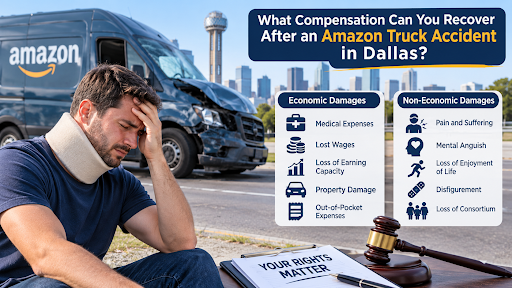
The most common economic damages in an Amazon truck accident claim include:
Future medical costs and lost earning capacity are often the biggest dollar figures in a serious claim. Proving them takes medical expert testimony and, in some cases, a vocational economist who can project long-term income loss. Don’t guess at these numbers yourself; they need to hold up against scrutiny from Amazon’s legal team.
Non-economic damages compensate for harm that doesn’t come with a bill attached. They’re harder to quantify, but they’re just as real – and in serious injury cases, they often exceed the economic damages.
Texas allows injured people to recover non-economic damages that include:
Calculating these damages involves looking at comparable jury verdicts, the severity and permanence of your injuries, and the impact on your daily life. A mild soft-tissue injury and a traumatic brain injury are both “non-economic” in the technical sense, but the recovery amounts are nowhere near comparable.
Liability in an Amazon accident isn’t always straightforward. Amazon uses a mix of employees, contracted delivery service partners (DSPs), and independent contractors, so the question of who actually employs the driver behind the wheel directly affects which insurance policies apply and how much coverage is available.
Amazon’s delivery network leans heavily on third-party delivery service partners (DSPs), small businesses that contract with Amazon to cover last-mile deliveries. The driver who hit you may actually be employed by one of those DSPs rather than by Amazon itself. That distinction matters because it’s the first argument Amazon’s legal team will raise to put distance between the company and the crash.
Whether Amazon may share responsibility depends on the specific facts and applicable law, including the degree of control it exercised over the work involved. A company’s use of contractors does not by itself determine liability, and responsibility must be evaluated case by case. If the DSP’s insurance coverage falls short of your actual losses, going after Amazon directly may be the only path to a full recovery. That’s exactly why pinning down every responsible party from the start matters so much.
Commercial auto insurance may cover a delivery-service partner’s vehicle, and other policies may apply depending on the driver, vehicle, contractual arrangements, and facts of the crash. The existence and limits of any additional coverage, including coverage involving Amazon, must be verified for the particular claim.
Defense-side insurance companies move fast after a crash. They’ll dispatch adjusters to collect statements, pull dashcam and telematics data, and shape a story that shrinks their exposure. Texas follows a modified comparative fault rule, so if they can pin even partial blame on you, your compensation drops by that percentage. And if you’re found more than 50% at fault, you walk away with nothing. Photos, witness contact info, and the police report you gather right after the collision can be the difference between a fair outcome and a dismissed claim. Don’t give a recorded statement to any adjuster before you know your rights.
What you can recover after an Amazon truck accident in Dallas comes down to the full picture of your losses: medical costs, lost income, long-term health consequences, and the emotional weight the accident has placed on your life. Texas law gives injured people real options, but those options shrink fast when evidence disappears or insurers get to frame the story first. Act quickly, document everything, and get an honest evaluation of your claim before signing off on any settlement. What Amazon or its insurer puts on the table first is almost never what your case is actually worth.
The post What Compensation Can You Recover After an Amazon Truck Accident in Dallas? appeared first on Gauge Magazine.