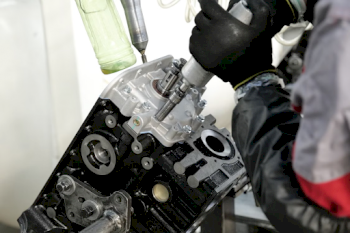

Lift the bonnet on an engine-swapped hot rod and the interesting parts are rarely the smallest ones. Yet a failed one-way valve can leave a brake pedal unexpectedly hard or help turn a warm restart into an extended crank.
For minitruck and custom-car builders, the questions often arrive after something else changes: a different engine, a relocated brake booster, a rebuilt fuel system or new plumbing around a turbocharger. The key is to understand what that valve controls, when it needs to open and what could happen if it cannot close.
A conventional check valve permits flow in one direction and resists reverse flow. The working fluid might be air, fuel or water, but those applications have different pressures, temperatures, materials and connection requirements.
Industrial catalogues show how broadly the idea is used. The check valves listed by Valves Online include piston, swing and duo designs, plus made-to-order duckbill versions. Those catalogue descriptions do not establish suitability for a vehicle’s brake, fuel or crankcase system. A valve that works in process pipework is not automatically a safe automotive replacement.
In custom builds, three applications illustrate why the distinction matters: vacuum-assisted brakes, fuel pressure management and positive crankcase ventilation.
On many petrol engines, the brake booster receives vacuum from the intake manifold. A check valve helps preserve that vacuum when manifold pressure rises, such as during hard acceleration or after the engine stops. Some vehicles use a separate vacuum pump, so the source should never be assumed from engine type alone.
The direction can be confusing because people talk about “vacuum flowing”. What actually moves is air. In a common arrangement, air is drawn from the booster towards the lower-pressure vacuum source; the valve prevents air returning through the line when source vacuum falls. Install it backwards and the booster may not build or retain assistance.
This matters during engine swaps, when a manifold connection or hose layout may no longer match the original vehicle. Confirm the valve’s orientation and hose routing against the booster and engine specifications. A persistent hard pedal warrants a proper brake-system inspection, not an improvised valve substitution.
Some fuel-injection systems use a check valve to limit fuel draining back towards the pump after shutdown. Maintaining residual pressure can help the system deliver prompt restarts, but not every vehicle uses the same arrangement or retains pressure in the same way.
A Bosch fuel-line check-valve patent shows why generalisations can mislead. Its design closes after pump shutdown to retain pressure for a hot restart. Under certain later conditions, however, it can permit limited reverse flow so pressure does not build excessively during daily temperature changes. That is a specialised design, not a rule for every fuel-system check valve.
The patent cites pump operating pressures of approximately 1 to 6 bar for its example system. That range is not a universal specification or a reason to select an aftermarket valve by its pressure rating alone. Injectors, regulator, fuel type, pump layout and the engine’s required pressure all matter. The patent also describes a rollover valve, whose role in limiting leakage during a rollover is separate from holding rail pressure.
Positive crankcase ventilation (PCV) moves blow-by gases from the crankcase into the intake so they can be burned. Its valve often does more than a basic one-way device: it regulates flow as manifold vacuum and operating conditions change.
An EPA training report describes a conventional PCV valve restricting flow at idle, when manifold vacuum is high, and allowing greater flow during cruising. The report also explains how early road-draft ventilation discharged gases outside the vehicle, one reason PCV became widespread on passenger cars in the 1960s.
The details become especially important with turbocharged or supercharged engines. Positive intake pressure can push air towards the crankcase if the system lacks appropriate control, and some boosted systems use additional non-return valves and alternative ventilation paths. A generic check valve is not a substitute for a properly designed PCV system.
Start with the function, not the outside diameter. A hose that accepts a fitting does not prove it meets the application. Before replacing or relocating a valve:
If the necessary specifications are unavailable, a qualified mechanic or the relevant component manufacturer is a safer source than a catalogue description.
A check valve is small, but its job changes dramatically from one circuit to another. On a custom build, getting the direction right is only the beginning. Understanding the system, verifying compatibility and leaving safety-critical decisions to documented specifications is what keeps these quiet components doing their job.
The post Check Valves in Custom Builds: Where One-Way Flow Matters appeared first on Gauge Magazine.