
Speeding doesn’t always mean someone is racing down the highway at an extreme speed. Sometimes it’s 45 mph in a 35 mph zone or 70 when surrounding conditions call for something slower. Those differences can feel minor from behind the wheel, but they change how quickly a vehicle reaches a hazard and how much room the driver has to respond.
A child steps toward the road. Traffic suddenly stops. A vehicle pulls from a driveway. The faster you’re traveling, the sooner that problem arrives.
This shrinking margin for error is one reason speeding accidents can become serious so quickly. A few extra miles per hour may not feel dramatic while driving, but those miles can matter enormously when something unexpected happens and every second counts.
The National Highway Traffic Safety Administration explains that speeding includes exceeding the posted limit and driving too fast for conditions such as bad weather, road construction, or poor nighttime visibility. NHTSA identifies increased stopping distance, reduced vehicle control, and greater crash severity among the consequences.
Drivers need time to recognize danger before they can respond to it. Suppose traffic ahead suddenly slows. The driver first needs to notice the brake lights, understand that the vehicles are stopping, decide how to respond, and physically move a foot toward the brake pedal.
During that entire process, the vehicle continues moving. Higher speed means it covers more ground before braking even begins. A distraction makes the problem worse because the driver may not recognize the hazard until later.
The same principle applies to curves, pedestrians, changing traffic lights, debris, animals, and vehicles unexpectedly entering the roadway.
Speed reduces the amount of time available to deal with all of them. That doesn’t mean driving slowly eliminates accidents. Unexpected events will always happen. But additional time gives drivers more opportunities to brake, steer, or otherwise avoid a collision.
Sometimes the difference between a close call and an impact is simply having another second available to react. Gauge Magazine’s guide to important road-safety practices offers additional ways drivers can create more time and space around their vehicles.
Stopping a vehicle involves more than pressing the brake pedal. First comes perception and reaction distance: the roadway covered while the driver recognizes the problem and begins responding. Then comes braking distance: the additional distance traveled while the brakes slow the vehicle to a stop.
Speed affects both distances. At a higher speed, a vehicle travels farther during the same reaction period. Braking distance also increases more rapidly than speed because the brakes must dissipate substantially more kinetic energy.
Road conditions can increase the distance further. Rain may reduce traction, while snow, ice, gravel, or standing water can make stopping more difficult. Tire condition matters too. Worn tires may provide less effective traction, particularly in poor weather. Brakes and other vehicle components also need to be properly maintained.
The relationship between tread and wet-road performance is explained further in Gauge Magazine’s guide to tire tread depth and hydroplaning.
Visibility adds another dimension. If darkness, fog, heavy rain, or a curve prevents a driver from seeing a hazard until they’re close to it, there may already be less roadway available for stopping.
That’s why a speed that feels comfortable under ideal conditions may be inappropriate when the road, weather, traffic, or visibility changes.
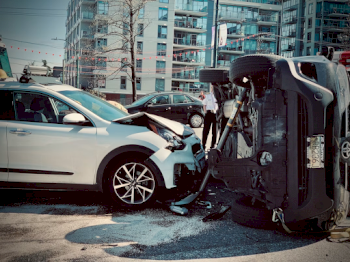
Speed matters even when the collision can’t be avoided. A moving vehicle carries kinetic energy, and that energy is proportional to the square of its speed. If speed doubles while vehicle mass remains the same, kinetic energy increases by a factor of four. That means a higher-speed collision can expose vehicles and occupants to substantially greater forces.
Modern vehicles are designed to manage some of that energy. Crumple zones are designed to deform in a controlled manner and help manage crash energy. Seat belts help restrain occupants, and airbags can provide additional protection in certain collisions.
But safety systems have limits. A relatively low-speed collision and a high-speed collision involving similar vehicles can produce dramatically different damage and injuries.
Pedestrians, bicyclists, and motorcyclists are particularly vulnerable because they don’t have the same protective structure surrounding them as occupants of passenger vehicles.
This is why reducing speed can matter even when a driver doesn’t have enough distance to stop completely. Slowing before impact reduces the amount of kinetic energy involved when the vehicles or people ultimately collide.
After a serious crash, determining how fast the vehicles were traveling can become an important part of understanding what happened. Investigators may have several sources of evidence available.
Some modern vehicles contain event data recorders or related electronic systems that may preserve limited information from the seconds surrounding a qualifying crash event. Depending on the vehicle, system, crash conditions, and available data, this information may include recorded speed, brake application, throttle position, engine speed, seat-belt status, or other variables.
These systems are not universal continuous-recording devices, and the presence, format, duration, and accuracy of recoverable data can vary. Investigators must interpret the information within the limits of the specific vehicle and recording system.
Physical evidence can also matter. Tire marks, debris, vehicle damage, impact locations, roadway grades, and final resting positions may help qualified specialists reconstruct the collision.
Video can be especially useful. Dashcams, traffic cameras, security systems, and recordings from nearby vehicles or witnesses may show how quickly a vehicle was moving before impact. Witnesses can contribute observations as well, although human estimates of speed aren’t always precise.
Rather than relying on a single clue, crash reconstruction often involves comparing multiple pieces of physical, electronic, and visual evidence to develop a clearer picture.
Speed changes more than how quickly someone reaches a destination. It changes how much roadway passes beneath the vehicle while the driver recognizes danger. It affects the distance needed to stop and increases the energy involved if a collision occurs.
Weather, tires, visibility, road conditions, and traffic can shrink the safety margin even further. That’s why the safest speed isn’t always simply the maximum number shown on a sign. Drivers also need to respond to what’s happening around them.
Unexpected situations are unavoidable. Someone may pull into traffic, a vehicle ahead may brake suddenly, or an object may appear in the roadway. Speed determines how much time and distance remain when that happens.
Slowing down gives drivers something incredibly valuable that can’t be created after the emergency begins: additional time and space to recognize the problem and do something about it.
The post The Few Miles Per Hour That Can Erase Your Margin for Error appeared first on Gauge Magazine.