
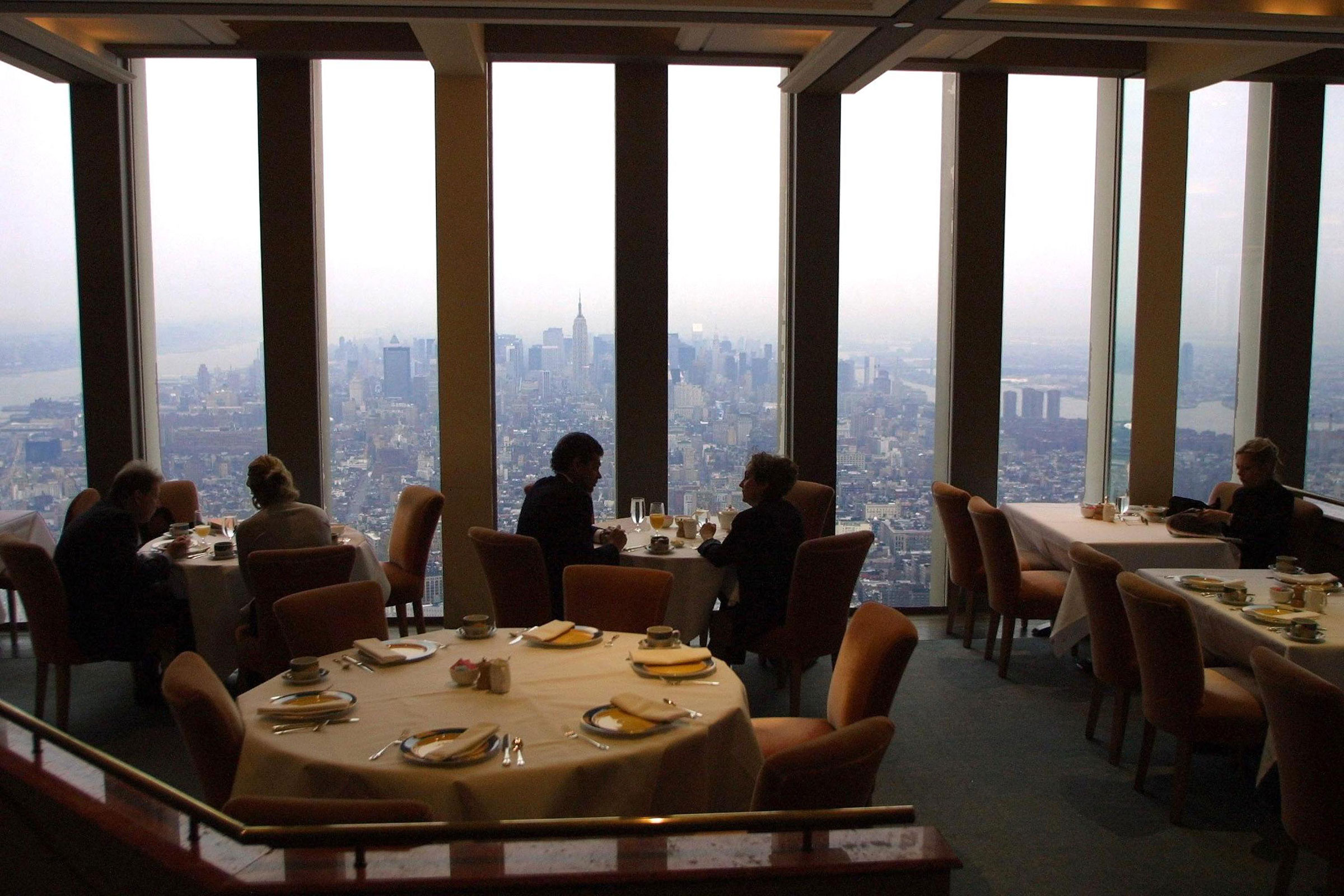
Early dawn. A slice of last night’s chocolate cake. Watching the rays of the sun spread over the city. Stealing a moment like this was a coveted morning ritual for some of the breakfast staff at Windows on the World, the restaurant that was on the 107th floor of the North Tower of the World Trade Center.
This was the meeting place where New Yorkers and out-of-towners went to celebrate birthdays and anniversaries; to revel with food and drink and to mark life milestones. And for many of the staff, it was a dream job.
“I would have worked there just for the insurance,” says Windows sommelier and waiter Paulo Villela, who immigrated from Brazil in order to get medical care for his son, who had a rare medical condition. “It was the best job.” He would tell his friends on staff, who hailed from dozens of countries—Bangladesh, Ivory Coast, Peru, China—“I’m never going to leave this place.”
On Sept. 11, 2001, so much changed. So much was lost. Most tragically, there are the 2,977 people who were killed, including 79 workers from Windows, and 91 of its guests. Those victims and their families are at the heart of this dark moment in history, which millions of us experienced from close or afar.
How one feels is at least partly determined by one’s proximity to the event. On that day, I was covering the Toronto Film Festival as a journalist. As a native New Yorker, I felt like I’d left my post. I was watching an 8:30 a.m. screening of Monsoon Wedding, a movie directed by Mira Nair, the mother of then 9-year-old Zohran Mamdani, who is now New York City’s mayor.
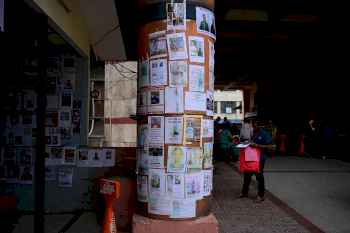
It’s a tenuous connection I mention because that’s what happened on 9/11; the attack cast in stark relief the myriad connections that are otherwise invisible in this city. Suddenly, we found out that our daughter’s fifth-grade teacher’s cousin worked at Cantor Fitzgerald, or a neighbor’s brother was a fireman who worked at Engine 54. On that day, the connections were rippled with panic. And then, for too many, grief. That manifested with the missing posters that filled the city for weeks; desperate pleas that became heartbreaking tributes.
Those posters were an early act of collective mourning. The city was still an open wound. You could smell the smoke almost everywhere for weeks. The randomness of the event—we were flooded with stories of those who died and those who didn’t by happenstance—draped over the city like an uncomfortable, existential veil.
One story was that of Michael Lomonaco, the chef at Windows on the World. He was in the basement of the World Trade Center, having decided at the last second to get his glasses fixed before he took the elevator to work. He felt the ground shake, saw debris raining from the sky, watched United Airlines Flight 175 crash into the South Tower, and observed people stranded above the 91st floor waving large sheets that were probably tablecloths from his restaurant.
“The memories are so vivid,” says Lomonaco, who helped start a fund for the families of his staff and who has gone on to run several successful restaurants in the city. “A generation has grown up since then, but it still seems like yesterday to me.”
A 25th anniversary marks a swath of time that can be illuminating because, to someone who is younger than 30, it feels like an eternity. Or a lifetime, which to someone who actually is 25, it is. But to someone who is over 50, as I am, it feels like a chapter. A long one, perhaps. But, still, a part of something else.
9/11 is a hinge of time that separates generations. It shouldn’t be surprising—but it always is—when I ask young folks about 9/11, and they just can’t get their hearts around it. It’s something that they learned about in class or saw on YouTube. They don’t feel it like I do. Like we do.
Those of us who are moved by this anniversary—no matter how close we were to the actual tragedy—should find some way to talk about it. “We have an obligation,” Lomonaco says. “When we talk about the people who died, we’re acknowledging the significance of their lives.”
It still seems like yesterday.
But there’s a delicate balance. Many of us want to avoid the sadness: say “Never forget,” and move on.
Over 25 years, Lomonaco says he’s gone through the five stages of grief—denial, anger, bargaining, depression, and acceptance—and I would contend he has wisdom to share. “When we mourn with someone else, we’re actually mourning our own loss at the same time,” he says. “That creates a human bond.” He emphasizes the connections between us, which were so palpable in the days after 9/11, when lines of New Yorkers wanting to donate blood wrapped around the block.
For me, the interminable years that it took to clear Ground Zero and eventually build the new World Trade Center felt like a void. I won’t overstate it. It did not consume me. But it was there. And, at least partly to fill that hole, I wrote a book, in 2019, The Most Spectacular Restaurant in the World: The Twin Towers, Windows on the World, and the Rebirth of New York. It has been turned into a documentary created with TIME Studios, Top of the World, which CNN is airing on Sept. 7.
I wanted to tell the life of the restaurant and the people who went there and who worked there. It was a way of honoring the people and a part of New York City that was erased. And, as Lomonaco indicates, it was also my way of working through my own personal grief: I lost my father when I was 10 years old, in 1980, when he was killed in an automobile accident.
I recently read William Styron’s book Darkness Visible: A Memoir of Madness, which introduced me to the concept of “incomplete mourning,” which is pretty much what it sounds like. I can see myself wrestling with incompleteness in the way that my books—one is about the bygone video-store era, and another is about how author Kurt Vonnegut sought to reconcile his World War II experiences by writing his masterpiece, Slaughterhouse Five—share a theme of loss.
But is there even such a thing as complete mourning? I stumbled upon a 2023 eulogy by Park Avenue Synagogue’s Rabbi Elliot Cosgrove, in which he refers to The Missing Piece by children’s author Shel Silverstein. In the book, a circle goes looking for a wedge of itself that is missing. It rolls around and has adventures. And when it finally finds its missing piece, it is delighted—at first. But when it is complete, the circle rolls too fast and it is no longer able to talk to the bugs and other passersby and have the experiences it enjoyed during its journey. So, the circle decides to release the piece, preferring to live without it.
Cosgrove was commemorating the passing of another rabbi, Harold Kushner, who first made the connection between grief and The Missing Piece. In Kushner’s words, “We’re more complete if we’re incomplete.” I think that’s a beautiful way to approach grief.
We need to see the light in the darkness. “In the face of loss, we must see the preciousness of life,” Cosgrove says. Lomonaco agrees: “My appreciation of individual lives, of life, has grown,” he says.
It’s a bit of a trick to both grieve and grow, like keeping two contradictory thoughts in your head, except in your heart. I hope to be getting better at it. I’d contend that the city has managed pretty well with the 9/11 Memorial and its reflecting pools. They’re solemn and reverential and, at the same time, thriving with tourists. (A New Yorker’s sense of irony, and humor, helps with the grieving.)
And the Tribute in Light, those awesome spotlights that pierce the sky each Sept. 11, are a pitch-perfect way to memorialize the day.
“It’s like going into a church and lighting a candle,” Lomonaco says. “It’s an act of mourning. But a light also literally lights our path forward.”
Roston is an author of several books and a New York City high school teacher